


J + 14 : Amalfi - Small is Beautiful?
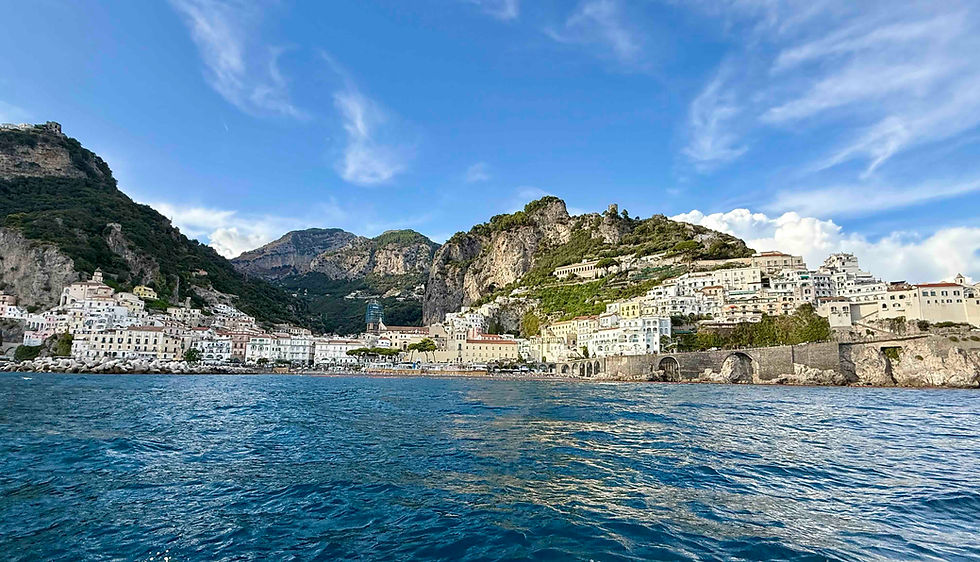
Amalfi today at 5 pm - People were queuing on the Pier for their Return Trip to Salerno
It is change-over day today. After a fabulous week which took us from Messina to Salerno, Team 2 left this morning at 8 am to return home. Team 3 boards at 3 pm. Within minutes of the safety briefing, "My Lotty" lifted anchor. We are off to Capri and hope that the waves allow us to visit Amalfi on the way. The weather improved since yesterday and the waves are back to 1/2 meter high.

Amalfi's main Square with the Steps leading to its Duomo with
Europe's first pointed Arches (imported from the Middle East)
Most people visiting Amalfi love it for its beauty. The village is small, medieval and has not changed for the last few centuries. You may wonder though how this tiny village made it on Italy's maritime flag. Genoa, Venice and Pisa, the other three cities on the flag, are bigger. How did this small town compete with its far bigger rivals? The answer may surprise. In the 10th and 11th century, at the peak of Amalfi's power, the other towns were not bigger. Amalfi could easily compete and hold its ground. Geopolitics though - unrelated to Amalfi - changed the game.

Italy's Maritime Flag: Top Left Venice. Top Righ Genoa. Bottom
Left Amalfi. Bottom Right Genoa
In 1130, the Norman Roger II was crowned King of Sicily. The German Emperor Lothar II did not like it. The fact that Normans established an independent state in Southern Italy was not his thing. In his view, he was the ruler of all of Italy - like his predecessor Charlemagne. To get what he believed was his anyway, he invaded Southern Italy in 1136. Within months, his armies successfully conquered most of the South including Bari but failed to dislodge Roger II from Sicily. Meanwhile the German troops in Puglia - not used to the intense summer heat - mutinied. Lack of opportunities to plunder, not enough supplies, outstanding pay issues and bribes by Roger II were the main reason. The army disintegrated. Lothar II had to return to Germany and died when crossing the Alps. In short, his campaign ended in disaster.

The unlucky German Emperor Lothar II who died in 1137
Further north, the German Emperor was more successful. Against its will, Amalfi became part of Roger II's new Norman state. Lothar II had no intention to let his adversary getting his hand on a lucrative cash cow like Amalfi. Also, he wanted to keep control over the supply line to the Holy Lands. It gave him leverage over the Pope. Lothar II thus asked his vassal Pisa to eliminate Amalfi, an opportunity the Pisans would not miss. In 1136 they sailed south to support Lothar and attacked Amalfi the following year. The town and the neighbouring villages were sacked and burnt to the ground, the inhabitants expelled, all the commercial goods confiscated, the depots and agencies around the Mediterranean seized. Amalfi never recovered from this blow. It was rebuilt but kept size and shape of a tiny medieval port.

The Amalfians are still proud of their maritime History. Every
Year on 12 Sept, they celebrate Madonna di P{ortosalvo, the
Protector of their Mariners
What visitors describe as beautiful and lovely today is actually the result of a military catastrophe and 800 years of stagnation. You need to look no further than the terraced hills behind Amalfi. What looks pleasing to our eyes is actually the result of centuries of back breaking work by many generations. People only do this is when there are no alternative. Amalfi was dirt poor until the end of WW II. Then it was discovered by American soldiers and movie stars - the rest is history.

Anchoring outside Amalfi tonight


Comments