


J + 16 : Ischia - Hot Springs and Mud Baths

Rocky Waters south of Capri at 06.45 am
Rocky start this morning. The wind had turned. A heavy swell run into our bay. The light sleepers got kicked out of their bed by 6 am. The heavy sleepers by 8 am. Time to lift anchor and sail over to Ischia in the hope of finding calmer waters. The fresh wind allowed us to sail to Ischia though. Nothing better than gliding silently through the sea. The only sound were the waves and the noise from the ropes. Paradise!

Silently gliding on the Sea from Capri to Ischia
Ischia has "become" a hot summer destination this year. Travel agencies in Europe and the US added the island to the Italian bucket list. Given the popularity of SpAs, the marketing focuses on bubbling hot springs, healthy mud bath, therapeutic SpAs, "dazzling" beach resorts and lush gardens. To complete the story, rolling vineyards - there are still a few left - and the Castello Aragonese d'Ischia are thrown it - it apparently dates from 474 BC. Whilst Ischia is indeed a beautiful island, the marketing campaign is a bit of an overhype.

The Aragonese Castle is now linked by a Stone Bridge to the Main Island
The island is one of the most densely populated islands in the Mediterranean. Thanks to its fertile, volcanic soil it can support a large population. Ischia entered history as an entrepot for Etruscan and Greek traders in the 9th century BC. The Greek brought olives and wines to the island, the Arabs lemons from Persia almost 2'000 years later. From the very beginning, the island attracted visitors for its over 100 thermal springs. The Romans loved it. But the island remained mostly agricultural, making wine and olive oil. As the Amalfi coast, Ischia was discovered by the Jet Set in the late 1950s. Ten years later, it transformed into a hotspot for mass tourism. A construction boom without precedent started. Today, the island has more than 60'000 permanent residents. Tourism replaces agriculture as the main industry.

Gravure of the Aragonese Castle in the 18th Century
One of Ischia's major sights is the Castello Aragonese on the north-east corner. It was built by Hiero I of Syracuse who helped the Cumeans defeat the Etruscan fleet in 474 BC. The Greek victory ended the Etruscans' southward expansion in Italy. The castle decayed during Roman time - they had no use for it during the Pax Augusta - but was rebuilt by Aragon King Alphonso V in 1441. Charles V fortified it further after devastating raids of Ottoman Corsairs in 1543, 1544, 1548 and 1552 They enslaved the entire population of 4'000 and sold them in North Africa's slave markets. Once the Castello was re-fortified, it could accommodate all of the island's 2'000 families for several weeks. Ottoman raids stopped.

View from the Aragonese Castle over the Town of Ischia
We visited the Castello Aragonese this afternoon and were surprised in what good shape it was. The Cathedral was destroyed by the Royal Navy during a bombardment in 1809 - when the English tried to evict French troops from Southern Italy. But otherwise, the castle is quite intact and definitely worth a visit.

Dinner in the Bay just below the Castello Aragonese - Moon was just setting.
.

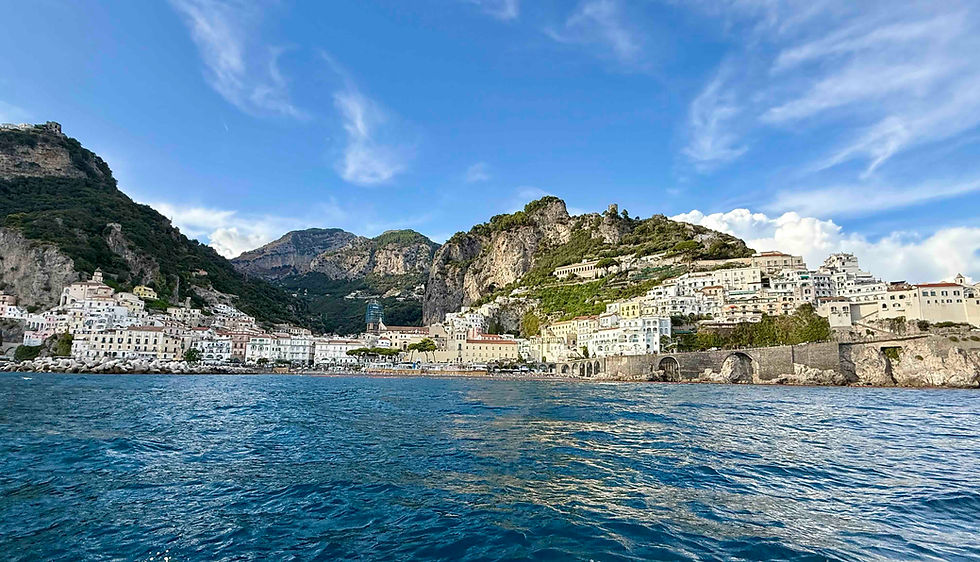

Beautiful island and not nearly as touritically overrun as Capri