


J - 24 : When Tremors are a Constant Fear

Several Tons of Steel now provide Structural Integrity to the Protine Project
One of the many things I learnt when refurbishing Protine in Tuscany is how comprehensive Italy's structural integrity requirements are. All new buildings or homes under refurbishment are subject to these laws. Geologists analyse the ground on which a house is built and perform stress analysis on how quake waves hit the building. The results are then forwarded to structural engineers. They identify the building's weak spots. Before you know it, steel bars and T-Rails pile up on your doorstep and are worked into the structure. Every steel pillar is anchored in the rock or a thick concrete plate. A strong earthquake may still damage the building. But the house will not collapse on its inhabitants and squash people in their beds.

A stable base is the best protection against Soil Liquefaction - if necessary a House needs to be put on Stilts to give it a solid foundation
Whilst these laws are good, the sad reality is that Italy's housing stock is old. Modern buildings represent a small fraction only. About 60% of Italy's homes were built before 1970 when no such rules existed and the science of earth quake protection was in its infancy. Upgrading a building to modern quake standards is also expensive. The structural stability work in Protine accounts for about 1/3 of the total bill. Most Italian families cannot afford this. Neither can the Italian Government with its high debt levels. There is simply not enough money. It is thus not the last time that we see disturbing pictures as from L'Aquila in 2009 when an entire old town was wiped out. It will take decades to upgrad Italy's old housing stock.

Onna near L'Aquila, 40 km NE of Rome, was hit by a 6.3-magnitude quake. 309 People died
Italy's history is littered with devastating earthquakes. It is one of the reason why so few antique buildings survive intact. Once severely damaged, locals used them as quarries to rebuild their homes. These ancient sites were often the only available source of building materials. Wikipedia compiled an excellent list of all Italian earthquakes. There is no need to do it again. On our sailing route this summer we pass by Sicily (hit devastatingly in 1693), Calabria (1783), Ischia (1883) and Messina (1908). Italy experiences about 15'000 earthquakes each year - one every half hour. 85% of these tremors are small and only detected by Italy's Institute for Geophysics and Volcanology. There are about 25 quakes with a magnitude 4.0 - 5.0 on the Richterscale - people can feel the shaking but damage is limited. And 5.5 + magnitude events every 4 years - such tremors break walls and can flatten buildings. Quakes in the magnitude of 7.0 - 8.0 destroy towns and regions and occur every few decades

The Earthquake of 1908 destroyed most of old Messin
We talked already several times about the cause of earthquakes in Italy. Here, the African continental plate and the European plate collide whereby the African plate is subducted. The Italian volcanoes result from it as well as the folding of the Apennine and the Alps. Over the last Millenium, of the Mediterranean's 2'000 earthquakes, 500 occurred in Italy. The country is not only home to all of Europe's active volcanoes, it is also its earthquake center. Many of Italy's earthquakes invisibly happen in the Tyrrhenian Sea. Japan is not the only country with Tsunamis talews. Many Italian coastal towns have experienced them as well. Luckily, Southern Italy's coast line features mostly mountains with steep slopes. It is not by accident that so many coastal villages and towns are located on hills. People remember.
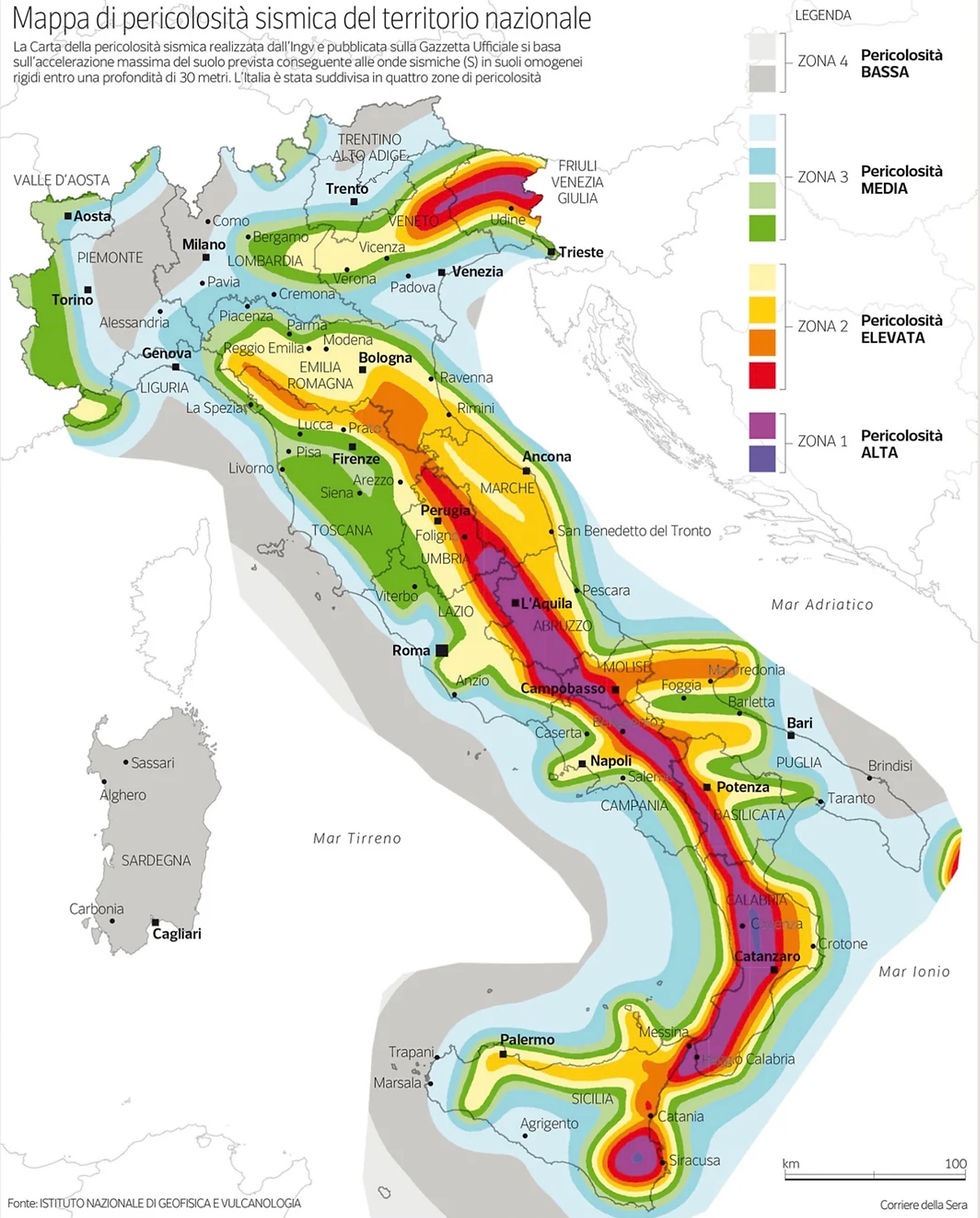
Earthquake Risk Map Italy
During our three weeks, we are unlikely to experience an earthquake. And if we ever get hit by a Tusunami, we are probably at sea or anchor in an open bay. We would notice a swell.


Comments