


J + 1 : Gozo - Once a Cemetery without Graves

The Cittadella in Victoria, Gozo's Capital, was modernized from 1599 - 1620
With less than 10% of Malta's population, Gozo, the northern island, was seldom at the heart of Malta's history. Its bays are narrow, the good harbours few, the sandy beaches in the north small. The island is better known for its high cliffs and hills. Though the limestone and sandy soil is not ideal for agriculture. In 1551, the island was raided by Turkish Corsairs who enslaved the entire population and sold these unlucky souls in Lybia's slave market. So much for the claim o f some "historians" that slavery was invented by capitalism. During the Second World War, Gozo provided shelter for many who fled the three-year long German - Italian aerial bombardment of the main island.

Terraces over the steep Cliffs on Gozo's South Coast
Today, we are on the way from Gozo to Syracuse, Sicily's most powerful city state during the time of Magna Graeca. The distance between the two islands is just 50 nautical miles. No wonder Carthage chose Malta as its main naval base. Its triremes could reach Sicily within ten hours if needed. An ideal forward base. The Phoenician fleet though was stationed on the main island and not on Gozo. Still, Gozo shared much of Malta's 7'000 year of history. There are several neolithic structures here (as on the main island) and remains of the 800 years of Phoenician presence can also be found. During Roman and Arab time, the island was a quiet, not well know place.

Gozo is an important Supplier of Agricultural Goods to the Main Island of Malta
All this changed in 1530 when Charles V., Holy Roman Emperor and Ruler of Spain, donated Malta to the Knights of Saint John. Eight years earlier, they had been expelled from Rhodes by the Turkish Sultan Suleyman the Great, after months of heavy fighting. The Maltese Knights, as they are more commonly known, dragged Gozo into the 150 year long war between Spain and the Ottoman Empire. The inhabitants of Gozo probably did not realized how this donation changed their fate. An island barely known before became now a legitimate target for Ottoman Corsairs.

Dragut, the Ottoman Corsair and Pirate from Bodrum
sold 1551 Gozo's population of 5'000 people into Slavery
21 years after the arrival of the Knights, the Ottoman Corsairs showed up in force. A fleet of 145 ships led by the Turkish Admirals Sinan Pasha and Turgut Reis (Dragut) with 10'000 men on board descended on the almost defenceless island. It took them only two days to breach the medieval walls of the Cittadella in Victoria. Thereafter, they rounded up the island's population, put them in iron and shiped them to Libya for sale in the slave market. They only left behind the old and fragile. Able men were sold as galley slaves, women and children as household aids, young girls into North Africa's harems.
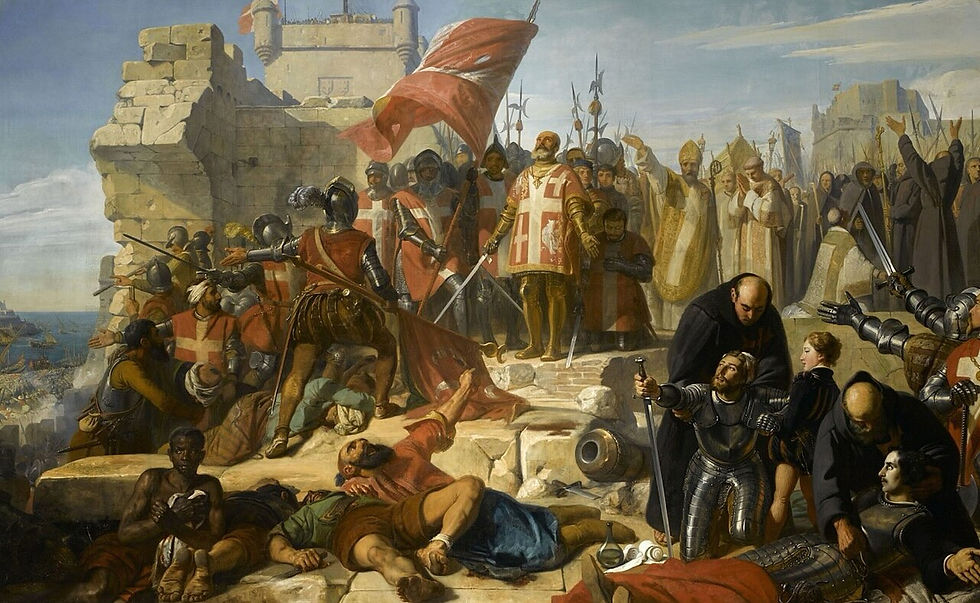
Lifting of the Grand Siege - Grand Master La Valetta at the Gates of Birgu - Painted by Lariviére (1798 - 1876)
Once the Turkish Corsairs left, the island was a cementary without graves. Life came to a standstill. There was no sound. Just silence. Agriculture collapsed. The villages were ghost settlements. Without protection nobody wanted to settle on the island ever again. It took Gozo 150 years to recover and reach the same level of population as in 1551. The Knights had no time for Gozo. They were busily fortifiying Birgu, Vittoriosa in the Grand Harbour and Mdina on Malta's hills. Before the Corsairs attacked Gozo, they had landed on the main island but were too weak to take any fortified town. 14 years later, they returned. This time with 40'000 soldiers. The Great Siege of Malta started. It would last four months. But after loosing 3/4 of their effectives, the Ottoman had to withdrew - tail between their legs.

La Valetta was built on the position of the Ottoman Siege Artillery which fired into Birgu
The Great Siege was a shock for the Maltese Knights. They came within a whisker of defeat. Both Birgu and Vittoriosa were bombarded from the ridges where La Valetta now stands. The Knights thus decided to build a new fortress town on these ridges and named it La Valetta, in honour of their Grand Master during the siege. Construction started a year after in 1566. Within ten years, the new capital with its impressive bastions and trenches was built. It is the Valetta north to the illuminated fountain we enjoy today.
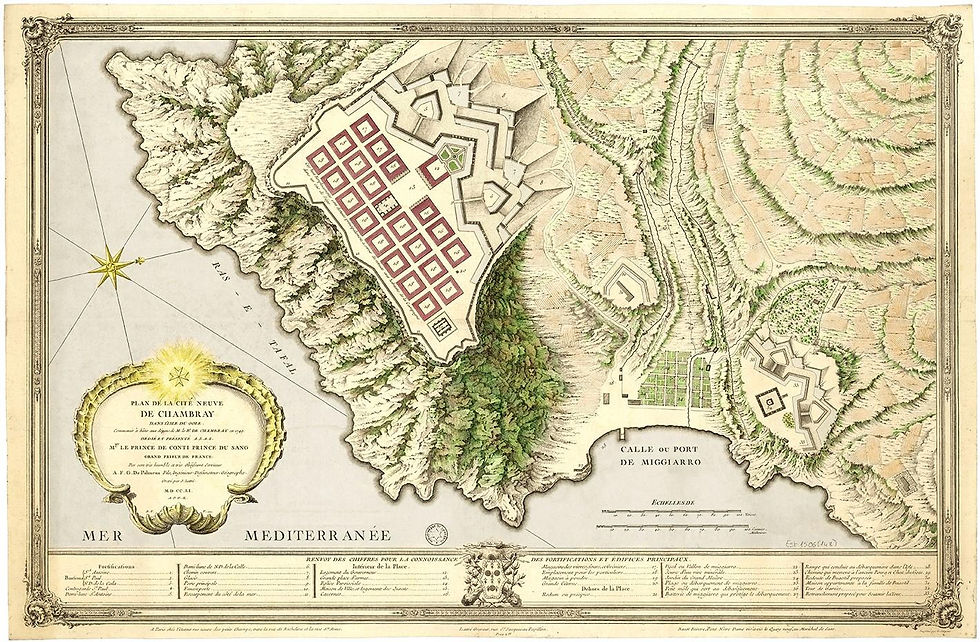
Plan of the New Capital: Fort Chambray - the Red Squares were for the civilian Population
Eventually, the Knights could turn their attention to Gozo again. In 1599, Victoria's Cittadella was modernised. Big bastions and artillery positions were added - see top photo. Slowly but steadily, the Knights repopulated the island with settlers from Malta, Sicily and Calabria. Elaborate plans were prepared to evancuate the population into the Cittadella in the event of a repeat Ottoman attack.

Fort Chambray in the 1960s before it was turned into a Luxury Resort
Also, plans were drawn up to build a new capital just above Mgarr, Gozo's main harbour on the island's south. The new town was called Fort Chambray after Jacques-François de Chambray, Gozo's Governor. He was a knight of the French Language chapter and became rich as Christian Corsair - raiding Muslim shipping. He financed the fort with his own funds. First plans were drawn up in 1716 but construction did not start before 1749. By the early 1760, walls and bastions were completed. However, the construction slots inside the fort could not be sold. By the late 18th century, the threat from Turkish Corsairs had disappeared Gozo's people saw no need to buy plots in the new capital. The town was never finished.
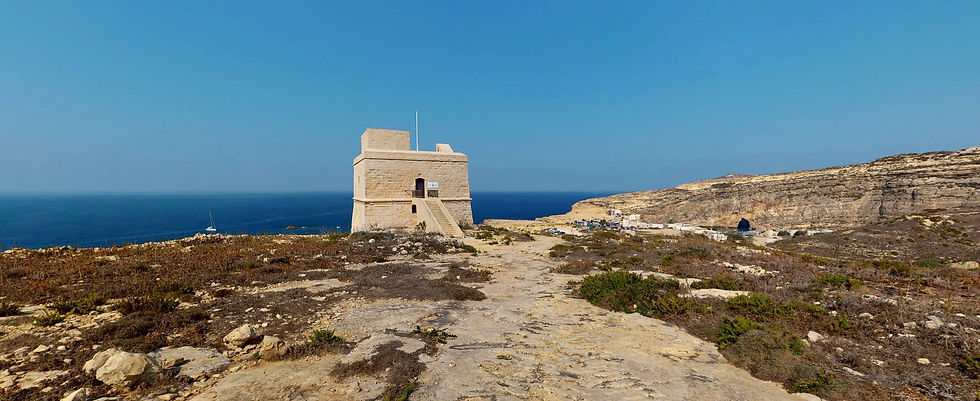
The Maltese Knights also built several Saracen Watch Towers on Gozo as an early warning System against Invaders from the Sea. A giant fire on top of the Tower was the Alarm Signal
For a short while, Fort Chambrey was used during the Napoleonic wars - English Marines liberated it in 1800 from the French occupiers. Later on, the empty fort served as hospital, asylum for mentally ill patients and as a prision. The decaying place was eventually sold to a consortium of private investors in 2007 to build a gated luxury resort inside. Construction started in 2012 and is today mostly completed. As a sad consequence, the fort is no longer accessible to the public.

Project of the Chinese CCC of a 9 km Bridge from Gozo to Malta from 2014
Due to its separation from the main island, Gozo kept the rural charm which is mostly lost in the rest of Malta. Not surprisinly, it becomes more and more popular with affluent tourists who look for a break in their hectic lives. There are only a few hotels though. Luckily, the 9 km long bridge proposed by the China Communication Construction Company in 2014 was never built. Estimated to cost EUR 1bn at the time, the project was far too expensive. Gozo could thus develop its high-value niche tourism, continues to be Malta's main supplier of diary products and livestock and recently became Malta's Digital Hub. As an irony of history, it preserved the original culture of Malta better than the fully urbanised main island.

Gozo's spectacular Cliffs to the South house also Phoenician Temples carved in the Stone


Comments