


J - 100 : The End of the Age of Sail

Shipyard Drawing of the Fernandino I from 1817 in Naples
Only 100 days to the start of our summer trip! It will take us from Malta to Pozzuoli, the journey Apostle Paul made in Spring 60 AD on his way to Rome. His voyage took place at a time when it was inconceivable that anything else than wind could power naval transport. Today, every sailboat has an engine to motor into the harbour when there is too little or too much wind. Times have changed.

Robert Fulton's Clermont established a regular Boat Service between Albany and NY in 1807
In the Mediterranean, the end of the age of sail came on 27th of September 1818, three years after the Napoleonic Wars. It was the date of the inaugural voyage of Ferdinando I , a wooden paddle steamer. Assembled in the shipyards of Naples, it had a steam engine from England, a cruising speed of 6.5 kn per hour and was supposed to connect Naples with Palermo, Rome, Livorno, Genoa and Marseilles. The Ferdinando I was the brain child of Captain Pietro Andriel, a native from Montpellier and fervent admirer of the American engineer and inventor Robert Fulton. The man who had built the world's first successful river steam boat service on the Hudson River in 1807.
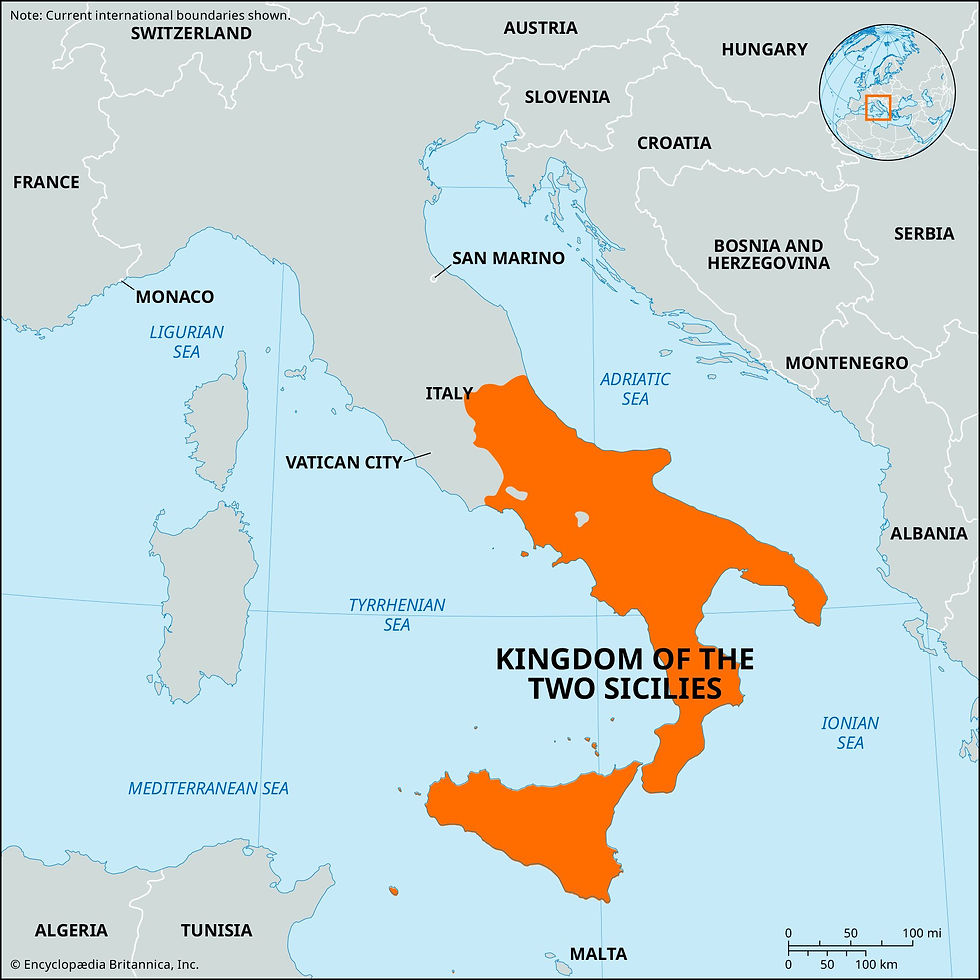
The Kingdom of the Two Sicilies had one of the longest
coast lines in 19th Century Europe
Having failed to find supporters in France - Napoleon had far more pressing problems after his defeat before Moscow in 1812 - Andreil left France in 1815 and moved to Naples. There he presented his ideas to Ferdinand I, the recently reinstalled King of both Sicilies. With thousands of miles of coast line, his kingdom needed reliable and weather independent navigation. In January 1817, King Ferdinand I granted Captain Andreil a monopoly for "accelerated navigation by means of fire trumpets" for 15 years.
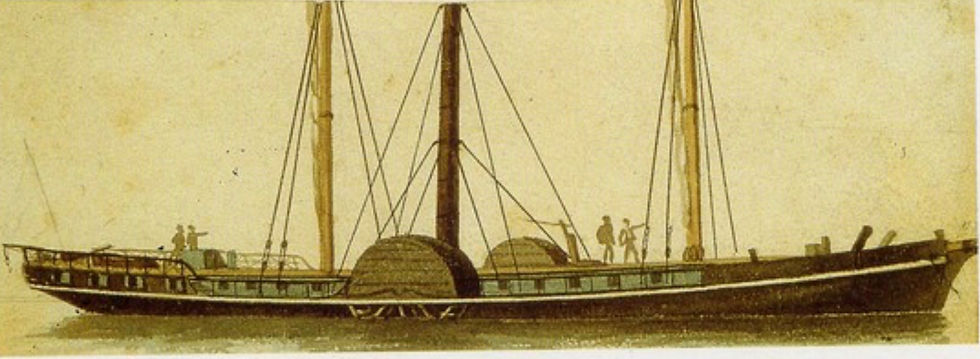
This Drawing of the Ferdinando I is from 1830 in Marseille. Could it be a different ship ?
Without further ado, Andreil raised money from the Neapolitan aristocracy and ordered the Ferdinando I from the Filosa shipyards for 5'780 Ducats. The ship was 38.5 m long and 6.2 m wide, had no mast, 2 steam boilers, a 45 horse-power engine and 2 giant paddle wheels on each side with a diameter of 3.6 m. At the stern, there were 16 cabins for "passengers with distinction" (= money). At the bow was a common room with 50 seats for ordinary people like us. The deck was sufficiently spacious to accommodate three carriages.

The Port of Naples in 1757 when Charles III left to become King of Spain
The maiden voyage of the Ferdinando I was "eventful". Crossing the narrows between Procida and Misenio, the steamer encountered rough waters and had to stop the use of one paddle wheel. Paddle steamers were perfect for rivers - the open sea was a challenge though. When the Ferdinando I arrived before Ostia, rowing boats rushed out. Having no masts and with smoke belching from its chimney, the locals believed that the ship was on fire. They never had seen a steam boat before. Unable to find a river pilot for the upstream journey, plans to sail to Rome had to be abandoned. The ship continued up the coast of the Italian peninsula until Porto Ercole where the boiler blew up. It limped barely into Livorno port where the boiler was repaired and continued a few days later to Marseille

The Real Ferdinando from Spain had Masts for Sailing - just in case. Painted here in 1827
Despite its promises, the ship was no commercial success. Customers did not trust the new technology and preferred traditional sailing ships. In December 1819 it was thus decided to sail the Ferdinando I back to Naples The return journey was even more adventurous than the maiden voyage. At Portovenere, the engine stopped working. It had to be repaired in La Spezia. The Ferdinando I eventually returned on 8 March 1820 to Naples, two months after its departure. The round trip took 18 months. The first steamer was scrapped. Unlike today, there was little if any testing for new technology. A year later, Spain also experimented with steam technology. It's boat was called the "Real Ferdinando". It was not more successful.

Sailers and Steamers served next to each other throughout the 19th century. Naples 1897
Making steam technology reliable for commercial use in the Mediterranean took a good decade. France launched in 1829 the "Sphynx" which was going to connect Toulon to Algiers. France needed this route for its new colonies in North Africa. Soon thereafter, the new Neapolitan Line offered voyages from Marseille to Genoa, Naples and Malta. The nautical distance between Marseille and Naples is 420 - 450 miles (depending on the route taken). With good winds, a sailboat covers the distance in 4 - 5 days. With adverse winds it takes longer - often much longer. A steamer could do it in half the time and did not depend on wind directions.

The Harbour in Naples in the late 19th Century
Operating steamers was expensive. Coal was imported from England or northern France and had to be shipped around the Cape of Gibraltar. There wa no railways yet that could do the heavy lifting. Steamboats were thus used for mail which had to be delivered fast and passengers who could pay. For bulky goods and commercial items where time was less important sail ships continued to be used. When we look at harbour photos from the 19th century, we see lots of sail ships with the occasional steam boat. It took World War I which accelerated the switch from coal to oil and steam to combustion to make the switch. Today, sail boats are pleasure boats. Modern sensor and steering technology though are preparing us for a comeback of wind power.

There are only 80 years between the first Drawing
and this Poster - What a difference Development in
Technology make - then and now


Comments