


J - 18 : Calabrian Wines - Name Labyrinth
Updated: Aug 16
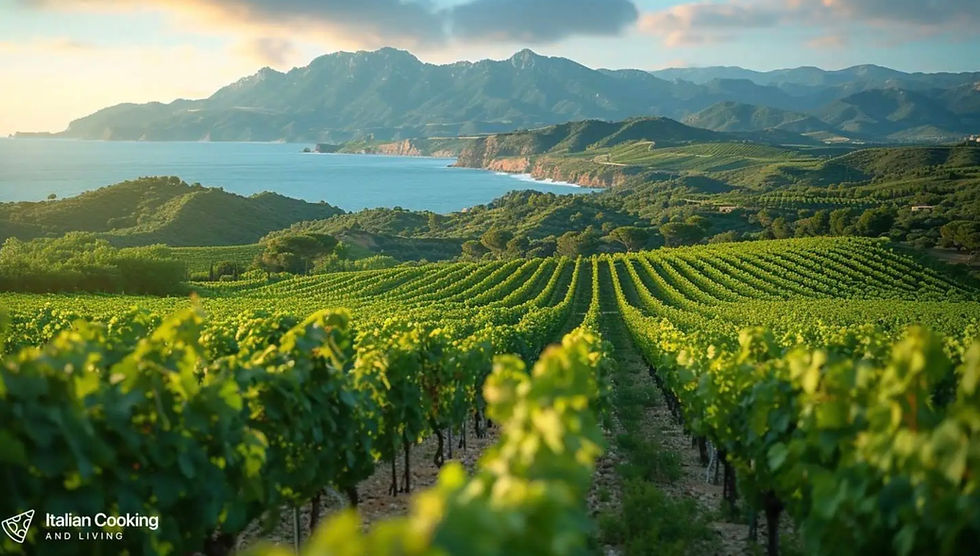
Some Calabrian Wine Estates are located spectacularly on the Mediterranean Coast
Learning about wines is a bit time consuming but not too difficult. For most wines, knowing the location and type of grape gets you far. Until you arrive in Calabria. Here, every grape seems to be "Greco" - from Greece. Even though none are actually planted in Greece. The wine brochures are full of references to Magna Graecia, when Greek settlers came over in the 7th century BC and settled most of southern Italy. We visited many of their ancient sites in 2021 and will visit more this summer.

You find Calabria's Wine Regions on both the Ionian & Tyrrhenian Coast as well as Inland
Most whites planted in the region are called Greco Bianco. The same grape is also called Guardavalle or Montonico Bianco. Does not get you too far. A clue though comes from the main island of the Aeolians, Lipari. There, the same grape is called Malvasia di Lipari. We recognize the name from our visits to Monemvassia (Peloponnese) in 2017 and 2022. The name stands for an entire family of indigenous grapes. Monemvassia, the Gibraltar of the East, was for centuries controlled by Venice and exported reds, whites and sweet wines to Italy. The white Malvasia di Lipari has a floral and fruity taste and is by many compared to the French Viognier. Winemakers use it to make dry whites, sparklers and sweet desert wines. Greco di Bianco is one of these and rumoured to be Italy's best desert wine.

Calabria's Vineyards are known for their refreshing, dry white wines
Calabria's wine producing areas enjoy a hot, dry summers with the occasional thunderstorm and rather cold winters. Temperatures do not only fluctuate between the seasons but also between day and night. Calabrian wine makers say this makes their wines balanced and elegant - have not heard that before. Inland you find many vineyards in alluvial valleys - on sandy and gravelly soils. On the coast, many vineyards are located on clay-like limestone slopes. One of them, Ciro is located a bit north of Cortone. It is said to produce Calabria's oldest red from the indigenous Gaglioppo or Greco Nero grape - cannot be too indigenous since the Greek settlers brought all wines form their motherland. Be it as it may, Gaglioppo is a full boddied tannic wine with strong fruity flavors.

Red Ciro from Crotone - picked this Photo from the Web - never had any Ciro and will put it on the Wine List for this Year's sailing
Calabria is a relative late comer in wine making. Like the South of France, it produced high volumes of low quality table wine for decades. But the connaisseurs' interest in "new" indigenous grapes gave Calabria a second chance. 90% of its wine production are reds, most of them made from Gaglioppo grapes. The rest from Magliocco, another indigenous grape variety mostly used in and around Cosenza. It is known for smooth tannins, red berry flavours and a spicey aroma. It is another wine I never heard of. Definitely does on the to-be-tasted list.

A Magliocco Vineyard near Cosenza in Central Calabria
There will be quite some wine tasting during out second week. Whilst the production of dry whites is small, there are also some few rosés - all with an excellent reputation. We definitely need to find them. Last on my task list is to find out why so many people say that Greco di Tufo (Campania) and Greco Bianco are identical. For sommeliers, these are two different varieties. We definitely need to keep a bottle of Greco Bianco before crossing into Campania where we shall drink and compare it to a Greco di Tufo.

Greco Bianco Grapes shortly before Harvest

Gaglioppo Grapes on their Way to the Wine Press


Comments