


J - 195 : How Obsidian Glass Stratified Society
Updated: Feb 16

Outcrop of Obsidian Glass on the Eastern Tip of Lipari, the largest Aeolian Island
Over the last few years, obsidian made an interesting come-back. Once material for cutting edge tools for our neolithic ancestors, it now adorns the necks and ears of modern women. Obsidian, a volcanic glass, acts like a mirror when carefully polished. Look at an “Alhambra” ear ring and you look at yourself.

An Obsidian Pendant from the
Alhambra Collection (Van Cleef &
Arpels)
Our ancestor relied on obsidian tools for hunting and cutting. They made blades and arrow heads but also humanity’s first mirrors. These objects were prestigious. Only elites could afford them (ordinary people were too busy for looking at themselves anyway). More to that later.

Obsidian Exhibits in Liparis Archeology Museum
Obsidian is a volcanic silicate which gets to the earth’ surface during volcano eruptions. When cooling rapidly like during flows into the sea, it “freezes” without having the time to arrange itself in its natural crystal pattern. Obsidian is kind of a “frozen” liquid. Its molecules arranged randomly. When split, it breaks along its molecules. This makes for much sharper cutting edges than flint stone. An obsidian blade cuts better than a Japanese sushi knife. It is quite brittle though and breaks easily under lateral stress.

A Block of Obsidian Glass in Lipari's Archeology Museum
We do not know when neolithic people discovered the material’s amazing properties. It must have been a slow process of trial and discovering. The volcanic sites where obsidian can be found are remote and not easily accessible. During the ice ages, the Carpathian and Anatolian sites were covered by glaciers.
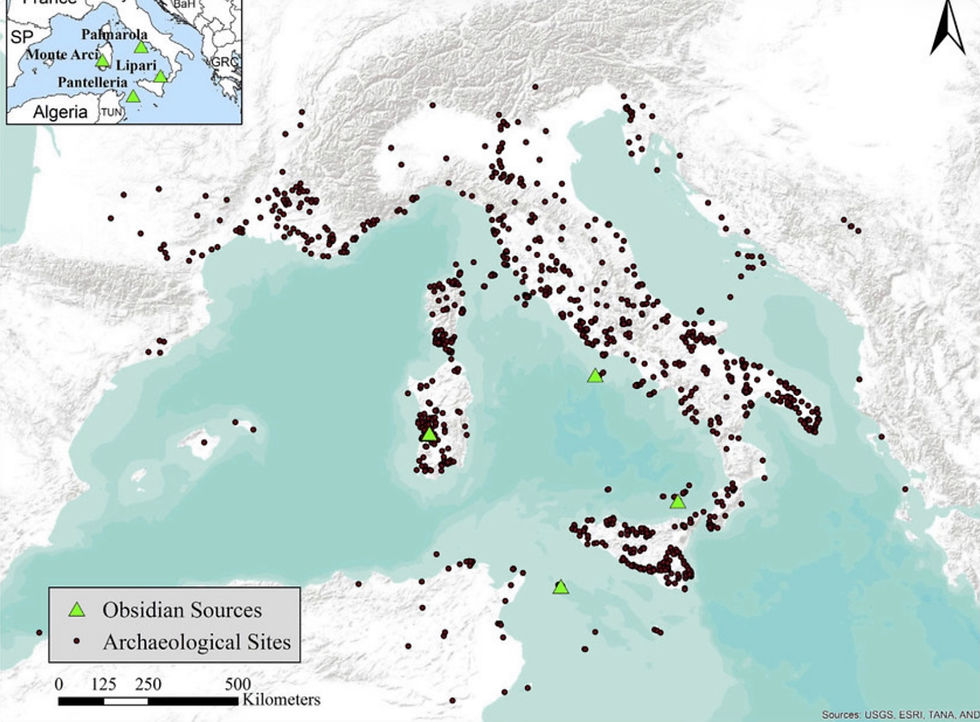
Archeological Sites where Obsidian Tools were found in the Western Mediterranean
Milos (Greece), Pantelleria (Italy) and Lipari (Italy) were alsways ice free but visitors had to master the sea as early as ten thousand years ago to get there. Since the composition of trace elements in each volcano is different, obsidian glass carries a finger print. The origin of each blade can now be tracked using a database of all obsidian sites.

Each Production Site comes with its unique Fingerprint
Thanks to this trackability, archeologists discovered humanity’s first long-distance trade network. Obsidian objects were found as far as 2’000 miles away from their place of origin. Archeologists also discovered from obsidian shards that production levels exceeded local demand by far. Obsidian tools were produced for export.

The Island of Lipari is literally "littered" with Obsidian Shards which were discarded
Obsidian mines were professionally run, the raw glass blocks skillfully hammered into small blades. It must have taken years to learn the skill of making blades from a block of obsidian glass. The professionalization of the mining led to a stratification of society. Miners and obsidian masons could not hunt or grow their own food nor could they ship their own products. Both Pantelleria and Lipari are also too small to support such a large mining community. Food and any other necessity had to be brought by sea from the mainland.

Obsidian Tools were used both by Hunter-Gatherers and the Farmers who settled in Europe
The Obsidian trade network was at its peak from 6’000 – 3’500 BC and reached every corner of Europe. Trade was probably conducted via dozens of middle men who passed on the precious glass to the next. Obsidian became more precious as the distance increased from the source. Archeologists found obsidian objects in graves of neolithic chiefs – they were so precious that they were buried with the deceased. For hunters obsidian was vital to ensure a kill when hunting big game. For tribal leaders an obsidian mirror was proof of elite status.

Obsidian Mirror from the Neolithic Settlement of
Catalhöyük in Anatolia where 5000 people lived
from 7500 - 5600 BC. Apparently it is the world's
oldest mirror. Does any one know the precise age?
Always thought that division of labor was the results of the agricultural revolution when humans settled and started working the fields. Division of labor though is clearly visible in obsidian mines, in the vast trading network and in the “luxury” goods made from this volcanic glass. A mirror does not add value except confirming that you actually look the part that you are going to play. The stratification of society thus has earlier roots than I assumed. Hunter-gatherers were probably less equal than the fairytale of benign savages tells.

Mining of Obsidian in Lipari stopped thousands of Years ago when Copper (3500 BC) and Bronze (2500 BC) became the preferred tool material. Pumice continued to be mined to 2007
During week 2 we will visit the Aeolian island and make a stop at the archeological museum in Lipari which is housed in the Spanish Renaissance Fortress. During my last visit in 2021, I was overwhelmed by the number of obsidian blades and arrow heads. This time I will look for symbolic and status objects which have less practical use but far more value. I wonder what I will find. Maybe women used obsidian as jewelry? I will report back in 205 days.

Sunset at the Spanish built Castello di Lipari
NB: after finishing this piece I continued reading and noticed that obsidian glass is one of the human discoveries that happened several times independently in our history. It is well documented for central America, where the Aztec Empire based its power on obsidian weapons and trade. We also have good evidence for Siberia where obsidian blades and objects were found north of the polar circle

Human ingenuity is just amazing. Recent discovery in the Pacific show that the Polynesian explorer brought obsidian tools with them from Asia and maintained the long supply chain for their entire history. Obsidian blades were indeed something incredibly valuable and useful. People made extraordinary efforts to obtain the material.

Sledges in Siberia were made with Obsidian Tools to make super smooth surfaces


Comments