


J - 200: Pointed Arches from the Middle East
Updated: Feb 11

Pointed Arches in the Duomo di Sant Andrea, Amalfi
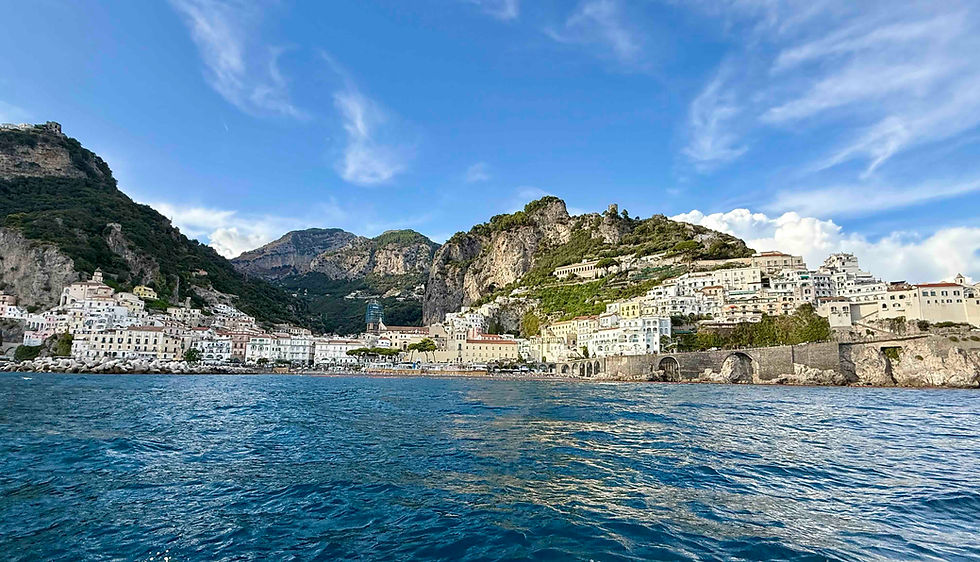
We will visit Amalfi and its Duomo in Week 3 this summer
A good year ago, Notre Dame in Paris opened its doors again. It was closed for five years for refurbishment after it burnt down in spring 2019. I vividly remember the TV pictures of the flames licking up the roof and how the spire collapsed. Next to the Duomo of Milan, Notre Dame is the world's most famous Gothic church. My favorite though is the smaller Cathedral of Saint-Denis, now a suburb north of Paris, where the French Kings are buried.

Inside the Basilisque de Saint Denis, the Burial Place of all French Kings, finished 1144
The Basilisque Cathédrale de Saint-Denis is smaller than Notre Dame. The much bigger cousin in Paris needs massive pillars to support nave and roof. As a result, the flow of light suffers. Notre Dame feels grey, dark and cold – even after the renovation. Saint Denis is much lighter. Smaller pillars and bigger windows leave it more illuminated. The stained-glass windows bath it in a warm and welcoming glow.

Stained-Glass Windows are the Basilique's spiritual Earmark
The Basilique de Saint-Denis is France’s oldest Gothic church. For years I believed that it was also the world’s first. Originally constructed in Roman style in the 7th century, it was rebuilt and enlarged in the 12th in Gothic architecture. Its famous choir was completed in 1144. The pointed arches are one of its key elements and give it its spiritual feeling.

The outer Wall of the Al-Aqsa Mosque in Jerusalem is supported by slightly pointed Arches
The gold medal for first "Gothic" building goes to the Middle East though. As far as I know, the architects of the Al-Aqsa Mosque were the first to use pointed arches. Not for stylish reasons. Their challenge was Jerusalem’s semi-desert. There were no trees. Using Roman arches resulted in low buildings with low ceilings unless arches were crossed like in the Hagia Sophia or built on top of each other as with the Pont-du-Gard in the South of France. Such structures were heavy and required a lot of material. Pointed arches were a perfect solution. Their invention enabled architects to build taller and with higher ceilings. These structures were also lighter and distributed weight better.

Krak des Chevaliers was rebuilt in 1140 by the Knights Hospitallers
When the Crusaders arrived from Europe and conquered Jerusalem in 1099, they took note of the new style. Always considerably less numerous than their Muslim opponents, they had to rely on fortresses to defend and hold the Holy Land. Tall, strong walls and large warehouses with high ceilings were an absolute must. At home in France, Germany or England ,they used strong oaks in their castles. But in the Holy Land there was no timber.

Unless you know you would not guess that you are in the
Krak des Chevaliers
The Knights had to adopt the pointed arches and flying buttresses to achieve the desired features for their castles. A few of these fortresses survived - like the Krak des Chevaliers in Syria just north of the Lebanese border (I hope to visit it one day). Its elevated inner towers provide excellent platforms for archers to shower attackers with missiles. They could not have been built so high without Gothic technique. The same holds true for the warehouses which held the Knight’s supplies for long sieges. Krak had a garrison of up to 2'000 soldiers.

Warehouses and Archer Platforms in the Krak - Muslim took it in 1271 with a War List
The stone masons builing these new style castles were thought after in Europe. They moved back and forth between Europe and the Holy Land on ships from Italy’s merchant towns like Noli, Genoa, Venice, Pisa or Amalfi. Not surprisingly, the architects in Amalfi learned about the new building method when they enlarged their Duomo in 1120. Amalfi thus has the first church built with Gothic style elements. In 60 AD, the Gospel travelled with Apostle Paul on Roman trade routes to Europe, a thousand years later the pointed arches did the same.

The Duomo di Sant Andrea in Amalfi with its Pointed Arches at the Church Entrance
The new style, named Gothic during the Renaissance, took roots when rapid economic growth led to a significant increase in population in the 12th century. Towns got bigger, wealthier and more powerful. They needed larger churches for their people and wanted to show their fortune. Gothic technology made it possible. After the peak of Roman power in 200 AD, no large structures were built anymore (Byzantium is the exception). Thanks to the ingenuity of “Gothic” technology, a single town could now build what in the past only a Roman Emperor could – albeit the construction took sometimes several decades.

Notre Dame de Reims where the French Kings were crowned
There are many marvelous Gothic cathedrals in France, Germany, England and Spain – and even one in Milan. It was built as a nod to the French Kings, the protectors of the Milanese Duchy. Most Art Books explain Gothic style as a spiritual expression of medieval people. Whilst this is certainly true, Gothic architecture was also very practical and allowed Europe to reconnect with ancient architecture and develop it further. Big structures were back in Europe. That the technique was developed in tree-less Jerusalem by Muslims is now mostly forgotten though.

Duomo di Milano (1386) last Summer in Morning Light


Comments