


J - 190 : Fufluna - Ancient Etruscan Port
Updated: Feb 21

The Castle of Populonia stands on the Acropolis of Fufluna, the ancient Etruscan Port
During years of sailing along ancient trade routes, we dropped anchor in many old Greek ports. There was usually a port basin for the ships, a rocky outcrop with an acropolis, somewhere temples for major deities and dual use buildings which lined the quays. Marseille, Knidos, Miletus and Rhodes are good examples.
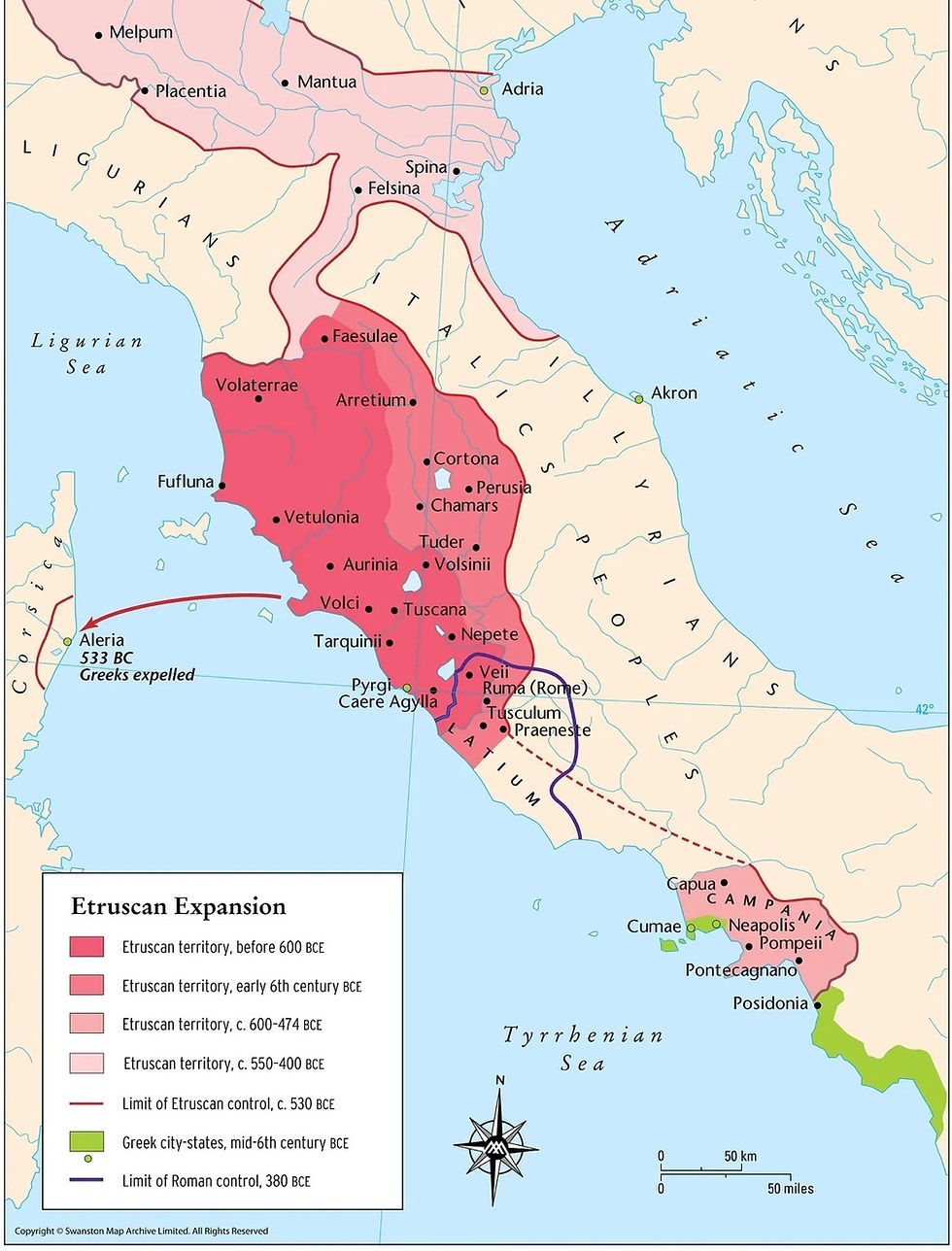
The Etruscan Federation at its Peak in the 7th Century
When Greek explorers pushed into the Tyrrhenian Sea in the 8th century BC, they encountered fast, long Etruscan boats. The boats were agile and highly maneuverable, their crews young, well trained Etruscan men. It is said that they loved to plunder, following the principle “what is floating on my sea, must be mine”. Greek commercial vessels were an ideal target. They carried cargo like gold, silver, copper and tin, fine pottery, rare textiles, exotic spices and amphora with olive oil and wine – desirable products the Etruscans did not know. No wonder these “savage” Etruscans earned the title “scoundrels of the sea”. The word “Tyrrhenian” became a synonym for pirates.
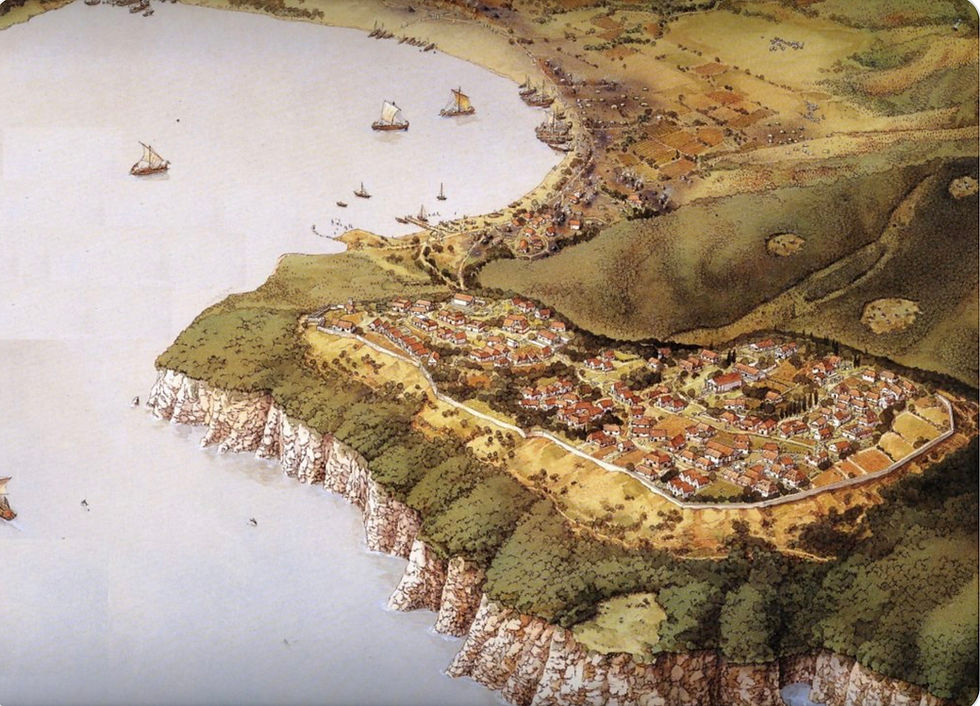
Artist Impression of Fufluna in 600 BC - The Iron Smelting was between Acropolis and Port
Where did these “scoundrels of the sea” live? Where did they keep their ships? Maybe the etymology of the word “Tyrrhenian” helps. It not only means “pirates” but also “people living behind high walls”. We know that Etruscans built their towns on hills and fortified them. Are there fortified Etruscan ports in the Mediterranean?

To my delight Google’s Artificial Intelligence found two Etruscan commercial centers with ports: Caera and Fufluna (Populonia). Will cover Caera in a separate blog. The town is situated on a hill 8 km from the sea and actually had three ports. In the Middle Ages, knights used the stones of these ancient ports to build sea castles – next to one of them, in Posta Vecchia, my Italian friend Ferro got married. I had no idea that the wedding took place on the grounds of an ancient Etruscan port.

The Posta Vecchia, a Boutique Hotel, is just to the right of Castello Odescalchi
Today I shall focus on Fufluna (Populonia) instead, a town opposite Elba. When the island, rich in iron ore, run out of wood for charcoal, Fufluna became the Etruscans’ major iron smelting site thanks to limitless timber from its coastal forests. The ruins of the iron smelters still stand. Scholars assume that up to half a million tons of iron was produced here (=7x the Roman Empire’s annual iron consumption). Production was in full swing from 600 to 100 BC when the mines were exhausted.
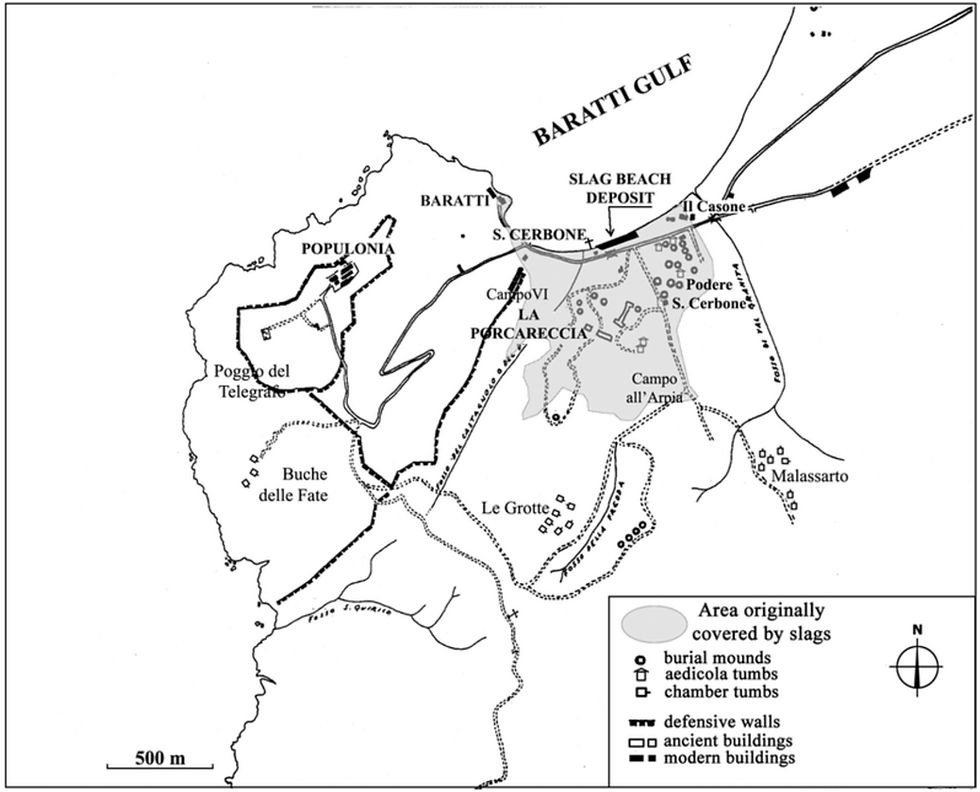
The Area of the ancient Iron Smelters shaded in Grey
There is still plenty of iron bloom in Fufluna, residue of the unfinished process. Under Mussolini’s much of this bloom was removed. Modern technology allowed Italy’s steelmakers to recycle at a lower cost than using iron ore. But some bloom is still left. There were apparently 220’000 m2 covered by iron bloom.

Ruins of ancient Iron Smelters on the Beach of Populonia - Fafluna Akropolis at the Back
Fufluna did not have a “proper” harbor. Etruscan ships were as light as the Minoans and pulled on shore overnight. There was no need to keep them in the water. Bigger Greek and Phoenician ships needed a proper port though. But for the Etruscans, the flat sandy beach of Fafluna (Populonia) was ideal.

Etruscan Ships must have looked like this 20 Tons Roman Single Row Pentecotera
On the rocky outcrop to the southwest of the beach was Fufluna’s acropolis which reminds me of other Etruscan Hill towns. It covered the entire hill top, was walled but had low population density. There were lots of fields within the walls.

Fufluna - 3D Computer Simulation based on Excavations and Archeology Findings
Not surprisingly, the medieval rulers used these ancient stone to build a small fortified town which towers over the hill plateau. But some sections of the Etruscan walls are still standing. Digs south of the medieval town have brought to light Etruscan temples and funeral sites.

The Remains of ancient Fafluna are five Minutes from Medieval Populonia
The port’s name Fufluna derives from “Fafluns”, the Etruscan God of Drunkenness. In Greek called Dionysus or Bacchus in Latin. I cannot reconcile the fact thought that the Etruscans had a wine God but grapes reached Etruscan territory only in the 8th century BC The name Fafluns has far older roots. Wonder how the Etruscans got drunk? A topic for a nextblog?

The Medieval Town of Populonia sits on Top of ancient Fufluna (and was built with its stones)
Fufluna was already a trading hub before the arrival of Phoenician and Greek ships. Etruscan were well known for their black smith mastery and their iron products were in high demand north and west of the Alps. Etruscan trade networks reached up to the North Sea. For their iron tools and weapons, the Etruscan traders bought amber, hides, furs and slaves back home. Fufluna was where these products were traded. Regularly, Greek and Phoenician ships arrived with their own offerings. In this little port without quays and warehouses, Europe’s north and south met and exchanged their products – an activity far more reliable and profitable than the occasional pirating.

Etruscan Trade Networks reached far into Northern Europe up to Scandinavia
Today, Fufluna is off the beaten track, albeit the nice sandy beach of Populonia attracts is fair share of Italian summer tourists. Wonder whether they know that they are holidaying on an important old Etruscan port site. Probably not – they are as ignorant as I was in Ponte Vecchio 19 years ago.

Populonia Beach - a perfect Summer Holiday - with the Fufluna Acropolis at the Back


Comments