


J + 2 : Was the Concept of Hell invented in Syracuse?
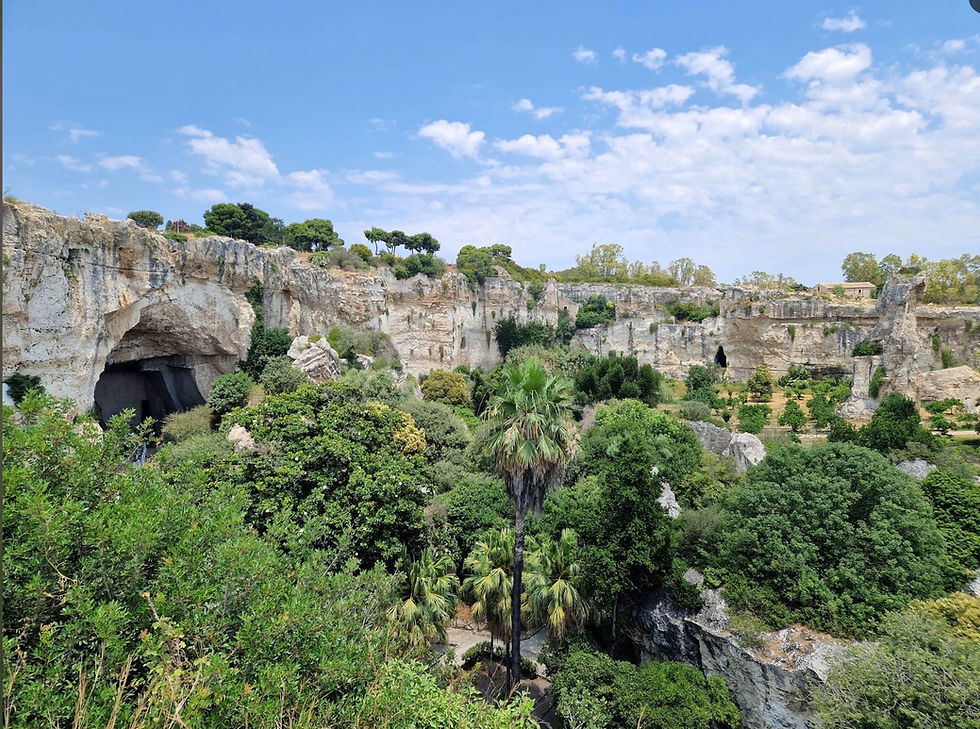
Latomie del Paradiso - Quarry of Paradise got its name from the lush Garden which is now growing inside - it was anything but a Paradise during Greek time
Yesterday's decision to cross early from Malta to Sicily was perfect. We lifted anchor at 6 am. The sea was flat as if Poseidon had ironed it. It was a hazy day. The sun was barely visible at sunrise. On the way we crossed a few container ships. One was huge with 200'000 BRT and a width of 60 meters. We were crossing the international waterways from Gibraltar to Turkey and the Suez Canal. It took us 12 hours to reach Syracuse not including the three hour break at Portopalo where we stoped for eating and some swimming.

Hazy Sunrise North of Malta at 06.53 am
The Arrival in Syracuse was a bit scary. The Lido south of the town was devoured by a rather big forest fire. We discovered the smoke column alreayd 90 min prior to arrival. As we learnt later, the Lido and the surrounding pine forest were completely gone.

Syracuse's Lido was consumed by a Forest Fire. The Pillar of Smoke was several km long

Meanwhile Summer Life on Syracuse's Sea Promenade continued as usual. We heard Music and People laughing when we anchored. Paradise and Hell next to each other. Spooky!
Today is our Syracuse day. We want to explore Nea Polis, the part of Syracuse built by Gelon, the cavalry commander from Gela. He became Syracuse's ruler or tyrant in 485 BC (wikipedia has an excellent summary on his career). Once in power, he relocated by force people from Gela, Caminara, Megara and Hyblaea to Syracuse and expanded the town from the Ortigia island to the mainland. To accommodate his new citizens, new residential quarters were built in Tyche and Nea Polis. He also commissioned public works - amongst them the famous Greek Theatre with 15'000 seats and the Temple of Athena.

The 2'600 Years old Greek Theatre in Syracuse is still used today for artistic Performances
Under Gelon's rule, Syracuse became not only the most powerful city in Sicily. It was the most powerful in the entire Hellenistic world. With 500'000 people, it was twice the size of Athens. Gelon claimed to have 200 triremes - Athens had only 100 more. When the Persian King of King Xerxes invaded Greece, envoys from Athens asked Gelon for help. He offered an army of 25'000 men and his fleet under the condition that he became the Greek Commander in Chief. Pericles, Athen's leader, and Sparta declined. They would not fight under the leadership of someone they considered a "start-up". Whether Gelon could actually have honoured his offer is another question. Carthage invaded Sicily in 480 BC and tied him down. Gelon defeated them though decisively at the Battle of Himera.

Archeologists recently found a Mass Grave of Soldiers killed in the Battle of Himera 480 BC
Syracuse was rich. Surrounded by fertile lands (volcanic soil and lots of water), the town could not only feed itself but was a big exporter of agricultural goods. Its location and safe harbour made it an ideal trading place at the cross-road of the Mediterranean. All big trade routes ended here. Custom fees were just rolling in and made the city rich. Last but not least, the town's large population made it a big manufacturing center. The division of labour allowed Syracuse to produce at scale - an early form of mass production.

None of Syracuse's Growth and Success would have been possible without the Latomie del Paradiso, the underground quarries below the new quarter Nea Polis.
Syracruse harboured a very dirty secrtet though. Deep below Nea Polis were the quarries of Sycacuse where slaves (usually prisoners of war) carved the stones needed for constructing the new public buildings like the Greek Theatre or the Temple of Athene (now Syracuse's cathedral) and the many new residential buildings. Today, these are open quaries but in the 5th century BC, they were underground. The ceilings collapsed millennia later due to several heavy earthquakes.

Pillars like this one were supporting the Quarry's Ceiling but later collapsed due to Tremors
Life in these quarries must have been hell. There was no daylight. The quarries were illuminated with big fires which heated the air and made it unbreathable. The food was dreadful - rotten porrige and water. The smell from human waste and the dead bodies was unbearable. Thousands of slaves worked in these quarries. Nobody survived for long. The work was back bracking, chiselling massive normed stone blocks from the bed rock - traces of their work are still visible today.

Traces from the Iron Chisels are still visible today
Compare this to the well aired Greek villas on top of these quarries where life was pleasant, full of light and fresh air. Here people enjoyed the produce from Syracuse's rich agriculture and happiness was guaranteed. Our guide in Syracuse, Masha Gallito, thus believes that the concept of Paradise and Hell must have been invented here. There were a few hundred supervising engineers in the quarries. They made sure that every stone block was cut to the correct size. But at the end of their shift, these engineers climbed out of the quarries and returned to their homes. For them, home above the quarries looked like Paradise when compered to the Hell where they spent their day. I find this explanation pretty convincing. But am sure many professionals historians will dispute this view given the lack of evidence.

The Pillars for the Dorian Temple of Athene (now integrated into the Syracuse Cathedral) were carved in the Quarries of Nea Polis. Took this photo late last night when walking in Ortigia, once the Acropolis of Syracuse
Tomorrow I am going to write about another controversial topic for which there is no direct evidenced - the strategic alliance between Persia and Carthage in 480 BC. But now it is time for a Campari Spritz


Comments