


J - 214 : How "Paradise Lost" and "Noah's Arch" became part of our Collective Memory
- hbanziger
- Jan 28
- 6 min read
Updated: Jan 28

Perception of the Garden of Eden by an unknown Artist in the 18th Century
We do not know whether Apostle Paul had any luggage for his journey as prisoner to Rome. Possibly he carried the Septuagint, the Greek translation of the Jewish Thora in his bag. In his teaching, he often referred to it. This way the Book of Genesis, the biblical story of the beginning of the world, reached Rome. Alternatively, wealthy Jewish merchants who already lived for decades in the capital obtained a copy from Alexandria. But we don’t know. In any way, the story of the world’s beginning, originating from Mesopotamia, had reached Rome.

An original, hand-written Page of the Septuagint - all in Greek Capital Letters
The book of Genesis is the first book in both the Thora and what we Christians call the Old Testament. The Thora was written in Hebrew. Under the Egyptian King Ptolemy II, it was translated in 280 BC into Greek. He had invited 72 scholars from Jerusalem. The word Septuagint means 70. They brought a trove of ancient Hebrew scrolls but also had access to the library of Alexandria. Translating a religious Jewish text into a language with a different philosophical context was a challenge. Still, the scholars got it done in less than 3 months’ time. There was now a Greek translation of the Thora.

The Ptolemy (brown) and Seleucid (green) Kingdoms around 280 BC
Ptolemy II, Pharaoh and successor to Alexander the Great, did not finance the project out of philanthropy. His intention was to secure the loyalty of the wealthy and influential Jewish communities in his kingdom. Many had lived for generations outside Israel. Their children spoke Greek and could not read Hebrew. Ptolemy’s plan worked. The Septuagint was widely accepted, copied and became the Thora standard outside Israel. The translation was also a foreign policy project. In 280 BC, the Seleucid Empire, Ptolemy’s archenemy, threatened Palestine. Clearly, his aim was to undermine their claim on the Holy Land.

Greek Settlements around the Mediterranean in the 6th Century BC
As an unintended consequence, there were now two versions of the Thora. A collection of ancient Hebrew scrolls in Jerusalem and the Septuagint for the rest of the world. With the Septuagint easily available, the Book of Genesis and with it the story of the world’s creation, spread throughout the Med. Copies made it to Greek cities in the Levant, Anatolia, Libya, the South of France and Magna Graecia. Every Jewish community wanted to have a copy.

Artist Impression of Ur and its Ziggurat in 2'000 BC and how it looks today in Southern Iraq
We know from text analysis that the Book of Genesis was written between the 9th and 7th century BC (roughly the same time as Homer wrote the Iliad). Interestingly though, the Book of Genesis talks about far older events: the beginning of civilization around 5'000 BC. The Book also had more than one author which is evident in often-contradicting text duplicates. A good example is the story of creation. In Version 1, God is a tribal Deity who lives in the Garden of Eden (“Pleasure”) where he walks among his creations. He forms Adam form mud and dust (everything in Mesopotamia is made from mud). Then he creates animals to keep Adam company and eventually Eve when he notices how lonely and miserable Adam was. In Version 2, written 200 years later, God is an omnipotent, universal authority who creates heaven and earth, day and night, the sky, moon and the sun, land, plants, the animals and mankind in his own image. God had escaped his human shape and became an ephemeral being high above in the sky.

Michelangelo painted his Scene "Eating from the Tree of Knowledge of Good and Evil" in the Sistine Chapel from Version 1 of the Creation Story.
The Genesis covers not only the world’s creation, but also Noah’s flood, the Tower of Babel and Abrahams journey from Ur on the Persian Gulf to the Jordan Valley. Abraham migrated to Israel by the 20th century BC, more than a thousand years before the Book of Genesis was written. His journey constitutes the crucial link between the Jewish people and the world’s first civilization. Ur where Abraham grew up is one of the world’s oldest towns.

Why Abraham would leave Ur in the 20th - 21st Century when the Town was at the Peak of its Power and Prosperity and move to barren Palestine is still an unresolved Question.
Ur, the Sumer town, was one of the places where civilization and urbanization were invented. As the ice age ended and sea levels rose, people living in large and fertile Gulf Valley were displaced - the never ending rise of sea water is the basis for the many flood myths that we find in this part of the world. When the water stopped, they settled close to the new shores and built canals to irrigate the lands with water from the Euphrates. Complex agricultural systems emerged with towns like Ur at the center. There are many indications that the now flooded lands were once the Garden of Eden, the fertile and well watered valley with abundant vegetation and animal life. It was the "Paradise Lost".
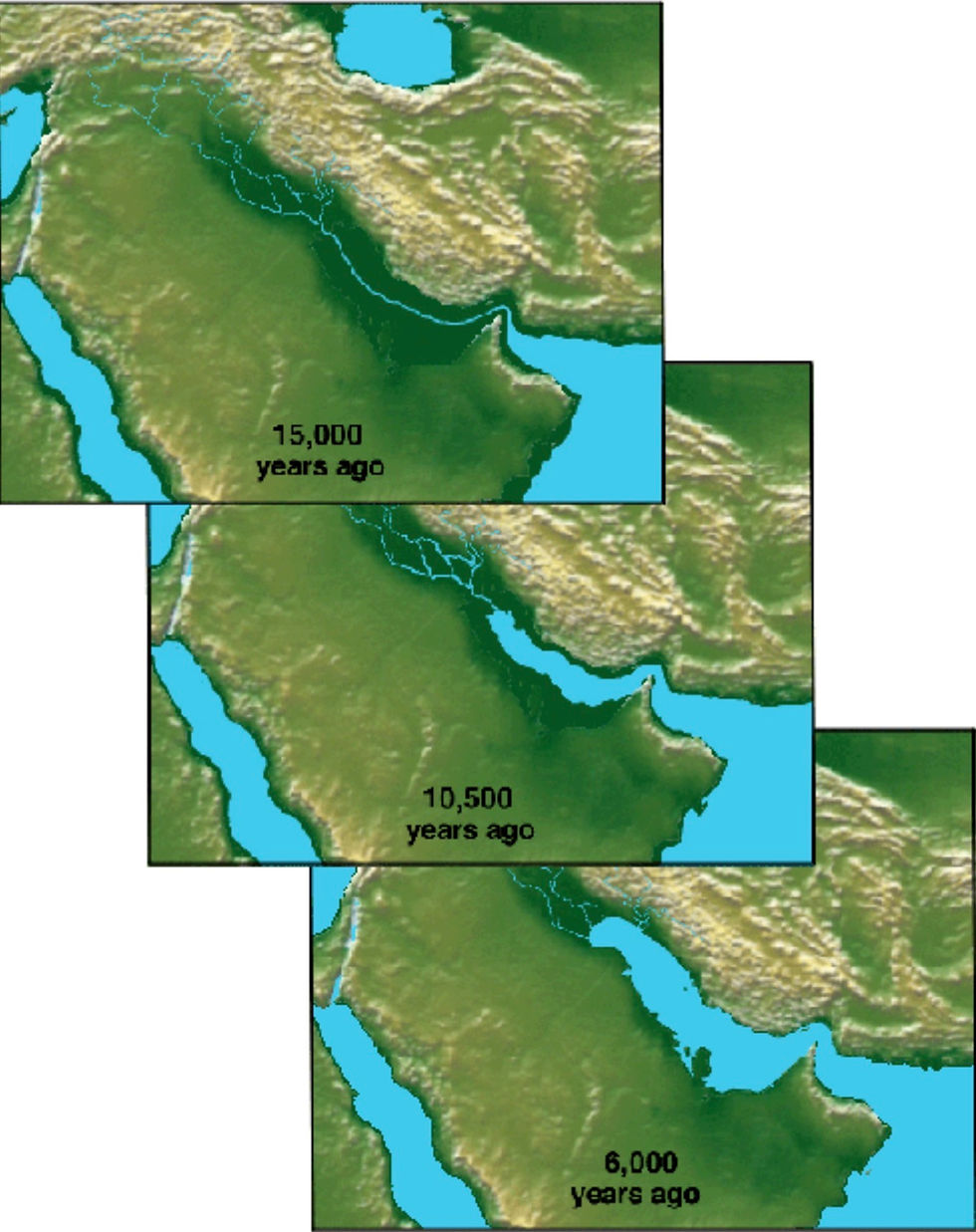
The Persian Gulf filled over 4'000 Years
Now living on the shores of the new Persian Gulf, the Sumer expanded the land they cultivated, built large food storage facilities for the colder periods, 'invented" bread and beer, developed the first writing system, watched and recorded the movement of stars, traded with the Indus Valley civilization and people living up-river in Persia and Anatolia to obtain wood, wool and wine. They also built the Ziggurats, large, multi-floor temples in the heart of their city where a priestly-royal elite with God like status ruled over their subjects and made the first laws. The Gilgamesh Epics evolved in this context.

Extension of the early Ubaid Culture in Sumer. The Persian Gulf reaches up to Ur
During my research, I could not find any evidence that Abraham ever travelled from Ur to Palestine. It is unclear to me why he would leave a town at the peak of its prosperity and settle in the barren lands of future Israel and Jordan. However, story of his journey links the bible to religious and philosophical principles much older than Israel - principles we find in the Gilgamesh epics: The basically good nature of humans made in the image of God but occasionally vexed with deception and sin. The existence of good and evil. That society (= living together) needs rules and that breaking these rules leads to violence. The importance of trust and faith. The power of forgiveness, reconciliation and recovery.

The Story of Gilgamesh, Semi-God and early King of Ur
was written down in Ur in the 20th Century BC - a full
copy translated in Arkadian dates from 700 BC
I also wondered how these tales - only discovered again in 1842 - found their way into the Hebrew Thora. Abraham’s descendants lived hundreds of miles away from Mesopotamia and a thousand years later. I guess the Assyrian expansion into the Levant and the conquest of Israel in the 8th century BC have played a role.
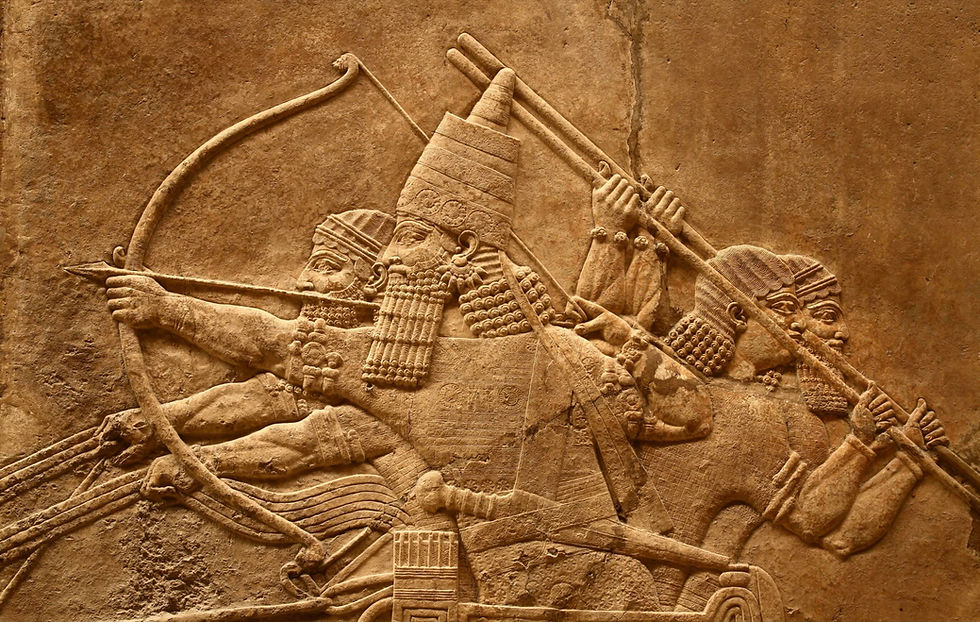
Assyrian Warriors on a Charriot. Assyria was the first State with a professional Army
As builders of a monolithic empire, the Assyrian enslaved the elites of the people they conquered. They wanted to erase defeated cultures and replace them with their own. Scholars assume that the Assyrians deported a good 10% of the Jewish population, mostly dwellers from the towns. Farmers were left behind to till the land and pay taxes. I believe it is safe to assume that the Book of Genesis was written by Jewish priests during the Assyrian exile where they had access to the ancient Gilgamesh texts and built them into the Thora to create a Jewish family tree that could rival the Assyrians.

Deportation of the Jewish Elite to Assyria - Jews could only return 200 years later under the Persian King of Kings Cyrus the Great in 538 AD
It is quite remarkable how civilization’s oldest myths, the narratives of creation, fall and redemption, found their way into our collective memory and values. That the Book of Genesis may have travelled in Apostle Paul's luggage occurred to me when looking at the maps of his and Abraham’s journey. They are 2’000 years apart - but they are linked through the stories of a Lost Paradise, tales of flood and the Tower of Bable. These stories are still taught to our kids in Sunday School. Their lessons and meaning are as valid as when they were first written down 4’000 years ago in Ur.

Apostle Paul's Journey as Prisoner to Rome in 59 - 60 AD


NICE