


J - 222 : Plate Tectonics Make Mediterranean Burgundy

Mount Etna in the Evening seen from the North - His standard Plume stronger than normal
When Apostle Paul sailed along Sicily’s east coast on his way to Rome in 60 AD, he must have noticed Mount Etna and possibly the many vineyards on the slopes. The mountain is huffing and puffing since people remember. Wine was planted on its slopes after Greek settlers arrived in the 8th century BC. The colonist cleared slopes, built terraces and introduced irrigation. For them, wine was part of their culture. I talked about this in my blog on the symposium.

Tenuta Tascante on Etna's northern Slope - a typical terraced Vineyard
In the 3rd century BC after Rome took over the island in the Punic wars, viniculture was expanded. Rome wanted Sicily for control of the Western Mediterranean and as bread basket. But once it discovered the wines growing on Etna’s slopes, it went for it. Pliny the Elder, Roman geographer and admiral, mentioned Etna’s wines as “amongst the finest produced in the Mediterranean”. Elevation, micro climate and drainage made these wines special. Apostle Paul may have known of them – red wine played a crucial role in the celebration of the Holy Communion, probably Christianity’s first ceremony.

The Etna Wine Region (DOC) produces both excellent white and red Wines
Mount Etna is actually an island on an island. With a circumference of 140 km, it covers an area of 1’600 square kilometers. The volcano is 3’357 meters high and wedged between the African and European continental plate. It is a geological island on Sicily. Where the African plate is subducted below the European Plate, hot magma chambers form deep below the surface and eject lava to the surface
.

Mount Etna is a geological Island in Sicily - its Lava is superimposed on ancient Strata
Mount Etna is now active for at least 500’000 years. 200 eruptions are documented since the arrival of Greek colonists 2’700 years ago. The volcano's slopes are thus covered with layers upon layers of ash, pumice and lava, all rich in trace elements which make these wines so special. No single square kilometer is identical - variety is guaranteed.
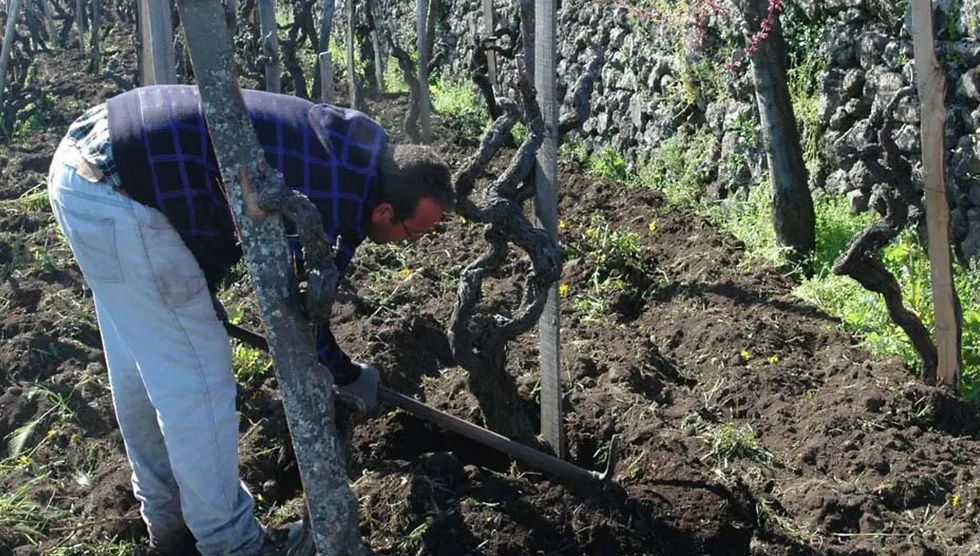
Working the black volcanic soil of the aptly called Tenuta delle Terre Nere
Always wondered why wine was growing on Etna’s slopes. Vineyards are usually found on sandy soil (Bordeaux) or limestone (Burgundy or Chianti). I found it an anomaly that wine grows in a volcanic environment. But upon closer look, the soil around Mount Elena is loose and sandy, not rocky. It drains well and allows grapes to develop deep roots, something they like.

Mount Etna's slopes have been created by hundreds of overlaying Lava Flows
The area around the volcano is also very humid. It rains 5 times as often as in the rest of Sicily. Last but not least, Etna wines grow from 300 – 1’200 meters altitude. The climate is cooler than on Sicily’s shores. It makes wines fresh and crispy with lots of acidity. Also, the temperature difference between day and night is high – grapes love warm evenings and cool mornings. This differential also produces morning fog which gently waters the grapes before the day gets hot.

Whilst Nature has to cede grounds occasionally, fresh Lava fields are reconquered by Nature within a few years
Wines from the Etna are now commonly described as “Burgendy of the Mediterranean”. Due to soil variety and different elevations, Etna wines are as differentiated as wines from Burgundy. There the distance of half a kilometre makes the difference between a Grand Cru and an ordinary – still good though – Cru Bourgois wine. There are 133 different vineyards (Contrade) surrounding Mount Etna in a semi-circle. Etna got its own DOC appellation in 1968 and now attracts wine makers from all over the world. The white wines are known for their mineral, sometimes metallic crispiness. The reds for the light color and the fact that they are drink ready early but still preserve well for several years.

The Etna DOC Area wraps itself around the Volcano
Talking about Mount Etna’s wines in more details will take me beyond the time allocated for this blog. I thus stop for today and describe Etna’s indigenous grapes and its wines in a separate piece another time.


Nice