


J - 28: Miseno holding the Crown for Augustus
- hbanziger
- 2 hours ago
- 5 min read

Misenium in Roman Time 2'000 Years ago - modern Miseno looks still bery much the same
In 49 BC, Julius Caesar built a giant new naval base in Fréjus (Forum Julium). 23 years later, his adopted son Augustus moved the entire fleet to a new base in Misenium (Miseno) near Naples. What happened? What made Caesar's huge investment suddenly so irrelevant? After the move of the fleet, Frejus slowed down, silted and eventually decayed. The old Roman harbour is now a good 1'000 meters inland from today's shore.
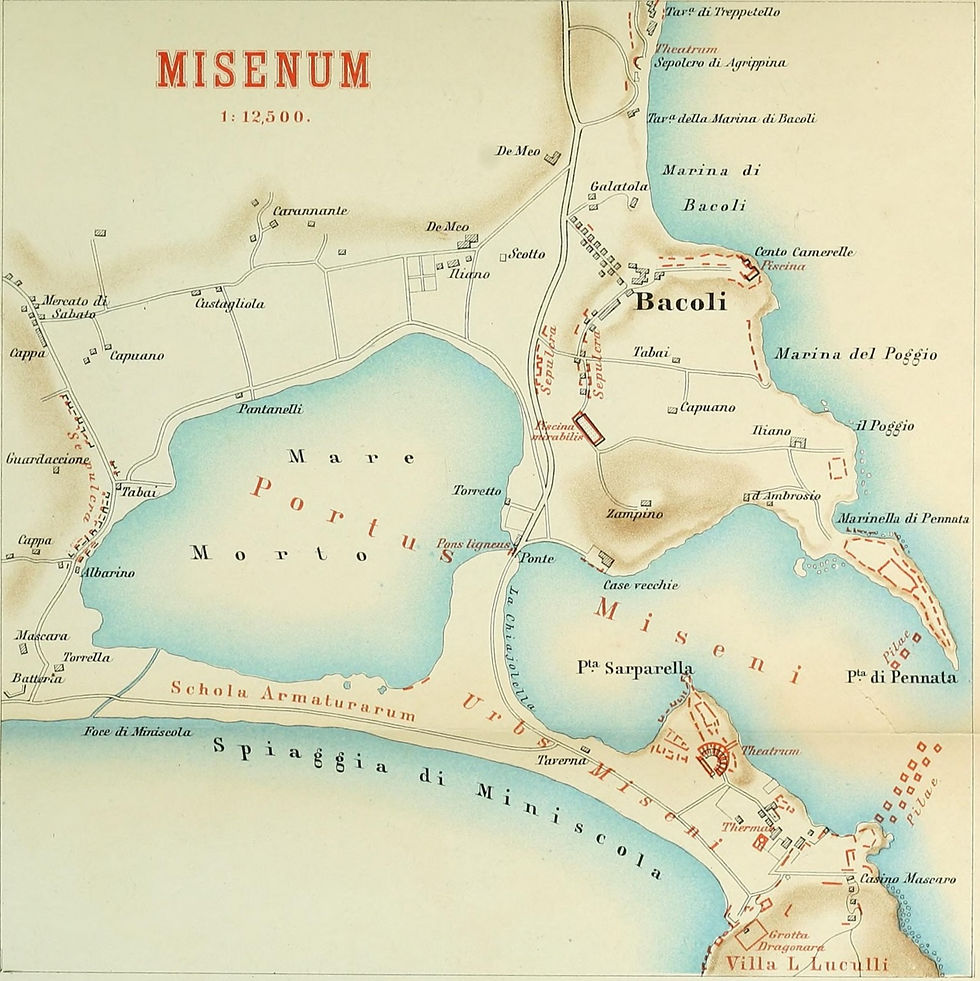
Map with the Remains of Roman Misenium
Ever so often, I stumble upon new history facts. It happens when I forgot to ask the obvious question. Why did Augustus have to build a fleet? Why did he hide it in Lago Averno? Did he not have a navy when he came to power? In 49 BC, is father Julius Caesar had 200 war ships in his base in Fréjus (Forum Julium). Where were these ships? Caesar deliberately built his naval base far out of reach of the Roman Senate, in anticipation of the coming civil war with his arch rival, Pompey the Great. Once Fréjus port was completed in 49 BC, he crossed the Rubico and marched on Rome at the head of his 13th Legion. It was a coup d'Etat. Caesar became Rome's Dictator for life - appointed "in free will" by the Senate. Am sure he brought his fleet to Ostia, Rome's harbour at the mouth of the Tiber river, to impress the Senators further.

Artist Impression of Caesar crossing the Tiber - "alea jacta sunt" - the dice are thrown he famously said. No military commander was allowed to enter Italy with his forces. Caesar broke this rule deliberately
5 years later, on 15 March 44 BC, Caesar was dead. Assassinated by Brutus, Cassius and 21 other Senators. The next round in Rome's civil war started. There was little Caesar's friends and supporters could do immediately. Their opponents controlled every lever of Roman power. Octavian (he adopted the name Augustus as emperor), Marc Antony and Lepidus swore revenge but had to plot carefully and first secure the allegiance of the troops. Within a year, the Roman Legions in Gallia, Spain and North Africa promised their support. Italy was still controlled by the Senate who had its hands on the fleet. The empire's eastern part was under control of Brutus, Cassius and Cleopatra who firmly opposed Caesar's assassins. She had a son with Caesar and had planned of becoming Rome' First Lady.

Control of the Roman Empire after Caesar's assasination in 44 BC
During these chaotic days, the son of Pompey the Great (murdered in 48 BC), captured Sicily and received 50 million Attic drachmas from the Senate for family properties Caesar had confiscated. He also was made Commander-in-Chief of the Roman Navy. Sextus Pompey now had the tools to set his grand strategy in motion:
Build a big, modern fleet with his new wealth and Sicily's tax revenue
Isolate Caesar's friends in the Western Empire
Blockade Italy from grain imports and make the Senate surrender
Take over the Roman Empire as next Dictator

Control of the Roman Empire in 42 BC after Brutus and Cassius' Military Defeat at Philippi
Sextus Pompey did not wait until his fleet was ready but started with daring raids on ships and coastal towns. Whilst Octavian and Marc Anthony had to focus on Brutus and Cassius in the east, he had free hand in the Tyrrhenian. Eventually Brutus and Cassius lost at Philippi in 42 BC and committed suicide. Many of their followers though fled to Sicily to serve under Pompey. Octavian could now direct his attention to the west. Marc Anthony though had to stay with many Legions in Anatolia to face the threat from the Parthian Empire. Sextus Pompey put the 2 years from 44 - 42 BC to good use, further expanding his fleet and consolidating his power over Sicily. His ships now captured grain freighters from Egypt and North Africa. Rome's storage facilities were getting empty. Rome's population worried.

Octavian's 1st Campaign against Sextus Pompey in 38 BC
With no fleet under his command, Octavian was in a tricky situation. He had to do some-thing. Not surprisingly, he lost his first encounter with Sextus Pompey before Messina in 38 BC. His few ships were no match for Sextus Pompey's fleet. Octavian had to return to Naples tail between his legs. In a humilating settlement, the triumvir Octavian, Marc Anthony and Lepidus conceded Sardinia to Sextus Pompey for the promise to lift the grain embargo. Octavian had to buy time to allow his friend and skilled general Agrippa to build a new fleet in the Lago Averno, well shielded from the spying eyes of Pompey's fleet.

````` Agrippa destroyed Sextus Pompey's Fleet in 37/36
By 37/36 BC the fleet was ready. Agrippa challenged Sextus Pompey before Sicily. After a draw at Mylae (Milazzo), Sextus was decisively beaten at Naulochus (Spadafora) at the end of the sailing season in September 36 BC. 300 ships participated in the battle on each side. Innovative Agrippa had equipped his fleet with a new weapon, the Harpax, a grappling hook fired from a ballista. Once caught, an enemy ship could be pilled closer for boarding. Pompey had no defence against the Harpax. His ships were destroyed one by one and set on fire. The last Pompeian resistance against Octavian had collapsed. Sicily was his.

Misenium with its double Bassins was ideally located at the West. Exit of the Gulf of Naples
Augustus never forgot the true lesson of war against Sextus Pompey. Protect Rome's grain supply or be dead! The ships from Egypt and North Africa had to be protected at all cost. In 26 BC, Augustus thus based his western fleet (Classis Misenensis) in Mesenium. From this central position it could sail against any enemy who ventured into the Tyrrhenian Sea. The Classis Misenensis usually had 70 - 100 large ships under sail, ready for any occasion - albeit for the next 200 years there was no war in the Mediterranean thanks to the Pax Romana. Misenium - as Fréjus 23 years earlier - got a Roman theatre, large docks and arsenals, a sophisticated fresh water supply, breakwaters and canals to facilitate port entry and exits. The Classis Misenensis and the naval base in Misenium secured the crown for every Roman emperor starting with Augustus.

Misenium's big Water Reservoir - the Piscina Mirabilis
The Port of Misenium was perfect for Rome's Trireme and Quadremes (max 35 meters long and a draft of less than 1.5 meters). For truly ocean going ships it was too small and shallow though. The port moved during the time of the crusades to Naples which has a deeper and more open harbor. It is still southern Italy's most important port and got a new lease of live from the cruise ships. It is the departure point for many Mediteranean cruises.

Today's Sailboats are not much smaller than the Roman
Warship which once harboured in Mesenium
We will visit Miseno at the end of this year's trip. Since Miseno was almost continuously settled, most Roman ruins are now below modern buildings and only come to light when a house is rebuilt. Still, cannot wait to see it.

Miseno is today a Summer Resort with a long Breach -
it attracts every Year thousands of Holiday Makers


Comments