


J + 3 : Persian - Carthaginian Alliance 480 BC?

Syracuse Yacht Harbour at 07.15 at Sunrise
Clear blue sky but a rather windy morning. Driven by the Mistral, a northerly wind is blowing through the Straits of Messina. It blows at > 20 knots. Waves south of the Straits are now at 1.5 meters. At breakfast, we decide to delay the departure to after lunch. We would get terribly soaked if we leave now. In the afternoon, the wind is supposed to die down. We will use the spare morning for things we have to do anyway. Whilst we do the shopping, the crew washes the deck and the hull. For once, nature dictates the pace. We just follow.

We bought four fresh Sea Breams (Dorada) from the local Fish Monger for tomorrow

Stocked up on Fresh Fruit and Vegetables ...

... and treated ourselves to Oysters & Wine for EUR 3.--
The farmers' market reminded me of ancient Syracuse's enourmous wealth. It was the most powerful city in the Hellenistic world. When Greece was threatened by the Persian invasion in 481 BC, Athens sent ambassadors to Syracuse to ask for assistance. The Athenians were well aware of Syracuse's military strength. So were the Persians. Legend has it that Gelon offered his army and fleet but asked in return for being appointed Supreme Commander of all Greek forces. Of course, Athens and Sparta declined. So nobody from Sicily fought at Marathon or Salamis.

Gelon (540 - 478 BC), the powerful Ruler of Syracuse
Have my serious doubts though whether this version of history is correct. Tyre, Carthage's levantine parent town, became a Persian vassal in the 6th century. Every year it was obliged to pay significant tributes to the Achaemenids (Persia's ruling dynasty). Much was financed by Carthage. Also, Carthage maintained religious ties with its parent. Large delegations of priests and nobles attended the annual Bal festivities. Through their spies, the Persian rulers knew pretty much everything that could be known about Tyre's former colony. So did the Carthaginians about Persia. They must have known of Xerxes' preparation for an invasion of Greece. Tyre built hundreds of freighters and triremes for Xerxes' 1'000 ship fleet.
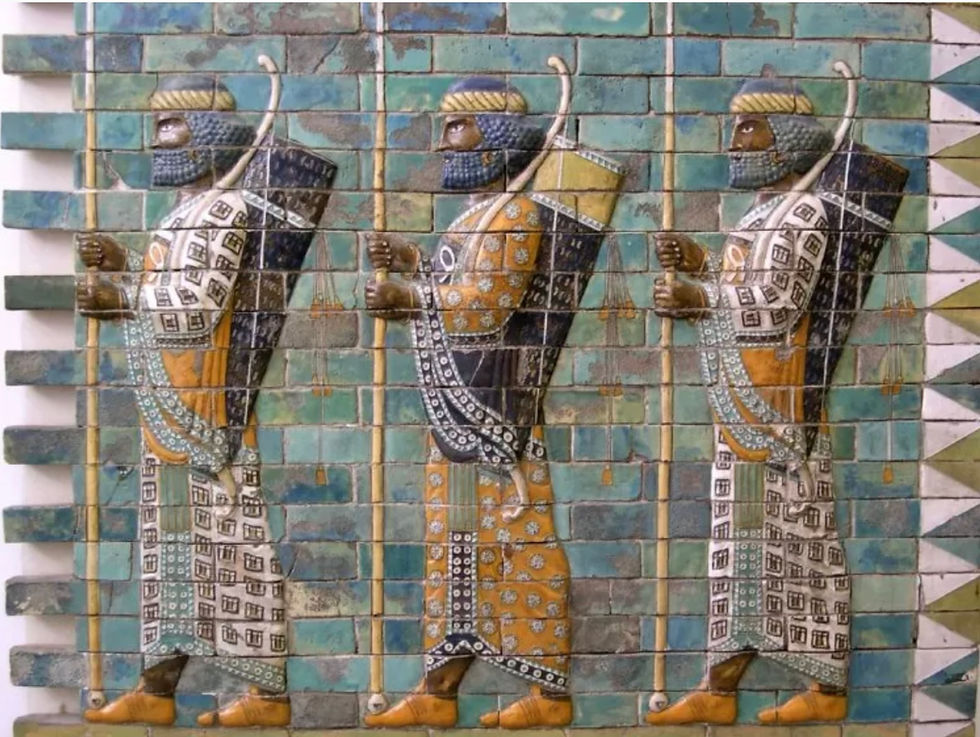
Persian Archers from Darius' Palace in Susa
It took Xerxes, the Persian King of Kings, three years to prepare for his planned invasion and assemble his 1'000 ships and 300'000 troops. Hamilcar, the ruler of Carthage, invaded Sicily in 480 BC with a force of 200 ships and 50'000 soldiers. His preparations for the invasion must have taken a similar amount of time. Carthage had much less men power available. Persia knew that Carthage planned an invasion. Carthage knew that Persia planned an invasion. Whether they actually coordinated the details of their campaigns or just jumped on the opportunity does not matter. If both attacked Greek territories at the same time, the Greek would loose the advantage of the inner line. Neither Syracuse nor Athens-Sparta could afford sending re-inforcements when their own homeland was under attack.

Persian Empire (green) and the Carthaginian Empire were linked through Tyre, the Parent town in the Levant which was a Vassal of the Persians.
That the Battle of Himera and the Battle of Salamis took place on the same day is not proof of my thesis. It was an accident. Planning so precisely over thousands of miles distance was impossible in antiquity. Neither the Persians nor the Carthaginians had Starlink. But that two of the Mediterranean's super powers prepared over three years thousands of troops and hundreds of ships for an invasion cannot be a coincident. We have seen in a previous blog that 60 years earlier, the Etruscans and Carthaginians forged an alliance to limit Greek expansion into he western Mediterranean. If Geopolitical alliances made sense in 540 BC, why would they not make sense in 480 BC?

The Greek World in 430 BC was threatened by Carthage from the West and the Persian Empire from the East. Magna Graecia was the richer part of the Greek World.
Because there is no written evidence, most scholars disagree with my view. In 146 BC, Rome burnt Carthage to the ground - and with it its library. There is no Punic source material we could consult. But we do not always need documentary proof for knowing that something is true. Also, the often quoted counter-fact that the Persian King Cambyses II planned to conquer Carthage in 525 BC is no argument. After his conquest of Egypt he wanted to use the Phoenician fleet (Tyre et al) to push further west. But the mariners of Tyre refused to sail against their own. The plan was ditched. Controlling Carthage through tributes was a more successful and less costly strategy. So let's say. One day we may find a "Rosetta Stone" that proves that my thoughts were more than just another "conspiracy theory".

By 3 pm, it was time to say Goodbye to Syracuse
Am continuing my blog after our lunch break. The wind slowed down as expected at 3 pm - in a few minutes we will lift anchor and sail towards Catania. It may be a bit rocky since the waves are still relatively high. But it could be fun with a bit of spray over the deck. ETA in Catania is between 7 and 9 pm.

By 19.15 h, just at Sunset, we arrived in Catania. The Mount Etna to the right. The Sea was far flatter as expected and everybody enjoyed the Cruise with full Sails. It took 4 hours only.


Comments