


J - 34 : Ferragosto - Why Italy closes in August
Every August, the shores of the Tyrrhenain and Adriatic sea are a place of joy and happiness. Whilst the country's biggest towns like Milan and Rome are largely shut down and taken over by international tourists, Italy's population moves to the sea and the mountains. Business comes to a stand still. An estimated 90% close for August. There are no workers on construction sites. The pace of industrial production slows to a trickle. With the exception of fashion and food, most shops don't open. Italy in August looks like being in a beauty sleep.

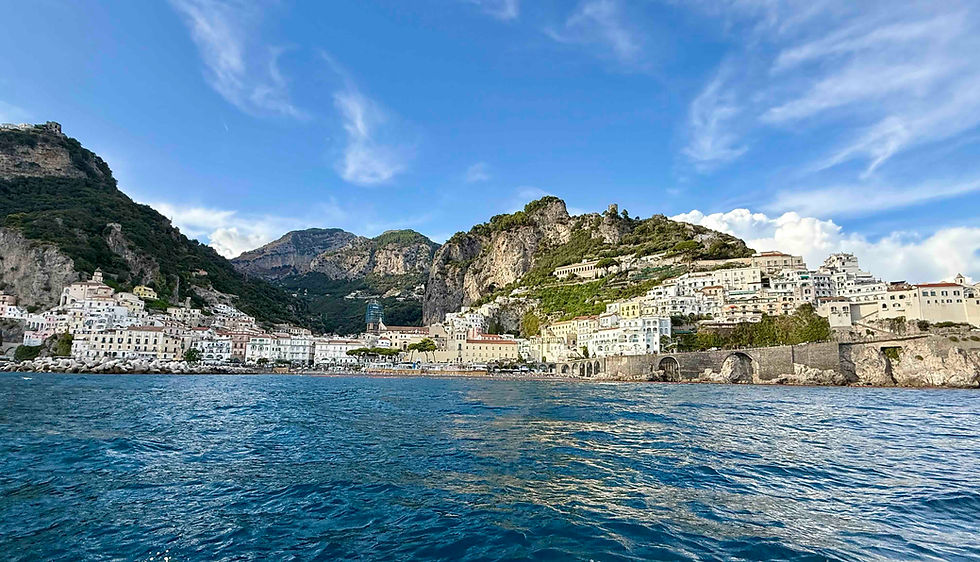
The Island of Ischia with the Castello Aragonese is a prime Ferragosto destination
It is not the only country in the world that slows down in summer. Many actually do. People look forwared to a few weeks of holiday to indulge in "dolce far niente". But Italy is the only one with a specific term for its summer break: Ferragosto. The word goes back to Roman time and derives from "Feriae Augusti" - Augustus' holiday. He decreed in 18 BC a month of feasts and celebrations which started on 1st of August with a feast to celebrate his own rule and ended on 25th of August with an exclusive party for Opis, the Roman goddess of fertility. Apparently only the Vestal Virgins and the Pontifex Maximus, Rome's supreme priest (= Augustus himself) were allowed to participate. You can guess what this was.

The Six Vestal Virgins were Rome's Highest Priestesses. Their Duty was to maintain Rome's eternal Fire which protected the Town. They served for 30 years - 10 Years of Learning, 10 Years of Working, 10 Years of Teaching the next Generation. They were not allowed to marry
The "Feriae Augusti" must have older roots though. On 5 August, there was a festival for Salus, the goddess of health, on the 13th of August a party for Diana, the goddess of hunt and several more for local deities. What these events have in common is the celebration of fertility, harvest and childbirth. It was a way to thank mother Earth for another harvest which allowed people to survive the coming winter. We know these types of thanks giving parties from all over Europe (and now also in America). The combination of feast and religious ceremony survives to this day, albeit female fertility goddesses are replaced by local saints. Traditions have a long lifetime.

Das Erntedankfest (Harvest Thanksgiving) is celebrated every October in Catholic Germany
It would not have survive though without the help of the church. For me, the Catholic Church is the ultimate successor of the Roman Empire. The cardinals elect the Pope. The Pope appoints cardinals. The Roman senators elected the emperor. The emperor appointed the senators. It is not by accident that cardinals dress in the same purple as senators. Nor is it an accident that Roman districts (diocese) became Catholic diaceses. And it is also no coincident that the Pope calls himself Pontifex Maximus as did all Roman emperors.

Catholic Cardinals wear the same purple that Roman Emperors and Senators wore
As Christianity started to replace Rome's pagan believes under Emperor Constantine, it had to be careful. The Romans loved their month of holiday after their ardeous field work. These feasts were one of the few occasions when ordinary citizens had meat to eat. The meat from the sacrificed animals was distributed to everybody who attended the ceremony. They were thus very popular. The church moved the starting day of the "Feriae Augusti" to 15th of August to have it coincide with the Assumption of the Virgin Mary. Fun detail, Ferragosto continued to be an event that celebrated female fertility.

The Assumption of Mary is the Believe that Virgin Mary
was taken up Body and Soul into heavenly Glory at the
End of her Life
As Italy industrialized in the 19th century, Ferragosto became less relevant. Industrial production is not seasonal but continuous. Also, workers living in big towns have different values than their cousins in the countryside. Ferragosto got a new lease of life from Italian dictator Mussolini. Italy's fascite regime (1922 - 1943) introduced several "Dopolavoro" laws to give Italians their first holiday. Mussolini's deeper motivation though was anything but altruistic. "Dopolavoro" was a deliberate move to buy people's support. His regime created the subsidised "Treni Popolari Ferragosto". For little money people could reach their holiday destination in the month of August. During the 20 years of Mussolini's rule, the idea that Holiday and August are synonyms was hardwired into Italian culture. It has not changed since even though the subsidies are gone and memories of the fascist regime fade.

View from the Island of Lipari, another Ferragosto destination, to Santa Maria Salina
Our sailing this summer is at the tailend of Ferragosto. But am sure we will still see plenty of Ferragostoni on our way to Pozzuoli.


Comments