


J - 41 : Ndrangheta - Another French Legacy ?
- hbanziger
- 3 days ago
- 6 min read

Castello di Fiuzzi with the Isola di Dino on the Tyrrhenian Shores of Calabria
Calabria is known for many things. The beautiful beaches. The pictoresque villages. The steep mountains. The high frequency of earthquakes (see later blog). Its upcoming and promising wines (also covered in a later blog). And the Ndrangheta, its Mafia.

View from the Castello Longobardo Normanno di Malvito towards Calabria's Mountains
According to Wikipedia, the Ndrangheta is today a highly sophisticated crime syndicate with operations around the globe. It is said to have 60'000 members organised in 300 clans and to be so powerful that the Columbian drug lords have to accept its terms of business. For centuries, Calabria's Ndrangheta lived in the shadow of Sicily's Mafia, its cousin. The public did not take note before the 1970s. The Ndrangheta (there is no undisputed exlanation for the name). was always involved in smuggling tabaco and other high value items. This century old expertise predestined it in the 1980s to take the lead in the European cocaine trade and recently in trafficking African migrants from Libya to Italy.

Sanne de Boer, a Dutch Author, lived in 2006 for several months
in Calabria. Her 2024 book is a good intro into the subject
There is little literature on the origins of the Ndrangheta. Most historians agree that it was present in Calabria since the early 19th century. But why? Organisations do not pop up from nowhere. Something must have triggered people to come together, unite and organise.

The Third Coalition (red) allied against Napoleon's France (blue) in 1805
In my view, it was the French Invasion of 1806. The King of Sicily had to flee from his palace in Naples to Palermo. Thanks to the Royal Navy, he and his court made it. His Kingdom was invaded and occupied though. Sicily was part of the 3rd coalition against France. Despite numerical superiority, the coalition was defeated. In 1805, Austria and Russia lost in Austerlitz. In 1806, Prussia was routed at Jena and Auerstedt. But Napoleon failed to submit England. On the 21st October 1805, at Trafalgar, close to Spain's south coast, Admiral Nelson destroyed the combined French - Spanish Fleet and with it Napoleon's dream of invading England.
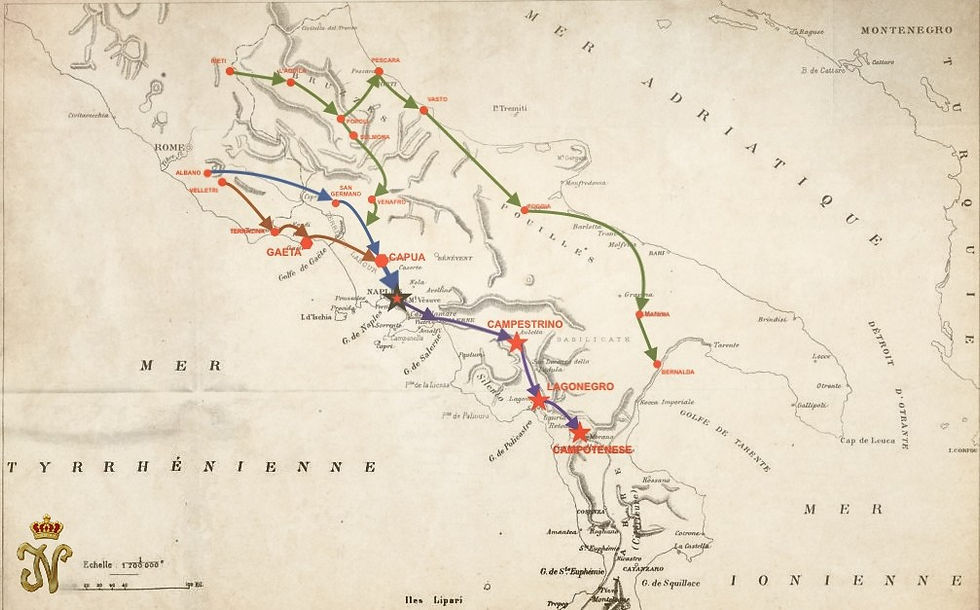
Marechal Massena invaded the Kingdom of Naples in 1806 with 65'000 troops
Once Europe's heavy gorillas were subdued, Napoleon shifted his focus on Sothern Europe. He instructed Marechal Massena, the bad ass who had conquered my home country only 8 years earlier, to invade. The invasion started early 1806 - but progress was slow. It took months to conquer the fortress of Gaeta north of Naples. The advance to the south took time too. Massena's army lived from the field. It had no train. His 65'000 soldiers consumed Italy's summer harvest - leaving the peasants nothing for the winter except certain famine.

Despite the British Victory at the Battle of Maida in 1806, the war was lost. British Forces had to withdrew over the Straits of Messina to Sicily.
Within weeks, the peasants rebelled. French retaliation was brutal. Men were summarily executed, villages burnt down for alleged attacks, women raped. The regular Neapolitan forces were crushed by the fall of 1806, but Europe's first guerrilla had just started. Marechal Massena never achieved his goal of evicting the British from Sicily. Without ships, his troops could not cross the Straits of Messina. Lord Nelson had sent them to the bottom of the Atlantic the year before. Sicily - like England - stayed out of Napoleon's reach.

Marechal Massena (1758 - 1817) was one of Napoleon's
most reliable and successful Generals
The war could have ended in 1806. But the brutality of French rule revived it. The retaliation agains villages and towns was on a level not seen before. In was a precourser to the events unfolding in Spain two years later. Napoleon appointed his brother Joseph Bonaparte as King of Naples and imposed a system of centralised rule. From his new kingdom the French Emperor expected tax revenues and soldiers for his never ending wars. For centuries though, Calabria was ruled locally. The presence of the Kings in far-away Naples was light, the taxes acceptable and no men were recruited. Calabria gave the Bourbon Kings what it could. But its topography made agriculture challenging. People lived from fishing and trading. None of its towns were large. Centuries of Ottoman raids had depopulated the coastal regions. In other words, Calabria was poor.

Joseph Bonaparte, Napoleon's older Brother, ruled
the Kingdom of Naples 1806 - 1808 and the Kingdom
of Spain 1808 - 1813. He retired as Comte de Survilliers
to Bordentown in New Jersey, USA
Joseph Bonaparte's confiscatory tax policy and mandatory recruitment were thus highly unpopular. He boasted that he doubled tax revenue in his two years of reign. Wonder who actually paid. The guerrilla attacked his tax inspectors with wooden sticks first. Later they besieged isolated French garrisons and took over the country side. Attacks on smaller towns followed. By 1807, Calabria was in open rebellion and fought Europe's first guerrilla war. In most modern textbook, this credit goes to Spain, which rose in 1808, following a bloody massacre in Madrid. Calabria was first. For people living in Calabria, the war was horrific. The scenes Goya painted from 1810 - 1814 in Spain could have been from Calabria.

Goya drew many vivid Scenes from civilian Resistance against French Forces from 1810 - 1813. His Drawings were only released in 1865.
The unfinished campaign for Sicily fuelled the guerrilla war in Calabria. Great Britain did not have enough troops to send an expeditionary force across the Straits of Messina to roll back the French - as they did under Wellington in Spain. But the British Empire supported the Calabrian resistance with money und weapons. Calabria's long und unprotected coast was ideal for sending ships at night. France had no naval assets to guard these shores. To stay in the fight for so many years (1806 - 1814), Calabrians need lots of money. They had to feed their people and run the local government wherever they had expelled the French.

Also from Goya, No Quieren - A French Soldiers trying
to rape a Spanish Woman before being stabbed
On 21 November 1806, Napoleon did them an unintended favour. He declared the Continental Blockade. No British goods were to be sold in Europe nor was any British person allowed to buy anything on the continent. Jackpot for Calabria's resistance! Within months, Calabria became one of the main contrabande routes into Europes - the others being Spain, the Austrian-Ottoman border and Sweden. The Calabrian guerrilla already smuggled British rifles. They happily added tea, tabaco, coffee, chocolate, sugar and cotton to the smuggling list - all goods difficult to obtain in Europe. Calabria established its smuggling tradition to finance their fight against the French occupiers.

The European States adhering to the Continental
Blockade are shown in green
When France was eventully kicked out in 1814, Calabrians kept their smuggling business. The reinstated old monarchy kept taxes high - after the war and the exile, the Kings of Both Sicilies needed money too. So did the new Italian Kingdom established in 1860. Both had a light local presence. The organisational structures developed during the resistance remained in place. The smuggling was often Calabria's only source of cash. Over time, these structures morphed into the Ndrangheta as we know it. Fairly decentralised, little hierarchy, bound by common purpose and often transactional, the Ndrangheta was and is fairly resilient - almost impossible to destroy. You cut a head, a new one pops up. Given that large parts of Calabria's GDP come from the informal sector (= untaxed), the local heads of the Ndrangheta are often the true authorities in their villages and small towns.

The provincial Town of Cosenza fought hard against the French Occupiers - it was the Site of many War Crimes against Civilians - there was no Geneva Convention yet in 1806
Following Calabria's Tyrrhennian coast this summer and making occasional expeditions to visit castles, churches and temples inland, we will only see idyllic scenery. The Ndrangheta is hidden and deeply embedded in Calabria's social fabric. As France could not discover it 200 years ago, neither will we. But it is there.


Comments