


J - 140 : Nelson and Bronte
Updated: Apr 12

Horatio Nelson (1758 - 1805) portraited in 1799
As someone with a keen interest in military history, I know quite a bit about Horatio Nelson. The British Admiral defeated Napoleon’s joint French - Spanish Fleet at Trafalgar in 1805 which prevented the invasion of England. One of London’s largest squares is named after his triumph. His column stands tall in the middle of Trafalgar Square. An uncounted number of English pubs carry Nelson's name. His victory paved the way for a century of British supremacy at sea. “Britannia ruled the waves”. Nelson also won the Battle of the Nile in 1798 which finished Napoleon’s fantasy of conquering India, Great Britain's richest colony (formally India was owned by the British East India Company).

Often, Nelson signed his personal documents with “Nelson & Bronte”, something I knew about but never paid attention to. There are many English families with complicated names. Had I not looked up ports in Sicily which the Royal Navy used 1806 - 1815, I would not have learnt that Bronte is the name of an Estate in Sicily. Together with the former Abbey of Santa Maria di Maniace, it was a dukedom or duchy. The Abbey became a Castello.

Nelson Obelisk erected in 1905 in Memory of the Battle of Trafalgar - Mt Etna at the back
Nelson was given the Duchy of Bronte in October 1799 by King Ferdinand IV of Sicily as a reward for helping the Royal family escaping from Naples and preventing the French from crossing the Straits of Messina. Nelson’s actions allowed the King of Naples to hang on to half his territory (=Sicily) and to continue governing. He resided in the medieval Palazzo dei Normani, Palermo’s old Royal Palace. The Bronte and Maniace estate is situated 15 km to the West of Mount Etna. Nelson’s property stayed in his family until 1981. Later, it was known as Duchy of Nelson, but this was never an official title.
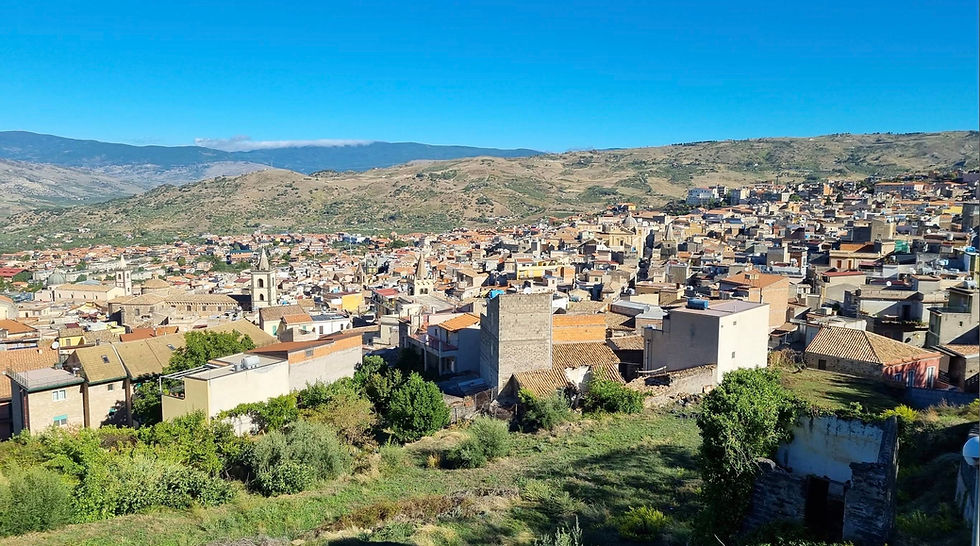
The Sicilian Town of Bronte - Nelson's Estate is about 5 km to the North
For us today, it is difficult to understand how an admiral of the Royal Navy can become a Sicilian Duke. Let’s look back to 1797, the year France invaded Italy. Under Napoleon, the French quickly conquered Milan and Venice. kicked out the ruling nobles and established the Cisalpine Republic. Two years later, a French Army under Macdonald occupied Rome and marched on Naples. A young English Captain, Horatio Nelson, was ordered to evacuate the ruling Bourbon family from Naples and bring them safely to Palermo. Nelson sailed his HMS Agamemnon into Naples' port when shots were fired. He calmly embarked the royals and sailed them to Sicily. The French had no ships to pursue him. Nor did they have a navy capable of launching an invasion of Sicily. The royal family was safe.

The Land Campaign in 1798 with the temporary retreat of the French from Italy
The so called “War of the Second Coalition” between revolutionary France and Great Britain, Russia and Austria ended with the Peace of Amiens in 1802. The war was a draw. The peace treaty ceded the left bank of the Rhein to France and accepted the status quo of the Batavian Republic (French occupied Netherlands), the Helvetic Republic (French occupied Switzerland) and the Cisalpine Republic (French occupied Northern Italy). France had to withdraw its troops from the Papal State and the Kingdom of Naples though.

Europe in 1802 after the "uneasy" Peace of Amiens - Naples and Sicily are free again
The Peace of Amiens was an uneasy peace – from today’s perspective nothing else than a short cease-fire. The war of the 3rd Coalition broke out in 1803 and would end in 1806 with the defeat of Austria at Austerlitz and Prussia at Jena. The French occupied Southern Italy and Rome again. Their navy though was still not strong enough to support an invasion of the island even though it was one of Napoleon's pet projects. The Royal Navy remained an insurmountable obstacle.

The Castello Nelson, the former Abbey of Santa Maria di Maniace, is now a Museum
Nelson never lived on his estate. Whilst he invested considerable amounts of money to restore and convert it, his duties as naval officer took him away. With his ships he had to blockade the port of Naples and help with the invasion of Malta in 1800. The small island would become Great Britain’s main naval base in the Mediterranean. After Malta, Nelson did not stay much longer in the Mediterranean. He served in these waters since 1793. He had to return to England. In 1801, the Royal Navy assigned him to the Channel Fleet as Deputy Commanding Officer. He participated in the Battle of Copenhagen.
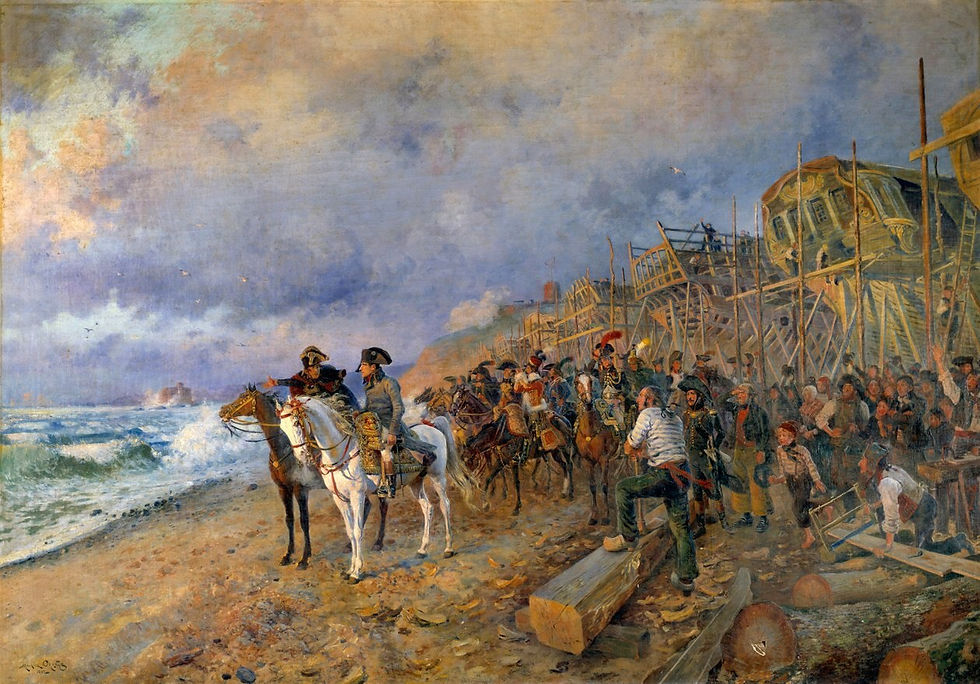
Napoleon inspecting the Preparation for the Invasion of England in 1804 in Boulogne
In 1803, after a year-long break in the UK, he returned to the Mediterranean as Commander-in-Chief. His next two years were busy. His main duty was to prevent the French and Spanish Fleets from combining to protect Napoleon’s planned invasion of England. It took Nelson more than a year to bring the Franco-Spanish Fleet to battle. He had to pursue it to the West Indies and back. In 1805 he trapped them at Trafalgar on the Spanish south coast. It was one of the most decisive sea battles in world history. Nelson won but paid for it with his life. The Franco-Spanish fleet was destroyed. Napoleon had to cancel his invasion. Nelson had never seen his estate during these two years.

Castello di Maniace in 1885 - the Bridge in the Foreground was built by the Nelsons
He left the estate to his brother who never set foot on it either. Only the 3rd generation of the Nelson’s family started living there. They looked after his memory and estate but were not so popular. People did not forget that Nelson had sided with the Bourbon King against one of their revolutionary leaders and hanged him. During the Mussolini years, a few fascists occupied the estate to convert it in remembrance of Sicilian patriots killed by Ferdinand IV. The Allied invasion in 1943 interrupted these plans. The estate was returned to the Nelson family. In 1981 they sold it to the Council of Bronte who converted it into a museum.

Coat of Arms of the Dukes of Bronte


Comments