


J - 91 : Why Eisenhower set-up NATO's Southern Command in Naples?
- hbanziger
- May 30
- 4 min read

The US 6th Fleet during a Visit in Istanbul in March 1950. Visible is an Iowa Class Battleship, the Aircraft Carrier USS Midway and several Destroyers
As an active officer during the Cold War, I always knew that NATO's Southern Command was located in Naples. Though I never visited and never bothered to ask why it was situated there. The threat by the Red Fleet was understood after 1973's Yom Kippur War between Israel on the one side and Egypt and Syria on the other. As officers, we all knew that there would be plenty of fighting in the Mediterranean if the Cold War ever turned hot.
AFSOUTH (Allied Forces Southern Europe) was established in January 1951, only one months after General Dwight D. Eisenhower was made SACEUR (Supreme Allied Commander Europe), NATO's commander in Europe. NATO was established in August 1949 to defend Western Europe against Stalin's totalitarian, communist rule.

This Map of NATO (North Atlantic Treaty Organisation) must have been printed before 1955 since the Warsaw Pact (established 1955) is not mentioned - also Algeria, then a Colony of France, is shown as Part of NATO. It left - obviously - in 1962 when becoming independent.
Why was there a need for a Southern NATO command in 1950? In 1948, the Communist partisans in Greece were defeated, Marshal Tito, the ruler of Yugoslavia, had broken with Stalin, there were negotiations with Greece and Turkey to join NATO (both did in 1952), Egypt was a dominion of Great Britain, Lybia a western-friendly kingdom and Tunesia, Algeria and Morocco French colonies. There were only a few Red Fleet submarines operating in the Mediterranean. Still, the creation of a unified command for Southern Europe was one of Eisenhower's first big decisions.

General Eisenhower and Staffers presenting the new Flag of his European Headquarter just outside of Paris in October 1951 - it reads "Vigilance is the Price for Liberty" - a year later, on 4 November 1952 he was elected as the 34th US President
Eisenhower was privy to top secret CIA reports on Stalin's massive fleet building program. By 1950, the Soviet Navy had about 300 - 350 deployable ships, of which 250 were diesel powered submarines. It was already the world's second largest navy but no real threat (yet) to the US and Royal Navy. But the conquest of Germany's Baltic coast and industrial centers in Berlin, Slesia and Czechia gave the USSR access to technology, blue prints and machine tools they never had before. The Red Army requisitioned everything and shipped it home. Only a few remember that Hitler's unfinished Aircraft Carrier "Graf Zeppelin" was towed to Leningrad to serve as school ship and master copy for future carriers. Other examples include the rocket technology the Soviets used to build their first ballistic and air defence missiles, the jet engines which powered the MIG-15 (a famous fighter over Korea) and the sophisticated submarines Russia was developing.

The unfinished German Aircraft Carrier "Graf Zeppelin". Its Completion was suspended in 1942 when the German Kriegsmarine was focussing on building new Submarines.
The shipyards destroyed in World War II were rebuilt with modern German machine tools. Many new ones were set up, specifically on the Black Sea Coast where access to Ukraine's iron and coal was easy. Cities like Odessa and Mariupol became major ship building centers - they still are - that is why they are fought over in the Ukraine War today.
With his blue water navy with 1'200 submarines, 4 large aircraft carriers (>35'000 tons) and a dozen major battle ships (>40'000 tons each), Stalin wanted to be able to challenge the US dominance of the seas. Never did he want the Soviet Union to be blockaded like Germany and Japan during World War II. All this was done under a shroud of total secrecy - one of the reasons Eisenhower pushed for the U2 high altitude surveillance program to find out what the Soviets were up to. It was not easy in the time before satellites.

The Red Fleet's Battleship Novorossiysk blew up in the morning hours on 29 October 1955 and went to the bottom of the sea with many of her crew.
The explosion of the Novorossiysk in Sebastopol in 1955 though ended these dreams. The Soviet leadership realised that the building of a blue water navy to take on the US Navy head on was more complex and expensive than anticipated. After a review led by Stalin's successor Chrustchev, the Soviet leadership concluded that they could achieve their goals by focusing on nuclear submarines and guided missile cruisers instead. Still, Stalin came quite close with his massive building program. Few in the west realised that the Soviet Union built more ships from 1945 to 1951 than all other nations of the world combined.
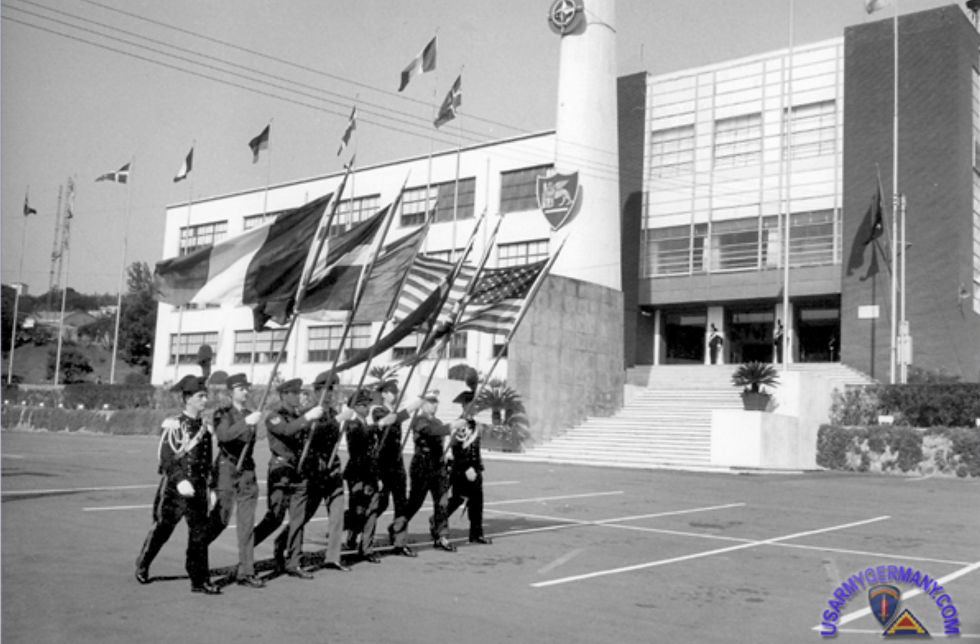
Flag Parade at the AFSouth located in the Bagnoli District of Naples. The building served the Italian Navy (Regia Marina) until 1942. Built in classical Fascist Style it was situated on the north of the Neapolitanean suburb Bagnoli overlooking the Sea and the steelmill Ilva.
Eisenhower's decision to build a Southern Command structure was thus a response to Stalin's massive ship building program. The same can be said for the efforts of the Truman (33rd US President) administration to bring Greece and Turkey into the NARO alliance. This diplomatic coup closed both the Straits of the Bosporus and the Dardanelles to the Red Fleet. It made any crossing a challenging if not futile endeavour as we know from the Gallipoli campaign in 1915. After 1952, AFSOUTH built additional secondary command centers in Izmir (Turkey) and Malta.

In 2004, the Headquarter moved to Lago Patria, about 13 kilometers north of Lago d'Averno
In 2004, the NATO's AFSOUTH outgrew its location at the old Mussolini facility and moved further away from Naples. , Still, it is easily recognisable by its large satelite dishes. The new HQ played an important role in the Balkan Wars when Yugoslavia fell apart. It is also a major coordination center in the current turmoil in the Middle East.


Comments