


J - 89 : ILVA Steel Mill - EU Policy Disaster
Looking out to the island of Ischia, located right between scenic Pozzuoli and vibrant Naples, there is a big empty plot of deserted industrial land - the old Ivla Steel Mill of Bagnoli. Closed in 2020, after decades of failed rescue attempts, the mill was closed, the workers sent home and most of the buildings dismantled. From the air, the space looks like a big dental gap - and probably is. The mill that employed once thousands is now guarded by a few security guards. The former employees had to look for new jobs. Few found work. Most ended up in permanent unemployment.

AI generated Image from Google Maps. To the left the Island of Nisida, then Ischia Island at the Horizon with the old Roman Port of Miseno in front.
The Bagnoli Steel Plant was set up in 1905 and was part of the Italian Government's effort to use Elba's plentiful iron ore deposits - we talked about Etruscan iron smelting a few blogs ago. Financed by Genovese capital, ILVA S.p.A. was set up with 20 million Lira of capital (= CHF 20 m at the time). The Bagnoli site was chosen to take advantage of government development schemes for Southern Italy (1904) and the locations easy access to the sea. It allowed coal ships to dock directly at the site. Italy had no coal and needed to import it. During its first decade and World War I, the mill did well. Demand was high for construction, railways, guns and shells. The depression after the war and the "Red Scare", a communist uprising in Italy's industrial centers in 1919 and 1920 put ILVA almost into bankruptcy. Banca Commerciale Italiana had to take it over.
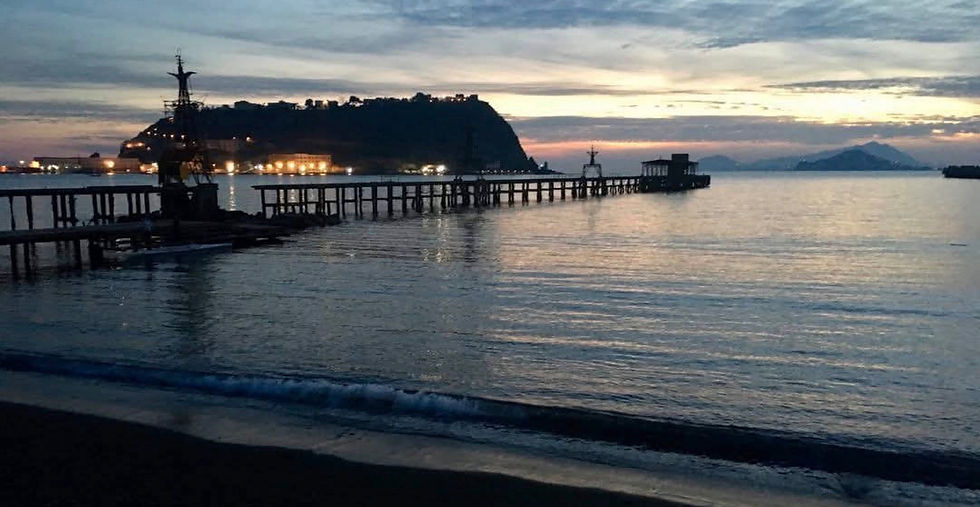
The now deserted ILVA Piers where once Coal Ships docked Day and Night
ILVA managed to stay afloat in the 1920s but did not survive the Great Depression. By 1933 it was bankrupt. To rescue Italy's dying industries, Mussolini set up the "Instituto per la Riconstruzione Industriale", or short "IRI" in 1933. I remember doing derivatives transactions with them in London in 1992. Within a few months, IRI controlled three quarters of Italy's industrial giants. Only in Communist Russia did the state controlled more. But IRI was a typical nationalisation. It was more a bail-out with capital cuts, fresh capital injections and the wipe-out of existing debts. The financial restructuring and the re-armament in the years before World War II put ILVA on an ok footing again. IRI was the majority shareholder and merged ILVA into Finsider, its holding company for steel, but it interfered only rarely in management decisions .

ILVA's operation at night - the Photo was taken in the Mid 1950s though
As to be expected, World War II was not good for ILVA. The site was bombed. The collapse of the Italian economy after the war was worse. But IRI's President, Oscar Sinigaglia, convinced the USA to give him Marshal Plan funds to rebuild the factory. Europe's reconstruction after 1950 made European steel mills boom. The times were good. Almost too good. They would not last though. The post-war reconstruction boom ended in the 1970s. The European had used the 20 boom years to chase their dream of an intergrated European Steel Market. Custom duties were abolished, production standards introduced, "unfair" competition and discriminatory practices abolished. Whilst Europe standardized, Japan, Brazil, India and Korea innovated. By 1975, a Japanese worker took 7.5 hours to produce one ton of steel. His European counterpart needed 15 hours.

ILVA today with the one and only surviving large Building
The oil shock in 1973 rang the bell for ILVA's final chapter. Europe's markets for steel had matured, the demand dropped. Consumers asked for smaller and lighter cars to save fuel. Post-war Europe was built. In Emerging Markets, ILVA had lost its competitiveness. The young nations preferred cheaper steel from Japan or Brazil. The protection of the European Coal and Steel Community stopped at Europe's borders. The erroneous believe that markets could be guided (a believe widely held in Italy, France and England), seduced European producers to build excess capacity like the giant new ILVA mill in Taranto in 1960 (we visited in 2021). This dream died in the oil shock. Lack of demand, overcapacity, outdated technology, new competitors, unaffordable energy prices and political meddling with plant closure produced a deadly cocktail for Europe's steel industry. IRI was dissolved in 2002, the components sold off to the best bidder.

Most of the former Plant Site is now overgrown with Bushes and Grass
But despite billions of subsidies and many restructurings, Europe's steel industry could not be rescued. The gap between world and European production cost was too big. The doors of the once proud factory, a beacon for Italy's industrial development, closed in 1991. Since then, many regeneration projects have been proposed and discussed - little progress was made though. The site is idle for now three decades.

The Italian Government tries to revitalise the old ILVA site with limited success.
What is amazing is how little this story is known and how little the European Union learned. Whilst the world innovates, Brussels regulates. This play is currently on show for Banking, the Automotive and the Energy Industry. America's GDP stands today at USD 31.8tr. Europe with 100 million more people at 23.0tr. In 2007, during the Great Financial Crisis, the numbers were comparable - the US at 13.8tr - the EU at USD 12.7tr respectively. The EU growth policy cost European citizens USD 8.8tr or USD 19'500 per person, Time to say stop to Brussels policy of industrial decline and bring back the spirit of innovation and the forces of markets. Otherwise all of Europe will soon look like the former ILVA steel mill.

A quiet Sunset over the once busy ILVA Steel Mill.


Comments