


J + 5 : Were Greek Settlers welcome in Sicily?
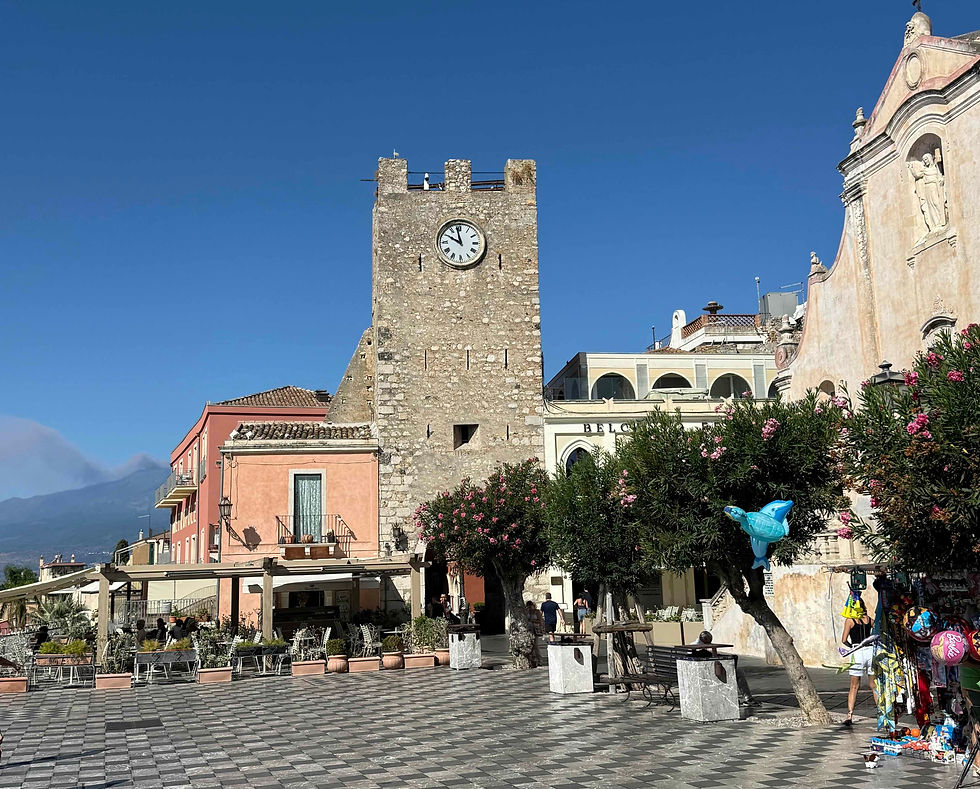
Taormina's Clock Tower is a time less Symbol of the Towns 2'400 Years - with an equally time less Mount Etna at the back
After a good night's sleep on the open waters south of Taormina, protected from swells by an invisible underwater ridge, we got up early this morning. The goal was to beat the Cruise Boat crowd. Coming from Messina and Catania, they arrive by coach at around 11 am. If we managed to get to Taormina by 9 am, we'd have the charming town for 2 hours to ourselves. And so we did.

The Steet is so clean, you could eat a meal on the pavement
Taormina is always worth a visit. Founded by Greek people in 396 BC in response to the continued military harassment by Syracuse, the powerful Greek colony further south, the new town in the hills was easy to defend. Romans loved it too and built pleasure villas there. It was perfectly located to beat back Arab raids and Ottoman attacks a thousand years later. The hills of Taormina are continuously settled for 2'400 years.

Taormina as seen from our Tender when we departed from "My Lotty" at 08.45 am
When we arrived at 9 am, street wipers removed a few cigarette buts from last night. Trash cans were emptied. Coffee shops slowly opened. There were no hotel guests out yet. Sales ladies made their way to their luxury boutiques on the main road. Iron shutters were pushed up. Toarmina opened for the day. Squeaky clean as always.

Opposite Taormina lies Naxos, Sicily's oldest Greek Colony, established in 734 BC by Greeks from Naxos and Chalcis, one year earlier than Syracuse, six years after Cumae was founded. Ancient Naxos in located in the green archeologic park and largely un-excavated.
After lunch, we took our tender to Naxos, the oldest Greek settlement on Sicily. It was 10 min accross the bay. Approaching Naxos, I wondered how the locals welcomed the Greek when they arrived in 734 BC. I guess they came in two or three boats, 50 men each. There were usually no women travelling in the first wave. The colony was an instant success. New settlers from Greece joined within a year. Only 4 years later Naxos spun-off a new colony in Leontini (Lentini) half way between Catania and Syracuse. The Greek Geographer Strabo mentioned that Naxians also founded Messina (Zancle in Greek) up north on the Straits.

View from the Naxos Plateau towards Taormina on the right and Castelmola to the left. Most of Naxos is still unexcavated and burried under two meters of mud.
We now know from DNA analysis and archeologic digs that the new settlers quickly inter-married with women from indigenous Sicilian tribes. And that the Greek culture difused fast. Considering how challenging the integration of migrants from distant cultures is, I wonder what made the Greek so special. What did they bring to the table that they were welcomed with open arms? Groups of strangers are usually distrusted for some time before being accepted by existing residents.

Town Grid of ancient Naxos from the 5th Century BC. The Town was quite big and must have been the home of 4'000 - 6'000 citizens
Have to answer this question by my own common sense since I could not find good answers in my research:
the new settlers brought grapes and olives to Sicily and the knowhow how to turn these fruits into valuable products like wine, vinegar, oil, oil lamps, soap
With thier sturdy, 50 oars boats they were exellent mariners and fishermen. They knew the seas and the winds and were not afraid to cross long stretches of open water. They had a network of long-distance connections
as Mediterranean traders they brought new technology like bronze, copper and tin items, new raw materials, colourful beads from the Levant, sophisticated pottery from Crete and the Dodecanese, spices from the Middle East
with their alphabet and numbers, they also introduced a revolution in communication - with these new tools people could communicate over long distances, track inventories
they also brought iron swords, daggers and spears, superior weapons on the battle field

A bronze Weight, Pottery, old Amphorae, a bronze Helmet and a silver Drachme found during excavations in Naxos (all Objects in the Naxos Archeologic Museum)
In a nutshell, the newcomers brought beneficial and useful skills and technology to the island. Plus a culture of making things word. The Greek settlers left their home country they were poor, there was not enough land to feed everybody and not enough opportunities to succeed. Quite a sharp difference to many of today's immigrants who reach our shores to benefit from social security networks. Am strengthened in this believe by the fact that Naxos only built town walls by 550 BC. Not as protection against indigenous people but to defend Naxos against the Greek countrymen from Gela and Syracuse. The Greek also brought their lust for war and empire building to the island.

Naxos' eastern Town Wall is 2 meters thick at the Base - from the 5th Century BC
Naxos was besieged and conquered in 492 BC and its population resettled. It was the first of more conflicts to come. Naxians participated on Athens' side in war against Syracuse. In 403 BC, they were betrayed by their own General Procles. He destroyed the town and sold the Greek Naxians as slaves - they may have ended up in the dreadful quarries of Syracuse. In 396 BC, the Siculi and a few surviving Naxians moved to a more secure place and called it Tauromenium which litterally means "dwelling on Mount Taurus" It is today's Taormina.

Returning from our Excursion by Tender to our "My Lotty"
The story of the Naxians reminds me of US H-B1 visas which are only issued to skilled workers. The vast majority of H-B1 immigrants integrate easily and often set up successful new family businesses. Also, Australia had a highly selective immegration policy from 1950 - 1900. Millions emigrated to Australia to create a new, successful life. Makes me wonder whether we should not add skills and culture again as criterium for future immigrants rather than treating everybody the same.

Naxos is no more but the Olive the Naxians brought from
Greece to Sicily still thrive in the Naxos Archeologic Park


Comments