


J - 76 : Messina - How to ruin a Town
1678 was not a good year for Messina. The town where the Christian Fleet assembled in 1571 to defeat the Ottomans at Lepanto and famous Spanish writer Miguel Cervantes ("Don Quichotte") recovered from his wounds, was sacked by Spanish troops. Four years before, Messina had revolted against the Spanish King and allied itself with Louis XIV, only to find out that his support went up in the air once the Peace of Nijmegen was signed. The conflict had started when the Spanish Crown revoked some of Messina's trade privileges.

The Fort of the Santissimo Salvatore with the Madonna della Laterna protects Messina's Port
In 1678, Louis IVX had achieved his war goals. He got the Franche-Compté on the Swiss border. This allowed him to sever Spain's last link between Savoy and the Netherlands. Spain had used this corridor to supply its army with fresh troops and silver. France also obtained the three cities of Cambrai, Saint-Omer and Ypres, towns which would become "famous" during the first World War. It also got German Freiburg, its first bridge head on the eastern side of the Rhine. For Louis XIV, Messina was a side issue. He withdrew his fleet and troops. Messina had to surrender.

Messina today is a classic Transit and Tourist Town - little reminds of its glorious Past
The return of Spanish rule was devastating for Messina. Fearing brutal retaliation, 5'000 to 7'000 citizens fled - most of them nobles, bankers and skilled silk workers. Within days, Spain annulled Messina's senatorial constitution, cancelled its trade monopolies and custom privileges and imposed its oppressive tax rules. From 1680 - 1686, it also built the fortress "Real Citadella" - officially to secure the port against further French attack. The large garrison indicates though that the Spanish soldiers were there to suppress any future rebellion. For the port defence, the fortress was in the wrong place.

The Real Cittadella was built from 1680 - 1688 by the German Engineer Karl von Grunenberg
The harsh Spanish terms snuffed out Messina's business. For centuries, it had been a center of silk production, weaving wonderful fabrics sold all over Europe. Quasi overnight, this trade collapsed. Messina also lost its monopoly in handling Sicily's imports and exports of wheat, olive oil and wine. Last but not least, the town now had to surrender the port fees from ships which used the port to sit out a storm. It became a ghost town which could not feed its own people. I could not find a number of how many of the 120'000 pre-rebellion population stayed. Does anyone know? It must have been a fraction. A few splendid monuments still remind us of this glorious time but most of the deserted town was destroyed by subsequent earth quakes. The bombing during World War II did the rest. Of all Italian towns, Messina was the most heavily bombed.
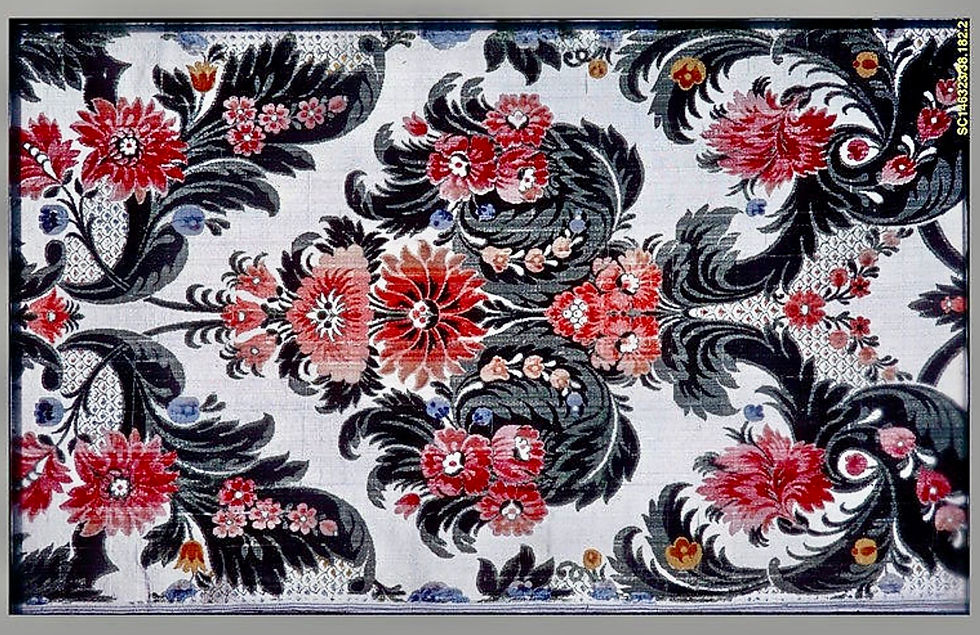
Silk Fabric with Floral Motives from 1700. This one is from Genoa. Could not find a sample from Messina - now on my To-Do-List
Messina stands as a symbol for Spain's decline in the 17th century. From 1559 to 1666 the Spanish Crown defaulted 9 times on its debt and acquired the reputation of Europe's most unreliable borrower. With a population of 7 million people, Spain was only half the size of France. Due to the threat from Ottoman corsairs, its costal regions were deserted. Its soil was not the best and it lacked industries. Had it not been for the silver from its Latin American colonies, Spain would never have been a world power. Bolivian silver accounted for 40% of the state budget. Spain blew its Great Power status by imperial overstretch. During Philip II's 40 years as King, Spain was at peace for a bare six months. Philip II fought Queen Elizabeth, the Turkish Sultans, the French, the Dutch and many more. His Kingdom was desperate for tax revenues. Where ever it could, it cancelled existing tax privileges.

Philip II's endless Wars ruined Spain's Economy forever
The exodus of thousands of skilled citizens from Messina was a bad omen for Europe. Only 7 years later, in 1685, Louis IVX revoked the Edit de Nantes which protected the religious freedom of French Protestants. Within a year, 200'000 Hugenottes - as the Protestants were called - had to flee. France lost its most skilled workforce. It could never replace it. As Great Britain embarked on the industrial revolution, France focussed on suppression and confiscation. Louis IVX's short-sightedness gave Switzerland its watch, banking and textile industry. Prussia recruited Hugenottes who made its army first grade. The Dutch sent them to Capetown where they developed a flourishing wine business. The English happily accepted them as bankers and merchants.

Hugenottes' Exodus from France in 1685
The refugees from Messina went mostly to France and northern Italy, where they again set up thriving businesses. Messina though descendet into poverty. Two devastating earth quakes, the first in 1783, the second in 1908, completed the job of destroying Messina. Buildings deserted for decades collapse quickly. The map from 1908 shows it all. It is no surprise that Messina was a center of the Revolution of 1848 and then the Risorgimento in 1860. The town had little to loose but a future to win.

Map showing the devasting Destruction of the Earthquake of 1908 (blacck = still usuable)
There is not a big amount of public information about Messina in the 16th and 17th century. Since we change crews here, there will be time to visit the local museums. Am very curious about what we are going to discover. The example of Messina makes me wonder whether politicians ever learn that wealth shall not be confiscated. A town is wealthy because its capital works. It is renewed every singly day. Once the state confiscates it under "Tax the Rich", it stops generating future profit. The Spanish Crown wanted Messina for its wealth. As a matter of fact, it destroyed it. Profits can and shall be taxed. Maybe New York Mayor Mandami should go on a holiday to Messina.

The expensive Fortress "Real Cittadella" eventually secured a Town with no Tax Revenue


Ho apprezzato la precisione con cui vengono presentate le informazioni. L'autore dimostra una buona conoscenza dell'argomento trattato. Ho segnalato questo testo a un collega che stava cercando informazioni simili. È un articolo che offre un quadro chiaro e completo della questione.