


J - 106 : Naples in 6 Castles and 1 Basilica
- hbanziger
- May 15
- 8 min read
Naples is often in the news for the wrong reasons - be it a bank robbery when thieves kept 25 people hostage before escaping through the sewer system, large scale tax fraud in real estate, the permant presence of the Mafia or uncollected garbage in the streets for months. Wondered how I could introduce the brighter side of Naples since our sailing this summer ends near the town. I will try to do it through history and a few photos.

Naples from Sant' Elmo Castle with the Castel Nuovo to the Right & the Vesuvius at the back
The Greek Acropolis (Greek)
Naples is one of Italy's oldest towns. Even older than Rome. The tiny Greek trading post of Parthenope (Pizzafalcone Hill just west to the Piazza del Plebiscito) was founded in the 8th century BC. About 200 years later, dissidents from Cumae built a new town = Nea Polis just to the east of it on a plateau where the surrounding valley and its slopes created a natural defensive position. The ancient Acropolis was located in Caponapoli (Top of Napoli). In 1058, the Napolitans built the Church of Sant' Agnello di Capobnapoli on top. It still stands.

Model of Greek Neapolis around 400 BC with its strong Town Walls. The Red Vectors show the ancient Street Grid which still exists today
Thanks to its natural harbour, Neapolis florished and surpassed Cumae in importance. Could not find any population numbers but based on the size of its theatre - about 1/3 of Syracuse's - I guess that around 50'000 people lived here. Napolis became quickly a center of Greek culture and learning, a status it kept far into Roman time.

The Greek Town Walls below the Piazza Bellini - 500 m south of the old Acropolis - are well preserved. Naples must have been a rich Greek City to afford such impressive Walls
Castel dell'Ovo (Roman)
The origins of Castel dell'Ovo go back to 600 BC when Greek settlers built a small fortress on the island of Megaride. Once Naples became Roman, the castle lost its military purpose. The Roman General Lucius Lucullus who had conquered Anatolia and Armenia for Rome, converted it into a splendid villa with a terrific water front view. It was one of his many spectacular villa projects, most of them actually in Rome.

The Foundations of the Castel dell'Ovo are from the Roman Castellum Lucullanum
There is little information of what happened with the Roman Villa over the next 400 years. We know that the ruler of the Western Roman Empire, Velentinian III (419 - 455 AD), who ruled from Ravenna and not anymore from Rome, fortified the island. In 476 AD, the last Roman Emperor Romulus Augustulus, was exiled to Castel dell'Ovo. 16 years later, the castle was converted again. The monk and scribe Eugippius lived here and made major contributions to the gospel's translation from Greek into Latin.

Artist Impression of Naples during Roman Time with the Circus and the Colisseum to the East. Note that the City did not significantly expand since Greek Times - the Town Walls still follow the original Lines (500 BC). Today's Piazza Bellini is at the Center of the Western Walls

Castel dell'Ovo which took its name from a tale about the Roman Poet and Writer Virgil, became a Royal Palace when Roger II the Norman conquered Naples in 1140 AD.
Castel Capuano
The Norman Kings were happy with the frugality of Castel dell' Ovo as long as they had to fight for possesion of their dominions. But it was wet and cold in the winter. King William I , the Bad, (1120 - 1166), not to be confused with King William I the Conqueror, who won the Battle of Hastings in 1066 and with it England, decided that Naples was too cold and moved the Royal Residence back to Palermo. To be on the safe side though, the commissioned the construction of a Royal Palace in Naples proper, the Castel Capuano.

The Palace takes its name from the medieval Capua Gate - it was built on its site
Castel Capuano did not serve long as Royal Residence. A good two hundred years after its commission it was downgraded to a secondary role. In the 16th century though, the new Spanish rulers gave it a new lease of life. They transferred all the legal offices and departments of the Kingdom to the Castello and made it the Hall of Justice. Known as Vicaria, its basement also served as prison. How convenient to have the courts and the prison in the same building! The Castel has undergone many restaurations and is in pretty good shape - open to the public, it is definitely worth a visit.

The last restauration of the Castel Capuano took place in 1860
Castel Nuovo (Angevin Dynasty)
The castle was commissioned in 1279 by Charles I of Anjou (1226 - 1285), the son of French King Louis VII. He had won the Kingdom of Naples on the battlefield in 1266 when he defeated the heirs of the German Emperor Friedrich Barbarossa, the former Lord over Southern Italy. Charles moved the capital from Palermo to Naples where he needed a new Royal Palace. The Norman castle at Capuano did not project the desired power. A proper medieval castle had to be built. Erected on a scenic location for everybody to see, the castle remained a Royal Seat for all the kings of Naples until 1815.

Castel Nuovo on Google Map - Street View - is visible from every corner of Naples' Port
King Charles I of Anjou was an ambitious man. He believed the world was his. He took part in Louis IX 's (his brother) 7th Crusade in 1244. It ended in disaster in Damietta (Egypt). He would try again. The 8th crusade with his brother led them to Tunis in 1270. But there his brother died from dysenteria. From now on, Charles I had to build his empire by himself. To most people's surprise - and always with a little help from the Pope - he got quite far. He successfully fought the weakend Byantine Empire - and helped to strengthen the hands of the Ottomans who took Constantinople in 1453.

Maximal extent of KIng Charles I's little Mediterranean Empire - Built by Force it fell by Force
Castel Sant' Elmo (Angevin Dynasty)
The castle was built by Robert of Anjou (1276 - 1342) in 1329 as a military fortress. It showed the consolidation of Angevin power. The Kings of Naples learnt the hard way that they could govern Southern Italy but not the whole world. The defense of their capital was thus vital. Naples fortifications though still followed the lines of the ancient Greek town - not much had changed except the Castel Nuovo built by his grandfather Charles I. Military technology had progressed though with the crusades and trebouchets were now able to fire missiles from the surrounding hills into Naples.
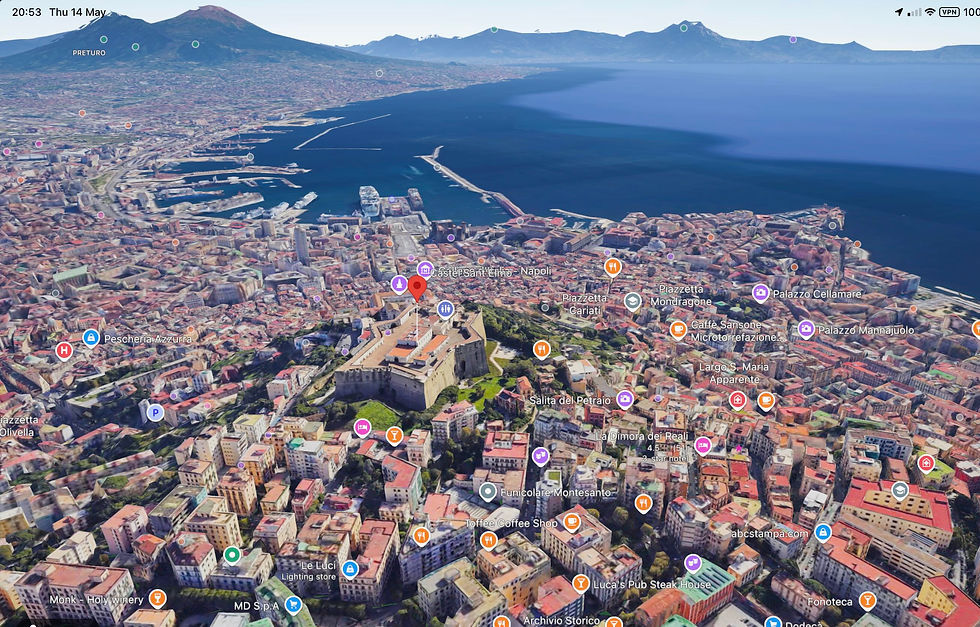
Castel Sant' Elmo on Google Map's AI Feature that integrates Street and Aerial Views
Robert's grandfather King Charles I of Anjou had already built a small fortified structure on the Vomero Hill. His grandson massively expanded it and called it "Palatium in summitatae montanae Sancti Erasmi". In daily parlance though it was just a fortress or a castle. Robert's Granddaugher Joan I of Naples built the Certosa di San Martino next to it (completed 1368).

The City of Naples in 1392. The Town had expanded
towards the Sea. The northern Part remained almost
unchanged since the Greek foundation. The original
Street Grid is visible on this Map made 2'000 years later
When the Spanish arrived in Naples in the 16th century, they gave the fortress a brush up. The new hexagonal shape enabled it to withstand prolonged artillery fire. In their wars with the Ottoman Empire, the Spanish had learned how to counter and survive heavy siege gun bombardments. Castel Sant' Elmo became Spain's major garrison. Over the following centuries, the castle also served as ammunitions depot and as a prison. In 1952, it eventually became a museum and is now open to the public. It can be reached by funiculaire.

Painting of Naples by Francesco Roselli in 1472 with Castel Sant' Elmo prominently on top
Palazzo Caserta (Bourbon Dynasty)
Covered the new palace of the Bourbon Kings already in a previous blog. Situated 35 km north of Naples, the palace illustrates what was wrong with the rule of the Bourbon's. Louis XIV could afford the splendor of Versailles because his minister Colbert underpinned French power with a sound industrial base. The coton and silk industry was brought to the South of France (remember Denim Jeans = Jeans de Nîmes), the French commercial fleet competed with the Dutch and English for dominance of the seas, northern France went through an early phase of industrialisation and science was promoted in as much as possible

View of the Northern Side of the Palazzo Caserta from the Venus and Adonis Fountain. The Park's central Via D'Aqua is 3 km long.
The Bourbon Kings did none of that. They were rent-seekers who spent tax money on luxury and the military to suppress their people. When we look at the Caserta Palace we should remember that this is the "other side" of the Mafia in southern Italy. After the Bourbons were kicked out by Garribaldi's Red Shirts in 1861, the palace fell into a beauty sleep until 1923. That year, Mussolini, the Fascist Italian Dictator, made it the siege of the Italian Air Force Academy. Of course, the building was bombed during World War II. Once Naples was taken by the Allied Forces in 1943, it became their Head Quarter. The English and American Generals knew how to live ... Today, one of the largest baroque palaces in Europe is a museum and a UNESCO World Heritage site.

One of the many magnificent Stairs in the Palazzo Caserta
Piazza del Plebiscito (Napoleon's Mausoleum)
My last building is the Basilica Reale Pontificia di San Franceso di Paola. You may wonder how a church makes it into my blog on Napolitanean castles. Its story is amazing though. In 1806, after Napoleon had defeated the Austrians and Russians at Austerlitz, he reordered Europe. The Bourbon Kings who resisted him for so long, had to go. He declared his brother as King of Italy and when he passed away in 1808, replaced him with his brother-in-law Marechal Murat (1767 - 1815). Murat fought with his buddy Napoleon since 1795, was his aide-de-camp and later the commander of Napoleon's cavalry.

Murat's planned Mausoleum for his Boss, Napoleon Bonaparte who gave him his Kingdom
Within a year of his arrival, Marechal Murat - now called Joachim-Napoleon, King of Naples - started the construction of a Mausoleum dedicated to his sponsor. Murat was fully aware of how Napoleon loved flattery. His wife, Napoleon's sister, would make sure that the Emperor learnt about his disciples admiration. The colomns, a copy of the Piazza San Pietro in the Vatican, were completed by the time Napoleon's fate turned. In 1813, he lost the battle of Leipzig. Within 9 months he would have to abdicate. The mausoleum proper though, a copy of the Pantheon in Rome, was only finished by Murat's successor, the Bourbon King Ferdinand IV. Murat himself did not survive the downfall of Napoleon. He was captured and executed in 1815 in Corsica by a firing squad.

Pantheon Copy in Naples on Top. Pantheon at Bottom
King Ferdinand IV would - of course - not dedicate the beautiful building to his arch-nemesis. He chose San Francesco di Paolo, a local Saint, instead. In typical Napoleonic splendor, Murat's copy was taller than the original. It measures 53 meters in hight - the Pantheon in Rome is "only" 43 meters. The Roman Pantheon is dedicated to "all Gods" (Pan Theos). The Napolitanen Pantheon just to one Saint. Lucky him!

The Basilica di San Fernando di Paolo from the Piazza del Plebiscito - the Equestrian Statue is Charles I of Naples, the founder of the Angevin Dynasty.


Comments