


J - 114 : Did Monte Nuovo found modern Geology?

Aerial View of Monte Nuovo - Pozzuoli to the left, Capri on the Horizon, Baiae to the right
On 29 September 1538, shortly after sunset, the ground 4 km to the east of Pozzuoli opened expelling flames and toxic fumes. A bulge formed followed by a strong earthquake. Within hours, the bulge exploded expelling white and black smoke, pumice, basalt stones and water drenched ash. During the night, the plume rose to 5 km hight showering the surrounding lands with wet ash and pumice. Pozzuoli received 25 cm of debris, Naples a good 8 cm. Driven by westerly winds, the fallout reached 100 km to the east.

The Eruption of Monte Nuova - Illustration by Maestra del Trabacchetto around 1540
The eruption did not come unexpected. For decades the land around Pozzuoli had risen by several meters. Since April 1538, the frequency of earthquakes had doubbled. Many people left Pozzuoli. The ones who were unable to leave slept in the open - sleeping inside the buildings was too dangerous. Nobody anticipated that they would witness the birth of a new mountain, the Monte Nuovo. It was the first time in human history that a volcanic eruption was widely documented and reported. The following day, on the 30th Septermber, many curious people from Naples came to have a look and watch the spectacle.
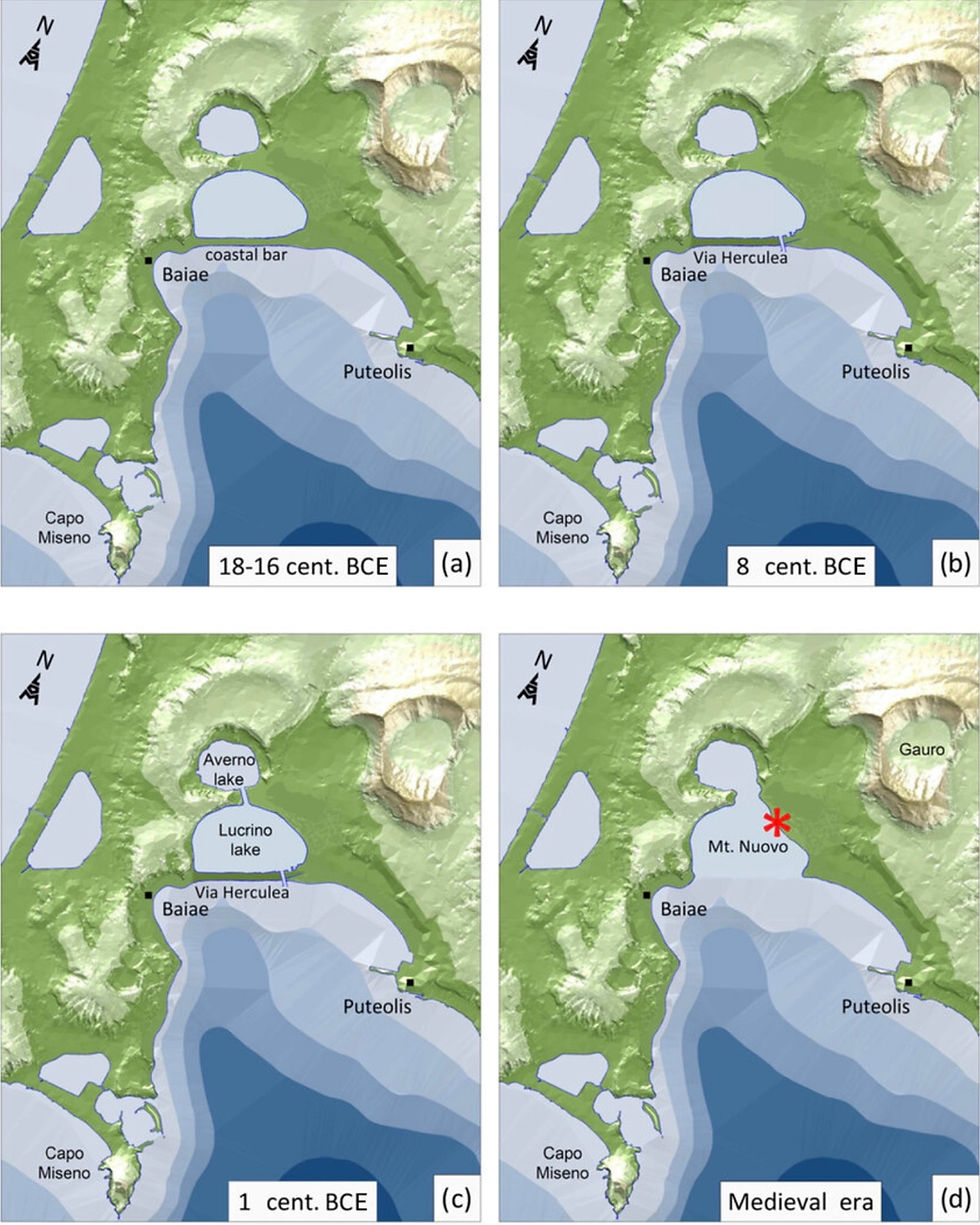
Change of Ground Levels over the 30 Centuries in
The Bay of Pozzuoli
One of the visitors was Francesco del Nero, Niccolo Machiavelli's brother-in-law, the famous and still widely read Florentine author of "The Prince". From him and other eye witnesses we have a precise description of what happened. The eruptions continued unabatted on the 30th of September. Heavy explosions ripped the air. The size of expelled basalt increased and the rain of wet ash remained heavy. Under the weight of the ejacta, half of Pozzuoli's cathedral collapsed. The town and the gardens were covered knee deep in ash. Monte Nuovo reached that day a height of 140 m (135 m today). In the process it destroyed parts of the village of Tripergole. On 1st October 1538 eruptions eventually slowed down. After a few more weeks, the spectacle was over. Monte Nouvo though remained and is still there.

Illustration from 1850 of Pozzuoli and the Monte Nuovo to the right
With so many people observing the eruption and writing about it, I wonderd whether the event launched geology as a science. The eruption happened around the life time of science giants like Leonardo DaVinci (1452 - 1519), Michelangelo (1475 - 164), Raffael (1483 - 1520), Bramante (1444 - 1514) or Titian (1488 - 1576). But it was a bit too early. Locally the eruption was viewed through the lens of faith. Many people saw this natural disaster as God's wrath for humanity's sinful life. Not surprisingly, the eruption intensified the devotion to local patrons. San Gennaro, martyred at the nearby Solfatara crater, became a central figure. Many processions were held for him. Some of them still survive to today. Thus, the Monte Nuevo eruption cannot be considered as the start of modern geology.

The Feast of San Dennaro in Naples is held every year on 19th of September
The start of geology as a methodological and systematic science began only 100 years later when Nicolaus Steno postulated in the 1660s the principles of stratigraphy (the law of super-position). Another one hundred years later, James Hutton revolutionised the science of the earth with his book "Theory of the Earth". It was published in 1785 and explained our geology as being shaped over millions of years by slow but continuous processes.

Illustration of Sediment Layers from James Hutton's Book "Theory of the Earth" (1785)
His research was based on data from coal and iron miners who were interested in better prospecting tools It would take a while until vulcanology could be fitted into Hutton's ground-breaking work. Eventually, the discovery of plate tectonics in the 1960 by the US Navy which carthographed the sea floor to better locate Russian submarines, solved the issue. Volcanos are a function of plate subduction. As long as the African plate pushes against the European plate, there will be volcanos in Italy.

Monte Nuovo with Pozzuoli and the Vesuvio at the back
We will return our sailboat this summer in Pozzuoli with a direct view on Monte Nuovo. It is definitely a volcano we have to climb. It is only 135 meters above sea level.


Comments