


J - 70 : How Amalfi made it to the Bucket List

Conca di Marini - Half Way between Amalfi and Positano
Between June and September, around 5 million tourists visit the Amalfi. More than three quarter come from abroad. Visitors from the United States lead the pack followed by English and German people. The Amalfi coast has become the ultimate bucket list destination. The dramatic scenery with steep cliffs, turquois waters and idyllic villages is the perfect back-ground for the mandatory instagram selfie. Half of the 5.6 million Americans visiting Italy include the Amalfi coast. It is a must.

The crowded, narrow Streets of Positano on 1st of May 2026
The surge of visitors strains Amalfi's infrastrucutre. The Strada Statale 163 resembles a parking lot during the hot summer months, the narrow streets of Positano and Amalfi turn into a crowded nightmare where people barely move, the beaches are so packed that there is no space for a king-size towel. Angry tourists yell at their tour operators. Green activists hose visitors with water and shout "Go home". Local guides call the situation challenging and suggest that visitors "go early or late in the day, book everything in advance and do not try to do too much." Others suggest to go to Liguria or Cinque Terre instead.

Parody on the Grand Tour - the Landing of Sir John Bull in Boulogne in 1792 - it must have looked similar on the Amalfi coast - who wants to get wet feet?
Amalfi's fame is recent. Tourist offices claim that it was discovered by young Englishmen who were on their "Grand Tour" in the 18th century. But this was a tiny group of people. They hardly had any impact. The SS163 was opened in 1853 by King Ferdinando II of Bourbon. It took 20 years to blast the narrow street through the rocks. It was not built for tourism but for connecting fishimg villages. Contrary to the French Riviera with Nice or Liguria with San Remo, the Amalfi coast had no railway connection. Whilst these two towns became to-be places for European nobles, rich and famous, Amalfi remained discovered.

The SS163 Amalfitana shortly after the opening with lots of Space for Horse-drawn Carriages
With World War I, tourism everywhere came to a standstill. In the absence of customers, the large Palace Hotels went bust. Not only in Nice and San Remo, but also in my home country Switzerland. Inflation, the rise of Mussolini, Italy's fascist dictator, to power in 1922, the depression of the 1930s followed by World War II left no room for pleasure and fun. People had other worries than going on holiday. The Amalfi coast was not covered by Mussolini's Opera Nazionale Dopolavoro, the state-run agency organising vacations for millions of people. Nor did the Italian government built any Colonie di Vacanze for its youngsters. The Amalfi coast remained as remote, poor and "idyllic" as it ever was. Nobody came.

Dopolavoro Manifesto (Brochure for Afterwork) 1938 -
The Couple using the resurected Roman Salve Greeting
Everything changed though on the 9th of September 1943. At dawn, Amalfi's inhabitants woke up to the thunder of heavy guns. The Royal and US Navy shelled the beaches south of Salerno to "soften up" German and Italian resistance prior to the landing of the US Fifth Army. 9 divisions (each 20'000 men) landed over the next few days and pushed towards Naples. On the 27th of September, Naples rose up against the German occupiers. On 30th September 1943, people had liberated their town. A day later, the Allied Forces arrived.
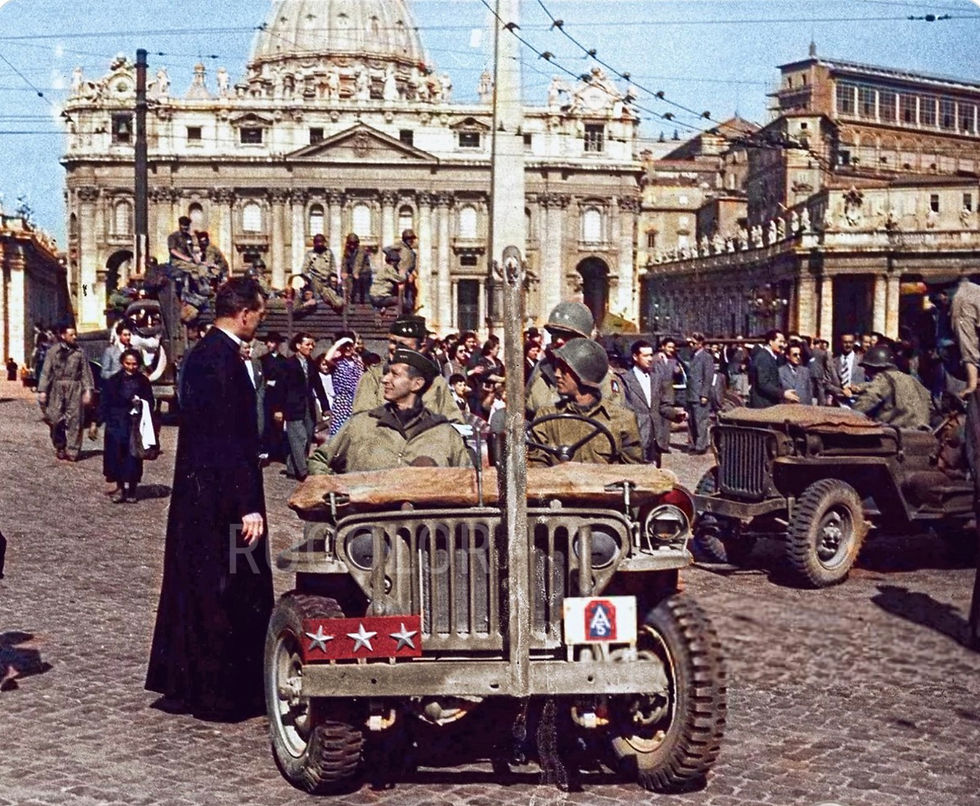
Lieutenant-General Mark Clark, Commander of the US Fifth Army, talks on 4 June 1944 to Monsignore O'Flaherty on Saint Peter's Square in Vatican City in Rome
Almost overnight, Naples became a beehive of activities. The port was the logistics hub for the Italian theatre of war for the next 18 months. Thousands of tons of equipment, fuel, ammunition and hundred thousands of soldiers passed through Naples. The US Fifth Army established its Headquarter in the Royal Palace of Caserta, a good 20 km north of town. Thousands of US staff officers coordinated these activities. Whilst working hard, they also had their leaves - and their own jeeps. This all purpose vehicles took them around the country. I have no evidence that these staff officers vacationed on the Amalfi coast but am sure they discovered it. It was only an hour south of Naples, no distance for an American. With the staff officers came the photographers who documented the war - mostly staffers recruited from Hollywood. The whisper of Amalfi's beauty reached America.

A US Brigadier with his Jeep - all high-ranking US Officers had their own Jeep and Driver
It is probably through these army connections that Luis Marden, a legendary contributor to the National Geographic, heard of the Amalfi coast. Over several months, he visited and documented its beauty. In October 1959, National Geographic published his article "Amalfi, Italy's divine coast".

Coverpage of the National Geographic October 1959
Marden introduced the world to the coast's breathtaking scenery, the pictoresque and untouched fishing villages and its more than 1'000 years of history. He laid the base for Amalfi's reputation as a top holiday destination. There were only a few hotels at the time. All family run. Fisherman and tourists shared the beaches. You had to be reasonably well off to afford a car or a boat in 1959. The only way to get there. The wealthy were Amalfi's pioneers
.

Amalfi Beach in 1959 - Photo by Luis Marden - once
the Fishing Boats were pulled up on the Beach, the
Tourists could unfold their Deckchairs and Umbrellas
In the meantime, a bit further north, "Hollywood on the Tiber" was busy making block buster movies like "A Roman Holiday" (1953), "Ben Hur" (1959) and "Cleopatra" (1963). The American movie makers had discovered Cinecitta, the studios that Benito Mussolini had built in 1937 to produce propaganda films. Located 12 km southwest of Rome, the site had lost its purpose with the end of the war but was fully intact. Since Hollywood had troubles repatriating its profits from Italy - the Italian Lira became fully convertible only in 1960 - it moved part of its film making to Rome to use its "frozen" cash. Cinecitta was ideal for filming grandiose sceneries, the stage settings were state-of-the-art, the camera crews skilled but on low salaries. Also, finding thousands of people for mass scenes was easy.

The Movie "A Roman Holiday" was entirely filed in Cinecitta. Cleopatra to a great Part.
"Cleopatra", one of Elizabeth Taylor's most famous movies, was mostlhy filmed in Cinecitta. For days, she and her co-star Richard Burton disappeared to the Amalfi coast to conduct their not-so-secret love affair. Of course, the Italian paparazzi got wind of it and followed the couple. Their photos put Amalfi on the front pages of the boulevard press. Amalfi went global. Whilst the Taylor-Burton affair peked people's curiosity, the coast's beauty tempted the masses. National Geographic had to cover the area in several follow-up issues. Only ten years after Liz Taylor's visit, Amalfi had established itself as a global holiday destination.

Liz Taylor at a Beach in Italy - not sure whether this
Photo is from the Amalfi Coast
The first time I visited the Amalfi coast was in 1979. I was a freshman at the University of Berne and worked on my first thesis. My topic was "seaborn trade in the Middle Ages". Of course I had to visit Amalfi to see with my own eyes - as I had to visit Genoa and Venice. I got there by train and bus. Amalfi was busy but not crowded. I was surprised how small it was. That such a tiny town could become one of Italy's prominent trading hubs amazed me. 1979 was the time before the internet though. We had neither cell phones nor e-mails. My research was done in libraries.
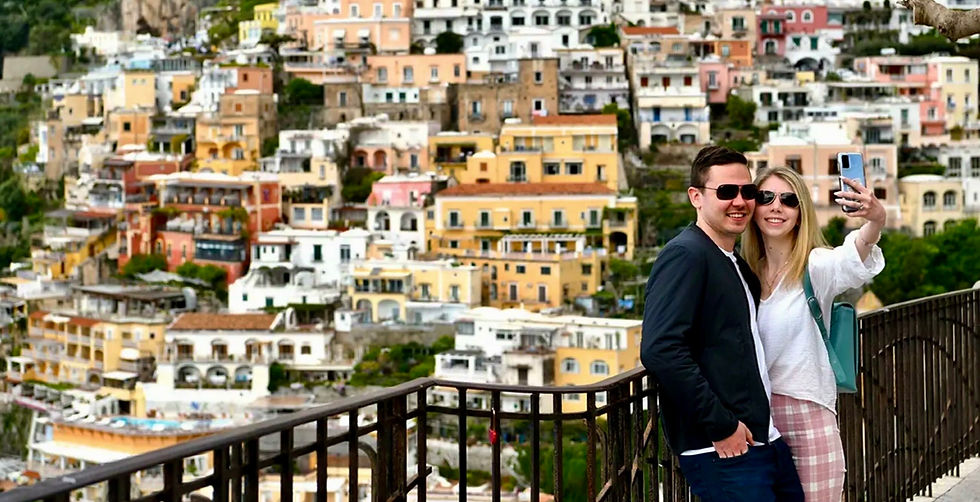
The Positano Instagram Selfie every Vistor comes for
The internet, specifically facebook and instagram, changed everything. People not only share their photos but also their "bucket lists" - things that you must see before you hit the bucket - meaning before you die. Now half of the US visitors who come to Italy "must" see the Amalfi coast. It is a trend like weating your baseball hat reversed. Tour operators with giant coaches happily proved a lift. That you end up in the parking lot called SS163 and can hold your favourite instagram spot for less than half a minute does not matter. Albeit one of the visitors in May 2026 wrote on social media "Glad we left early today.What a mess! And such a sad story for Positano and this whole region."

There will be never enough Space for Millions of Visitors - but they all come June - Sept. The Coast is as beautiful during the off-season and you get the place for yourselfr
I do not know how this will be sorted. Maybe the coast introduces a toll and limits the absolute number of visitors as Venice did two years ago. When visiting this summer, we will be privileged - we arrive by boat and anchor where we please. Whilst Amalfi is crowded, the cathedral remains a must. The first pointed arches in Europe deserve our homage.


Il testo è ben strutturato e affronta l'argomento con la giusta profondità. Il contenuto è ben bilanciato tra teoria e applicazioni pratiche. Ho trovato questo testo particolarmente utile per un progetto a cui sto lavorando. È difficile trovare testi che spieghino questo argomento con tanta chiarezza.
great