


J - 72 : Kingdom of Sicily - a Norman Legacy

The Castello Normanno - Svevo di Aci a few Kilometers north of Catania in Sicily
For almost eight hundred years, precisely from 1071 to 1861, Italy was split in two. To the north was Venice, Milan, Savoy, Tuscany, Siena and tha Papal State. To the south the Kingdom of Sicily. The north was fractured. The south unified. How was this possible? The population in the north was homogeneous. In the south there were Greeks, Romans, Arabs, Arabic Jews and Normans. You would assume that the south should have splintered first. The opposite was true. It never did.

Europe 1190 - Italy's North is Part of the Holy Roman Empire. Sicily an independent Kingdom
To understand we need to go back a few centuries. The Eastern Roman Emperors never accepted the loss of Western Rome. In 535 AD, a mere 60 years after the abdication of Augustulus, Rome's last emperor, the armies of Emperor Justinian were back. The wealth of Constantinople allowed him to reconquer the West except Gaul, northern Spain & England.

Portrait of Emperor Justinian I and his Court in the Church San Vitale in Ravenna, Italy
Had it not been for the plague which ravaged the Roman Empire from 541 to 549 AD and the fierce resistance of the Franks, he may well have succeeded. History may have taken a different turn. Europe's development could have been closer to China's which fractured several times but always re-united.

Emperor Justinian almost succeeded with his Goal to reunify the Roman Empire
Back to Italy. Even after Justinian's eventual failure, large parts of Italy remained under Byzantine contol. Venice, Genoa, Naples, Rome and all of southern Italy were governed from Constantinople. An efficient and centralized bureaucrathy regulated trade, settled civil disputes, administered the churches, raised taxes and protected the peninsula with troops and galleys. After 680 AD though the pircture changed. The Arab pincer attacks by land and sea forced Byzantium to concentrate its forces on the Anatolian frontier and the eastern Med
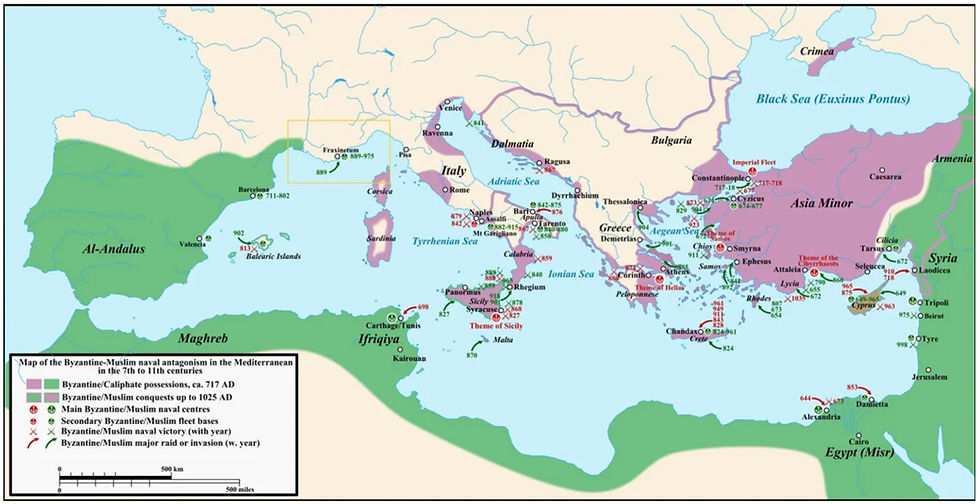
Map of Byzantine - Arab Battles from 650 - 1050 in the Mediterranean
Italy was barely defended and had to look after itself. On the request from the popes, the Frankish Kings stepped in. In several vital battles, the Frankish armies stopped the Arab invasions. Their kings became the protectors of the west. In recognition, Pope Leo III crowned Charlemagne as Holy Roman Emperor in 800 AD. Hence there were two Roman Empires - both competing for supremacy. The Franks' influence expanded to Rome. Italy's south remained under Byzantine rule.

The Frankish Empire under Charlemagne had become the Protector of Western Europe
All the while, Byzantium and Fatimids (the Arab rulers of North Africa and Egypt) fought over Sicily and southern Italy. At the beginning of the 11th century, local Muslim rulers hired Norman mercenaries having heard of their fighting skills. The Normans were more than just hired "guns:. Having carved out Normandy from France and successfully captured England (1066, Battle of Hastings), they were seasoned power players. Noticing the exhaution of both the Arabs and Byzantium, they saw an opportunity to establish themselves as rulers. The brothers Robert Guiscard and Count Roger conquered Sicily between 1061 and 1091 and made Palermo their capital (1072).

The Norman Castello towering over the Town of Castelbuono in Northern Sicily
The arrival of the Normands was enthusiastically welcomed by the popes. The enemy of their two arch enemies became their trusted friend. Whilst the popes had no army, they had money. 10% of all church revenues were remitted to the Vatican. The Normans did not say no to the lavish subsidies and became the Popes' most loyal supporters. By 1130 AD the Normans also captured Naples. The Kingdom of Sicily under Norman rule was established.

Norman Conquest of Sicily and Southern Italy from 1161 - 1154
Whilst the Normans fought Byzantium on the battlefield, they recruited the existing Roman administration and built an efficient, centralized state. As all successful empires, they did not meddle with the life of their citizens and let them keep their religion and trades. Sicily and southern Italy became a center of agricultural and protoindustrial development - the Normans understood that only a thriving economy could support their political goals (=taking over Byzantium and the Holy Land).

Neither the Normans nor the Pope were impressed that the Hohenstaufen had the Imperial Crown of Charlemagne - it was actually a crown made for Otto the Great in 962 AD
When the Kingdom of Sicily got through marriage into the hands of the Hohenstaufen, a German dynasty, the popes were not amused. The Hohenstaufen ruled the Holy Roman Empire and fiercly competed with the Vatican for power. In their eyes, the pope was a suject of the Emperor (as in Constantinople). Since Leo III had crowned Charlemagne in 800 AD, the popes saw it differently. As God's deputies of earth (and richest guys in Europe) they wanted to call the shots. In the end they succeeded. By 1266, the Hohenstaufen had lost the Kingdom of Sicily - with the helping hand of the Popes Urban IV and Clement IV. They made sure that the French House of Anjou got it - of course by paying for their invading army.

There are many Norman Castles in Sicily - we can only visit the ones on the East Coast
The Kingdom of Sicily - or "both Sicilies" as it was called after 1815 - thus never became part of the Holy Roman Empire but stayed separate. Thanks to their independence, we can admire today many Norman castles, the Royal Palaces in Palermo and Naples and the renaissance towns rebuilt in Spanish Baroque after major earth quakes. The Spanish Kings of Aragon inherited the Kingdom of Sicily in 1479. Spanish monarches ruled it for almost 400 years to 1860.


Ik heb dit artikel aandachtig gelezen en vond veel interessante punten. Ik waardeerde de precisie waarmee de technische details worden behandeld. Ik waardeerde het dat ik al deze informatie op één plek kon vinden. Het is een tekst die een helder en goed georganiseerd beeld van het onderwerp geeft.