


J - 147 : Amalfitans - Rome's Heirs on the Mare Nostrum

Amalfi's medieval Townwall towards the East - Just beyond the Walls is the Village of Atrani, where Amalfi's Wealthy had their Villas and where its Doge was "crowned"
Writing about the Amalfi coast – the former Duchy of Amalfi – is challenging. Everybody knows it, has been there or has it on the bucket list. About 5 million tourists visit Amalfi every year – a town of 4’600 inhabitants. The Amalfi coast was discovered by English nobility in the 19th century. Without railways and cars it was time consuming to reach – unless you had a yacht. During the interwar period, artists and intellectuals discovered the coast – on the coastal SS163 they could get there by car. The real take off came after World War II when cars became affordable to ordinary people. By the 1970s, the Amalfi coast was a Jet Set destination for the Jacqueline Kennedy’s and Liz Taylor’s of this world. In 1997, it was officially recognized as an UNESCO Heritage site.

Amalfi's Coat of Arms: the Red Stripe links it to
Roman Nobility, the White Cross to Byzantium
and the Crusades, the Compass to its maritime
prowess, the banner says "Descended from Roman
Fathers"
In most brochures, Amalfi is celebrated as Italy’s first maritime power after the fall of Rome in 476 AD. Also for its invention of the portable compass and the beauty of its raw coast. Its full story is richer though and told by its coat of arms. Amalfi was subject to direct rule by the Byzantine Emperors - Rulers loved territories directly under their jurisdiction – they did not have to share taxes with local dukes. Means Amalfi was rich and a good source of taxes!
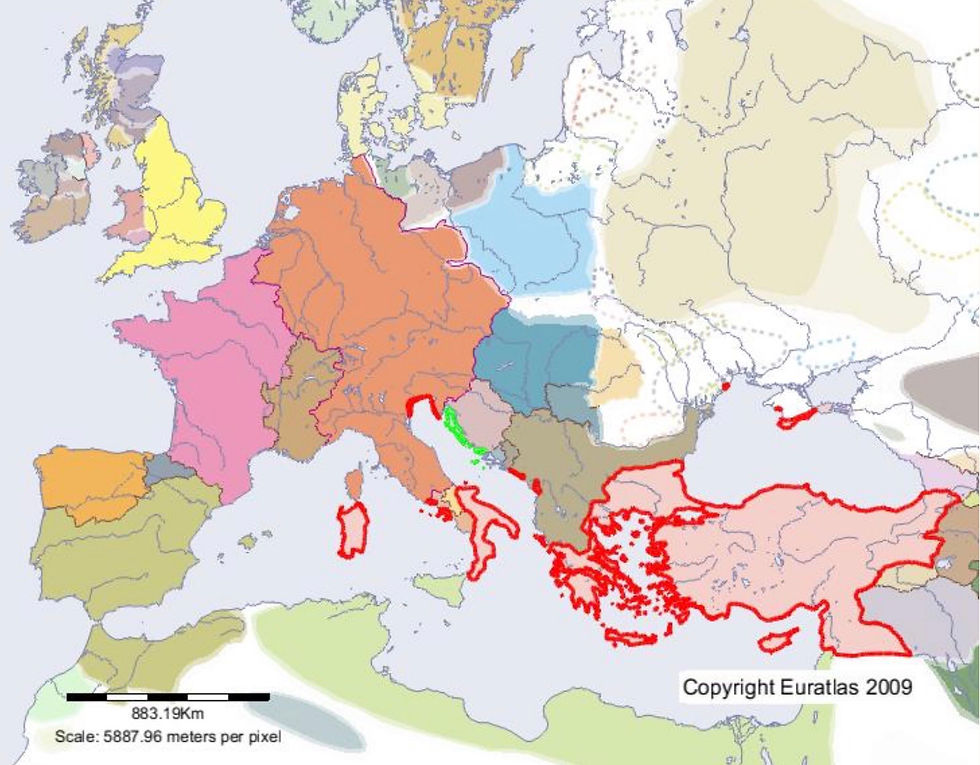
The Byzantine Empire by 1'000 AD - still controlling Sardinia, Calabria, Puglia and Naples
Most people do not know that the Byzantine Empire ruled Southern Italy until the end of the 10th century AD. The few orthodox Christian communities in Puglia remind us of this long history. The ever increasing raids of Seljuk Turks into Anatolia after 900 AD forced Byzantium though to focus on its eastern borders. Defending the Italian provinces was delegated to locals. People on the Amalfi coast - Mediterranean fishermen for centuries who are still producing the “Colatura di Alci” (a condiment based on Anchovies) - were asked to contribute galleys to the Byzantine Navy.

The Battle of Osia in 849 AD, painted by Raphael in 1515 in the Pope's Private Chambers
Amalfitan mariners were rather successful. In 849 AD they destroyed an Arab fleet before Ostia. Three years earlier, in 846 AD, an Arab raiding party under Muhammed Abul Abbas had looted St Peter’s Basilica and St Paul outside the Walls but luckily could not breach Rome’s walls. In 849, a more substantial Arab force gathered in Sardinia. When it arrived, a Christian fleet of Byzantine, Gaetan and Amalfitan galleys counterattacked.

Drawing of an Amalfi War Galley with 108 Oars - Could not establish the Drawing's Date
The invasion force was scattered and destroyed. Rome was saved. Centuries later, Raphael painted this crucial battle for the survival of the catholic church for the Pope. The victory underlined Amalfi’s loyalty to the Byzantium Empire – since 839 AD, it was an independent Duchy - hence the crown on top of its coat of arms.

13th Century Amalfi - Arsenal in the Center - They could build 2 Galleys at the same Time
With a population of 50 – 70’000 people, Amalfi could deploy roughly 10% of its male population for maritime affairs or naval engagements. Their galleys were slimmer and faster than the old Roman triremes, had only 120 oars and a total crew of 200. The rest were warriors on deck. Their fleet thus counted between 25 and 35 galleys commensurate with Amalfi’s arsenal capacity of 4 galleys per year. The fragile galleys never lasted longer than 10 years. Sending 30 galleys to Rome’s defense in 849 AD was a sizeable contribution.

Amalfi's Arsenal with its "Gothic" Arches is 40 meters long - Like a Roman Shipyard
Most of the time, Amalfi’s dual-purpose fleet was not at war but used for commerce. Being part of Byzantium for centuries, Amalfi’s vessels continued the trading patterns established by Romans merchants centuries earlier. They shipped timber to North Africa and sold it for gold. Then used the gold to buy spices, jewels, pearls, textiles and high quality steel in Alexandria and the Levant, sailed to Constantinople where they sold some and bought imperial silk for the Pope and his cardinals, Frankish nobles and Norman knights. Given that the warm Roman climate optimum was over, they also shipped grain from Europe to Northern Africa. It was a tremendously lucrative business. Driven by the long established wind pattern that powered Mediterranean trade for millennia, the Amalfitan mariners were the Heirs to the Roman sailors of the Mare Nostrum.

Amalfitan Merchants dominated the Mediterranean in the 9th and 10th Century AD
Could not find any detailed research on how quickly Amalfi traders stepped into the shoes of Byzantium who had to focus on the Turkish threat. The Fatimid rulers were quite happy to continue trading with whomever showed up in their ports. Why killing a goose that lays golden eggs? By the 10th century, Amalfitan merchants had branches throughout the Fatimid Caliphate. It had become the Mediterranean’s most successful maritime power – the dominance of Venice, Genoa or Pisa was still in the future. It is thus no surprise that Amalfi borrowed heavily from Arab architecture. Its church and the arsenal are both built using pointed arches - the future "gothic" style.

Amalfi's Duomo di Sant Andrea Apostolo with its pointed Arches from the Levant
Amalfi’s dominant position in maritime trade lasted a good 200 years but was eclipsed when geopolitics changed. Byzantium suffered a catastrophic defeat at Manzikert in 1071 AD by the Seljuk Turks. Its entire army was wiped out, the Byzantine Emperor was a prisoner of war. Quickly Byzantium asked the Pope for help. But none came. The schism between Catholic and Orthodox Church in 1054 had open wide trenches. It took 2 decades of effort of Popes Gregory VII and Urban to rally the Western Kingdoms to help. By 1095, the Pope, the Holy Roman Empire, France and England sent troops. The Crusades had begun. Genoa, Venice and Pisa provided transportation. By 1099 Jerusalem was in Christian hands. Amalfi now had fierce and powerful competitors. Henceforth it had to share trade with the new Italian Maritime powers and eventually succumbed. In 1135 and 1137 Pisa sacked Amalfi. It eventually became part of the Kingdom of Naples.

Amalfitan Compass from the 2nd Half of the 13th Century in the Museo della Bussola
Amalfi continued to trade over the following centuries albeit in a junior position. Amalfitan navigator Flavio Gioia "invented" the boxed compass in 1302. Albeit, the floating magnetic needle in a water bowl was a Chinese invention which Goia improved and put in a wooden box. He is now honored with a statue in the middle of the town. Amalfi made another contribution to the world which is still with us: Gerardo Sasso from Scala, a village to the east of Amalfi, founded the Order of Saint John, better known as the Maltese Knights, in 1080 AD. Amalfi's star became their symbol, albeit on red, not on blue.

The eight "Languages" of the Knights of Saint John formed the Order
Amalfi is a busy tourist location today. It seems small when you are there. But there is no doubt that Amalfitans resurrected the Mediterranean's long-distance trade which powered and financed the Renaissance. It eventually paved the way for our modern, western society.

Amalfi in the Evening when the Daily Tourist Rush is over and everybody is at Dinner
If you are interested in a well made, scenic video on YouTube, click below:


Comments