


J - 63 : Where 2 Tides clash - Straits of Messina

The Straits of Messina with a typical big Swirl at the Entrance
In 2021, five years ago, we crossed the Straits of Messina twice. First on our way to the Aeolian Islands. Then on the way back to Calabria. At one point of the return crossing, the AFAET, our boat in 2021, was caught by a giant swirl. Within seconds it was 45 degrees off course - no problem for a modern sailer with a strong engine. The autopilat put us back on track. For ancient sail ships or galleys the problem must have been more tricky.

View of the Swirl from the Deck of a small, 12 Meters long Sailboat - Sicily to the left
No wonder that our superstitious ancestors assumed that evil forces were at work. They believed that two terrifying seamonsters preyed on innoent sailors. Scylla, the six-headed monstor, lived on the eastern cliffs and was said to snatch with her long neck sailors off the decks and gobble them alive. The other monster, Charybdis, on the Sicilian side, was notorious for creating massive swirls that swallowed entire ships and drowned the crews. The story is told in terrifying details in Homer's Odyssey.

View from a Google Based Navigation System - the Currents can be as fast as 5 Knots
Having experienced these giant swirls myself I wondered what caused them. Luckily, youtube is full of interesting videos which explain them. Seems the subject interests all sailors who cross the Straits of Messina. The swirls and the strong currents are the result of two overlapping forces:
The tide. The Mediterraneran is too small for large tides. High Tide and Low Tide differ by about 30 cm. In the Adriatic or the Aegean it is considerably less. Still, the Western and Estern Mediterranean are sufficiently large bodies of water that the tidal effect is felt. When the Moon pulls the sea east, the Levant has High Tide whilst Sicily's east coast has Low Tide. The water mass is pulled by the Moon's gravity to the east. Since the water has to come from somewhere, it is lower in the West => Low Tide. The same logic applies to the Tyrrhenian where the water is pulled to the Italian coast on the East. Calabria thus has High Tide whilst Sardinia has Low Tide. The Straits of Messina link the Tyrrhenian and the Ionian Sea. When Calabria has High Tide, Sicily's East coast has Low Tide. As a powerful current, the water flows from north to south. When tides reverse, the water flows south to north.

The small Size of the Mediterranean limits the Magnitude of its Tides
The second effect is the salinity differential between Ionian and Tyrrhenian. As noticed in the past, the sailinity of the Mediterranean increases as you go further east. The fresh water inflow from the Nile is insufficient to compensate for the water lost due to high evaporation. The climate in the eastern Med is much hotter than further west. The salinity of the Ionian is thus 0.5 parts per thousands (ppt) higher than in the Tyrrhenian. Saltier Water is heavier. When water from the Ionian sloshes into the Tyrrhenian, it sinks below it. The sinking during the rapid flows causes the large swirls.
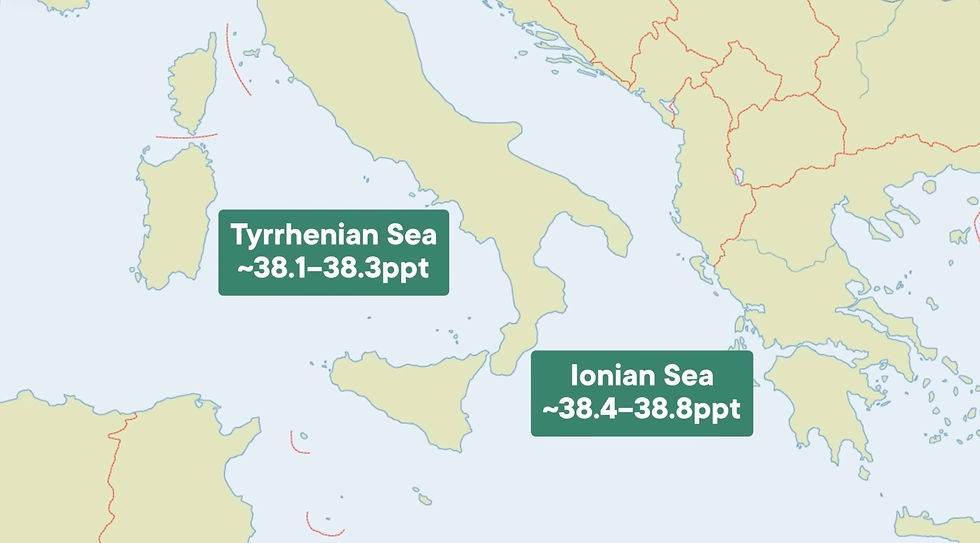
The Salinity Differential between Ioninan and Tyrrhenian is 0.3 - 0.5 ppt
Since the Italian government plans to build a giant suspension bridge over the Straits of Messina, the phenomenon is now well researched. Several indepth .studies were conducted - not only to understand the water currents but also the seismic activities which keep Sicily and Calabria apart. With a main span of 3'300 meters, the new suspension bridge would be the world's longest. Earthquakes and high winds are formidable challenges. Even more so is the estimated cost of EUR 14.4 bn and a completion date by 2034. Is such a big price tag to reduce crossing time from 100 min (by ferry) to 10 min warrented? We will have to see. As everybody knows, public projects are notoriously late and over budget.

Digital Rendering of the future Suspension Bridge over the Straits of Messina
For the next couple of years, ferries will continue to cross and everybody is able to enjoy the spectacular swirls and think about how frightened Odysseus was when sailing through here.

Me plotting the Course through the Straits on my new Mediterranean Map


Comments