


J + 13 : Magna Graecia's Incredible Wealth

Paestum's Temple of Poseidon was built a two Decades before the Parthenon in Athens
Last night we could not stay in Agropoli. A bad weather system with lightning and thunder storms was moving in from the west. We needed a more secure anchor place. Luckily, Captain Mario had booked a berth at Marina d'Arechio near Salerno - just in case. Here, we were safe when gales started blowing. It rained all night - we hardly noticed.

Paestum from the Air - the City had 50'000 inhabitants at its Peak. To the left the Temple of Poseidon and Hera - The two Main Roads cross the Center - the Port is to the Right.
It was Poseidonia or Paestum day today. We wanted to see the ancient Greek city with our own eyes. It has Italy's best preserved Dorian temples. Three out of original twelve are still standing - all built with local travertine. The Temple of Hera to the South, the Temple of Poseidon in the middle, the Temple of Athena to the North. Even more impressive was the size of Paestum. With 120 hectares, it was about half the size of Athens even though it had only a quarter of the population. Having lots of space means is a luxury. As a young history student, I could barely afford a room. Now I live in a house. Paestum's 4.7 km long town wall made from solid travertine blocks also speaks for the city's wealth. As does the Temple of Poseidon (24.5 x 60 m) which is a bit smaller but older than the Parthenon (31 x 70 m) on the Akropolis. The Temple of Hera is 100 years older.
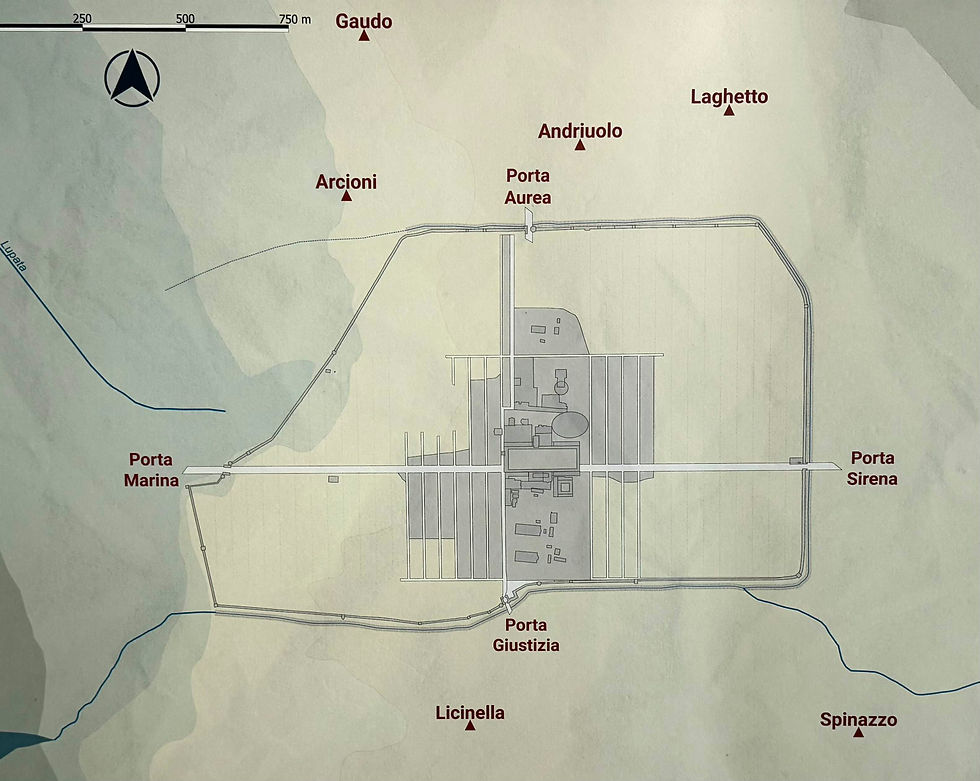
Map of Paestum - the Sea reached directly to the City's Western Walls. Only a quarter of Paestum is excavated - Most of the Land is still privately owned.
Already wrote in one of my previous blogs about Paestum's wealth. But I overlooked one important aspect. Paestum was bordering Etruscan territory. The town of Eboli, an Etruscan strong hold, is only 25 km to the north. The relations between the Greek and the Etruscans are not well documented. The Etruscan did not keep written records of history and events. And the Greek rarely talked about the Etruscans even though the Etruscan adopted the Greek alphabet and imported large amounts of pottery from Attica. It seems the two people knew each other so well that there was no need to talk about it.

Etruscan Bronze Vessels and Household Goods were found throughout the Mediterranean - the above items date from the 5th Century BC
On closer look, the Greek and Etruscan economy were complementary. The Etruscans exported iron weapons (swords, spears, arrow points), bronze castings (helmets, body armor, cooking and storing vessels, household goods), timber and agricultural goods. The Greek luxury products from Attica (black pottery) and the Levant, which we find in large quantities in Etruscan graves. Since the Etruscan products decayed (iron rosts away) or were recast (bronze), comparatively few items survived in Greece. But there is a sufficient number to establish that the trade existed.

Four Views of the Terracotta Volute Kater found in an Etruscan Tomb in Spina (Ravenna). It was made in Athens around 440 - 430 BC (now in the Archeologic Museum in Ferrara)
The interaction between Greek and Etruscan people was so close that the Etruscans adopted many Greek customs like drinking banquets, painting style, some of their cuisine, their plants and even some elements of their religion. Such a cultural exchange requires daily and frequent contacts between peaceful neighbours. Poseidona must have played an important role in this exchange. We cannot see the size of its harbour any longer since it silted many centuries ago. But the size of the Sea Gate indicates how important the port was. The Porta Marina was at the western end of Paestum's main road which allowed the easy move of goods and items. It feels like Paestum was the Etruscan's gate to the wider world.

Paestum's Main Road leads to the Marina Gate - the Pavement
is Roman though - In Greek Time the Street was a Gravel Road
When Etruscans visited Paestum, they must have been impressed by the large temples. Such large structures which did not exist in thier culture. Etruscan shrines are smaller and more modest. Dorian temples were an expression of Greek engineering and construction skills. As we know from the Parthenon in Athens, it takes a workforce of 1'500 to 2'000 men with several more thousands contributing to complete a temple within 15 years. It required specialist workets like stonemason, sculpturers, carpenters and metalworkers plus hundreds of less skilled workers to move and lift the blocks around. All these workers needed to be paid and fed. No money in the treasure chest = no temples.

The Dorian Temples are a Masterpiece of Engineering and still stand tall after dozens of Earthquakes during their History
In antiquity, there were only two options for a town to become rich. Trade or rule. Rome was never a big trading town but the empire's taxes accrued there. Public money financed the magnificent buildings we admire today. Or be a trading town like Tyre, Alexandria, Rhodes, Venice, Pisa or Genoa. In a few, almost exceptinal cases, a town is both a capital and a trading center. Constantinople was one. London in the more recent past. Paestum was clearly not a capital city but still a place where all sorts of people met to exchange goods and trade. Its infrastructure certainly made it possible.

Paestum's Temples attracted many Visitors on the Grand Tour already in the 18th Century. This Painting is fictional though. The Sea was already a Mile away at that time.


Comments