


J - 165 : Temples paid for by Honey?

The well preserved Greek Temples in Paestum attract every summer Thousands of Tourists
The piece I wrote two days ago showed a photo of the Castello Aragonese di Agropoli. A few kilometers north of it lies Paestum, a town founded by Greek colonists from Sybaris in 600 BC. Its original name was Poseidonia. Pictures of Paestum made me wonder why the town had such big temples. Three of them are well preserved and attract thousands of tourists every summer. They are almost as large as the Parthenon on the Acropolis in Athens. The Parthenon is 69.5 m long and 30.9 m wide. The Temple of Poseidon in Paestum is 60 m long and 24.3 m wide, only 1/7th smaller than the most famous Greek temple in the world. Two more temples in Paestum are of similar size.

The magnificent Dorian Temples at Sunset
Wonder how Poseidonia’s citizens paid for these large structures. The Athenians used silver from the mines in Attica. These riches made Athens the superpower that orchestrated the victory over the Persians in 479 BC. The Parthenon was re-built after Athens was sacked and the original Acropolis destroyed in 480 BC. The reconstruction took from 447 BC to 432 BC. The new Parthenon was inaugurated with one of the biggest parties ever. A good 1’000 km to the west on faraway Italian shores, majestic Dorian temples were built around the same time. The Athenians paid with their silver. How did the Poseidonians pay for their temples?

Plans of the Dorian Temples - Photo from the Archeological Site in Paestum
Poseidonia was founded by Greek colonists from Sybaris in Calabria, a place we visited in 2021. They were always looking for good, arable land and trading opportunities. The site of their new town, Poseidonia, had it all. The gentle slopes drain well. The Sele river provides water all year around. Vineyards, olive orchards and wheat fields soon prospered around Poseidonia. But wine, oil and wheat alone did not make them rich enough to build their magnificent temples.

Reconstructed Map from 400 BC. Paestum sits on a slab of Travertin, the Marble used for the Temples. It is well watered by the Sele River and had direct Access to the Sea.
Maybe archeologists found an answer in 1954 when they found eight bronze jars with bee wax and residues indicating that the jar were filled with honey. They were found in shrines as offerings to the Gods, not in a private household setting.

Chemists from Oxford Univeristy identified Honey in a 2'500-Year-0ld Shrine in Paestum
People offered Gods only the very best. They asked for favors and good outcomes – the offerings were supposed to put the Gods in a good mood. The bronze jar by itself was already rare. Filling it with expensive honey made it even more precious.

The Relationship of Humans with Bees is more than 10'000 years old
Since we buy honey nowadays in supermarkets, we barely know how it is made. We pay for it, put it in our Greek yoghurt. That’s it. The production of honey has a long history though. The market is worth USD 8 bn. The relationship between bees and humans goes back for millennia. Neolithic people loved and consumed honey. They “hunted” it from wild bees by smoking them from their beehives. It is documented in old cave paintings in southern Spain.

Egyptian Hieroglyphs for Bees
As far as I know, the first society to cultivate bees were the Egyptians who had a special hieroglyph for bees and cultivated them for at least 4’500 years. One of the titles of the first Pharaohs’ was “Sealer of the Honey”. Honey, with its golden colour, was called “Food of the Gods”, "Ambrosia" standing for good health, immortality and wisdom.

Before the Age of Sugar Cane, Honey was the most important Sweetener in Europe
Beekeepers were held in high regards. They dealt directly with the “ambassadors of Gods”. Their work was dangerous and required skills. A beekeeper does not only need to have an intimate knowledge of how a bee colony works. He also has to have a good understanding of where to find good nectar for his bees and which herbs and flowers produce the best honey. In this respect, Paestum was well located. Its hilly backdrops provide a continuous source of nectar and pollen from trees, shrubs and herbs to this day. Bees love clover, lavender, borage, thyme, sage, rosemary, mint, oregano and basil.

Borage is primarily found in the Eastern Mediterranean but also on the Italian Peninsula
In antiquity, products from bees had more applications than today
Bee wax was used for candles – one of the few sources of light at night. You only have to read the bible to understand how miraculous light at night was for people in antiquity. Light was an tool of the Gods and was revered accordingly
The father of modern medicine, Hippocrates, prescribed honey as medicine for digestive problems, fevers and sore throats. It was often used in conjunction with vinegar – reminds me of my mom’s treatments when we had colds as kids
Honey was one of the few sources of sugar in antiquity. It was also used to preserve fruits for the winter and to ferment alcoholic drinks. Honey kept this role until deep into the middle ages. It was an expensive sweetener though.
In Greek methodology, honey was associated with Zeus who was supposedly raised with honey. Precious honey was thus used for offerings.
Could not find any research describing the honey trade in antiquity but firmly believe that Paestum’s temples were financed with this lucrative trade. It is always good to have goods that everyone else wants or needs. Just look to Norway which carefully invests its oil and gas proceeds for future generation. When the energy transformation will make fossil fuels redundant, Norway's citizens can comfortably live from the dividends of its sovereign fund. It is too early to say “Quod erat demonstrandum (QED)”. The idea is intriguing though.
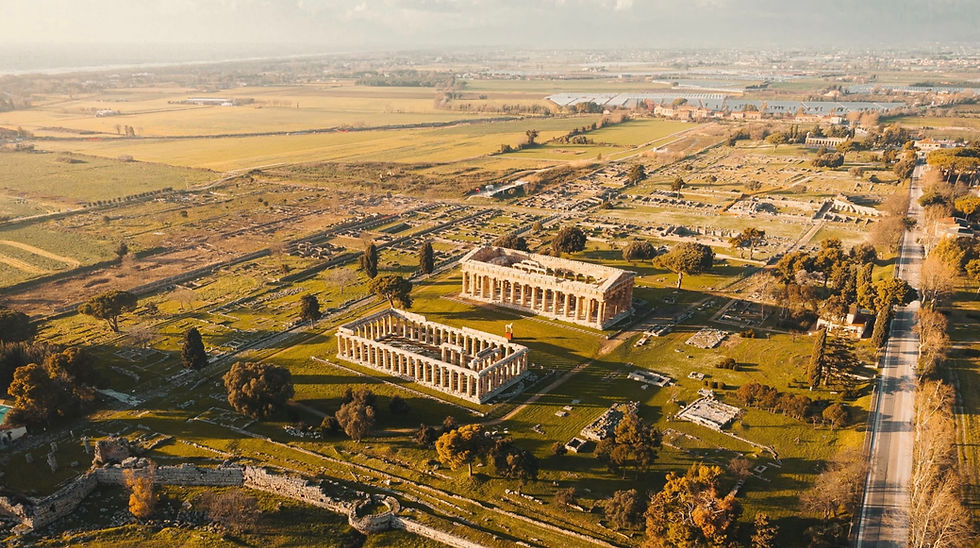
Aerial Vue of Paestum - The Tyrrhenian Sea is now at a distance of 1.5 kilometers
.


Comments