


J - 122 : Mostra d'Oltremare - Mussolini's Fantasy of Empire

Rhodes Pavillon in the Mostra d'Oltramare - Remember the Deer from Rhodes Harbour?
When you ask young Italians about Italy’s colonial past or which African countries Italy ruled, you get a blank stare. Whilst the British Empire made it into common knowhow, the Italian Empire never got that far. Italy’s colonial ambitions started with Eritrea in 1882, followed by Somalia in 1889, Libya in 1911, the Dodecanese in 1912, the brutal conquest of Ethiopia in 1935 and finally the annexation of Albania in 1939. The new Empire's life was short though. By 1941 the British Army kicked the Italians out of Ethiopia, Somalia & Eritrea, 1943 Libya was taken,1944 the Dodecanese islands followed. Italy's colonial fantasy lasted for 60 years. Public opinion suppresses the memories of Mussolini’s horrific nerve gas attack on Ethiopia – it is better to talk about Italian Renaissance than a war crime your own army committed.

Conceptual Study of the Mostra d'Oltramare from 1937
Italy’s ambitions were big though. And grew even bigger after Mussolini, Italy’s Fascist dictator, took power in 1922. He rapidly created a modern navy and air force which he used to expand his influence in the Mediterranean and Eastern Africa. He intervened militarily in the Spanish Civil War, occupied the Balearic Islands to conduct air raids on the government held coast between Valencia and Barcelona and attacked Greece in 1940 when he thought they were weak and an easy picking.

Mussolini's megalomanic Ambitions for the Time after
the Axis Victory in World War II
Mussolini was so convinced of the everlasting nature of his conquests that he celebrated them before they were achieved. He may have been jealous of Hitler’s success with the Olympic Games in 1936. In 1937, his Italian government approved a plan to host a Universal Thematic Exhibition in Naples devoted to “Fascist Italy’s political and economic Expansion across the Seas and the Overseas Territories”. The location of the exhibition in Naples was lively debated. Eventually, the flat lands of Conca Flegrea, halfway between Baiae - Cumae - Lake Averno - Pozzuoli and Naples were chosen.

The Fontana d'Esedra was and still is one of the dominating Features of the Mostra
It was building on grand scale. On 1 million square meters, 36 pavilions, a Coliseum like open-air arena, two theaters, an Olympic sized public swimming pool, restaurants and cafes, an amusement park, a zoo with African animals and a tropical aquarium were built. The planners used the colossal, modernist style which was famous for Mussolini and which we noticed already in Leros and Rhodes in Greece.

The Facade of the Modern Italian Theatre at the Mostra d'Oltramare
No costs were spared for the undertaking. It was completed in record time after only 16 months – compare this to building projects in Italy today when planning alone takes years! The Mostra d'Oltramare was inaugurated on the 9th of May 1940, a day before Hitler launched the invasion of France.

Inauguration of the Mostra d'Oltramare with King Umberto III and lots of Pomp
Within two years of the inauguration, Italy was at the peak of its power – albeit as a junior partner to Nazi Germany which let it happily occupy territories to free up its own soldiers. On the 1st of October 1943, Naples was liberated by General Clark’s 5th US Army – Italian partisans had kicked out most Germans already a few days earlier. Less than 3 ½ years after Mostra’s inauguration, the Fascist fantasy of a Mediterranean and African Empire was over. The monuments survived though. Few heavy weapons were used in the liberation of Naples.
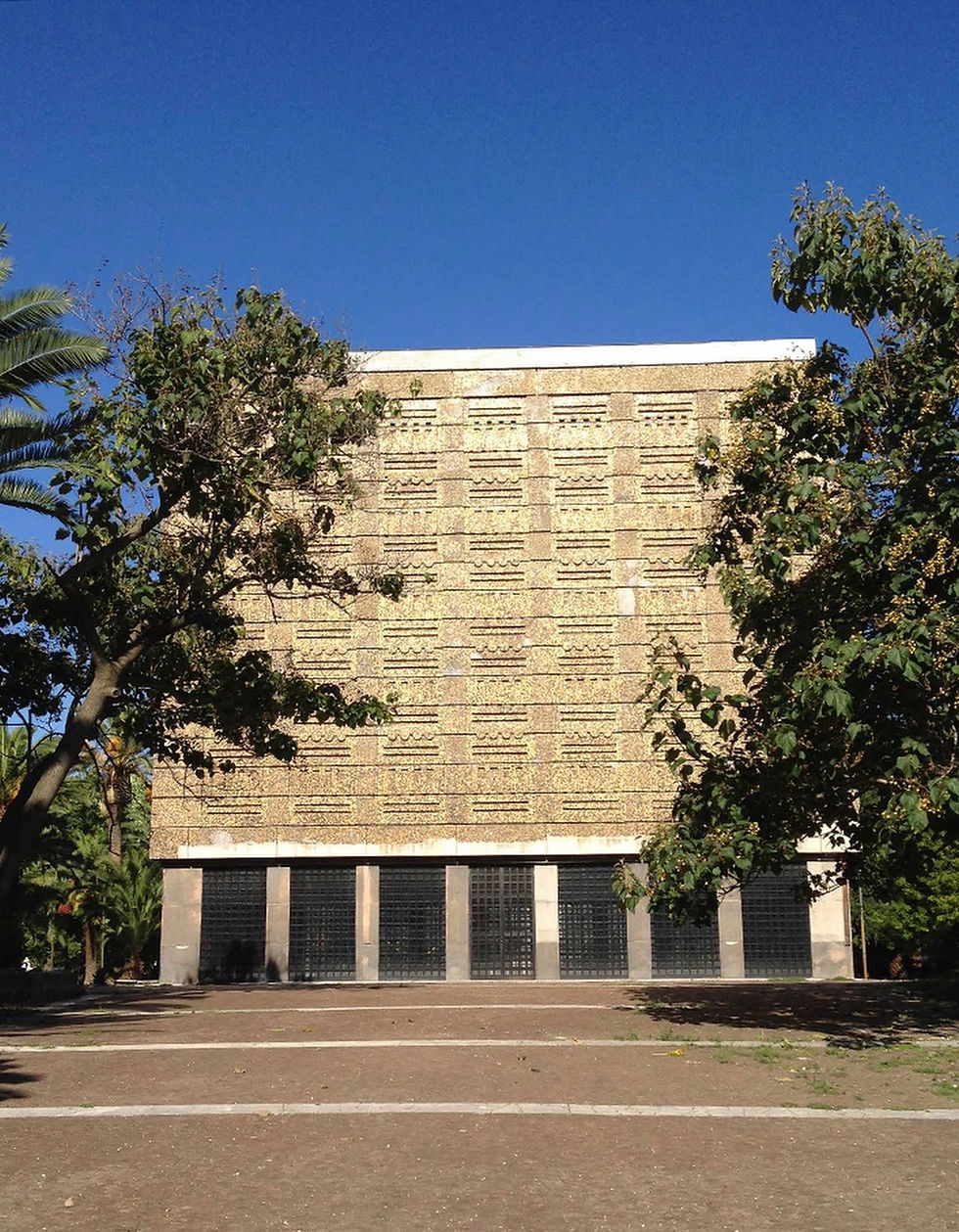
One of the Original Pavillions, the Cubo d'Oro
Today, the “Mostra d’Oltramare” has kept its name but only the buildings and a few monuments remind of its Fascist past. It is now an amusement and sports park. The zoo and the aquarium continue to be operated. International swimming contests are held at the site. The open-air arena is Naples' preferred place for smaller rock and pop concerts.

The Open-Air Arena looks like a modern Slice of the Coliseum - it is ideal for Pop Concerts
The new football stadium Diego Armando Maradona is just nearby as is a dedicated subway station. The Mostra is a bit run down, not everything is used. But Mussolini's architectural grandiosity survived.

Ballet Performance at the Mostra's Italian Theatre
We will visit the site at the end of our third week after saying goodbye to our boat in Pozzuoli. We usually visit ancient sites which served the people for centuries. At “Mostra d’Oltramare” we visit a a modern site which served its purpose for just 3 ½ years :-)

International Swimming Competition in the old Olympic Pool at the Mostra
In history, human nature is always constant. Technology changes though and with it the speed of events unfolding. Mussolini’s dream of a modern empire was driven by nostalgic ideas of a new Roman Empire. It was no match though for the modern American and British democracies and the innovations and production capacities they could unleash to win World War II.
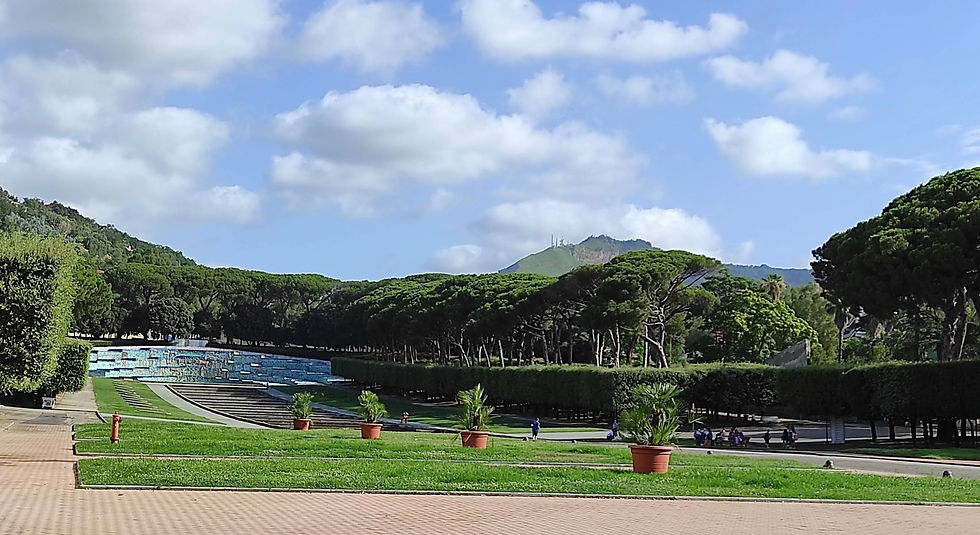
The Fontana d'Esedra is a Place of Peace today - the Imperial Attitude is gone


Comments