


J - 22 : The Never Dying Dream of a Bridge
Updated: Aug 10

The Bridge over the Messina Straits as approved by the Meloni Government on 6 Aug 2025
A good year ago, the Italian Government under Prime Minister Giorgia Meloni approved the latest iteration of the Messina Straits Bridge project. It is now before Italy's Audit Commission which will or will not approve the project. Wonder how Italy managed to give itself a political structure where a project approved by Government and Parliament can be challenged... But that is beside this piece today.

Project Scheme of the Messina Bridge seen from the South
If completed, the bridge over the Messina Straits will be the world's longest and highest suspension bridge. With 3'666 meters in length, a longest span of 3'300 m, a hight of 400 m and clearance below the bridge of 76 m it is enourmous. Built over a geological fault line, where the tides of two seas clash, the regular occurrence of devastating earthquakes as the one in Messina in 1908 and wind speeds which would easily flip any ordinary suspension bridge, the project is of incredible complexity. The price tag of EUR 13.5 bn reflects the engineering challenge. Delivery was once scheduled for the early 2030s but this date is way too optimistic. I guess 2040 is a more realistic target.
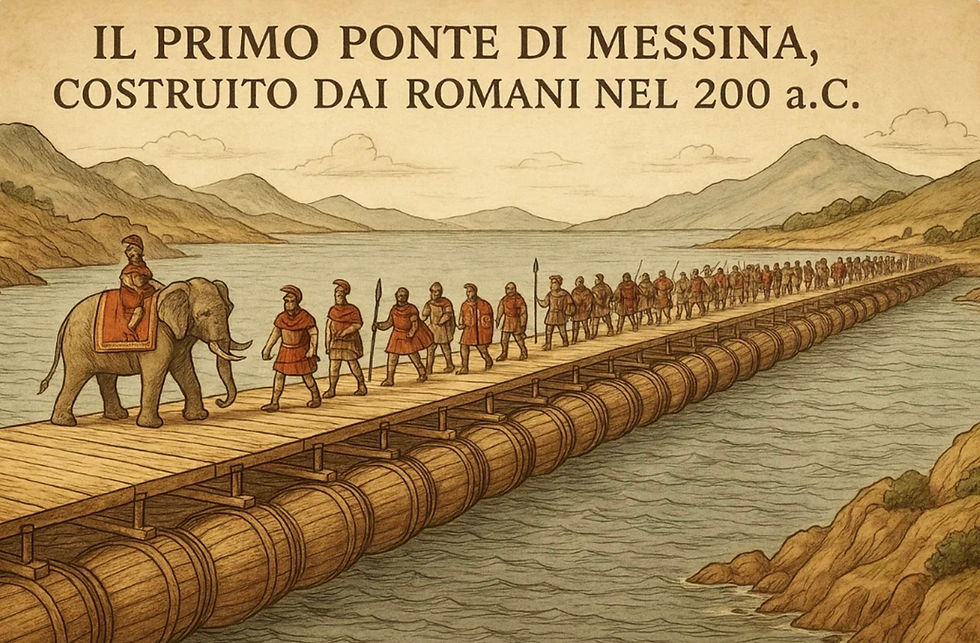
Already the Romans dreamt of having a Bridge linking Sicily permanently to Calabria
The idea of the bridge is millennia old. Roman Admiral Pliny the Elder (23 - 70 AD) who lost his life rescuing people from the eruption of Monte Vesuvio in 79 AD, mentioned it. So did the Greek cartographer Strabo (64 BC - 24 AD). Apparently, Roman Consul Lucius Caecilius Metellus linked Sicily in 251 BC with Italy by using empty oak barrels and wooden planks for his temporary bridge. He needed the bridge to return home with the 100 elephants he captured from the Carthaginians at Palermo. They would guarantee a sensationally triumphant entry into Rome.
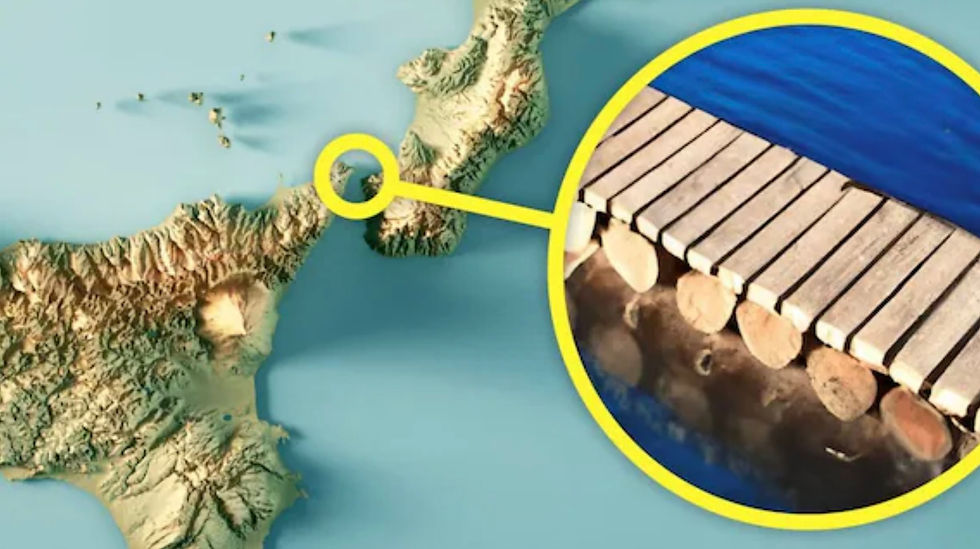
AI generated Photo from of the Roman Ponton-Barrel Bridge of the Straits of Messina
The possibility of crossing wide bodies of water with pontoon bridges was well known in antiquity. When invading Greece in 480 BC, the Persian King of King Xerxes crossed the 1.4 km wide Dardanelles by building a pontoon bridge. His army of 100'000 men took seven days and nights to cross - the logistics train added another 200'000 people. The strong current of the Dardanelles bent the bridge. It was probably 2 km long (straight line is 1.4 km). Xerxes corps of engineers was experienced in building large structures. And they were lucky. In the 5th century BC, the hills above the Dardanelles were still forested. Today, as we noticed during our visit in 2022, no timber is left.
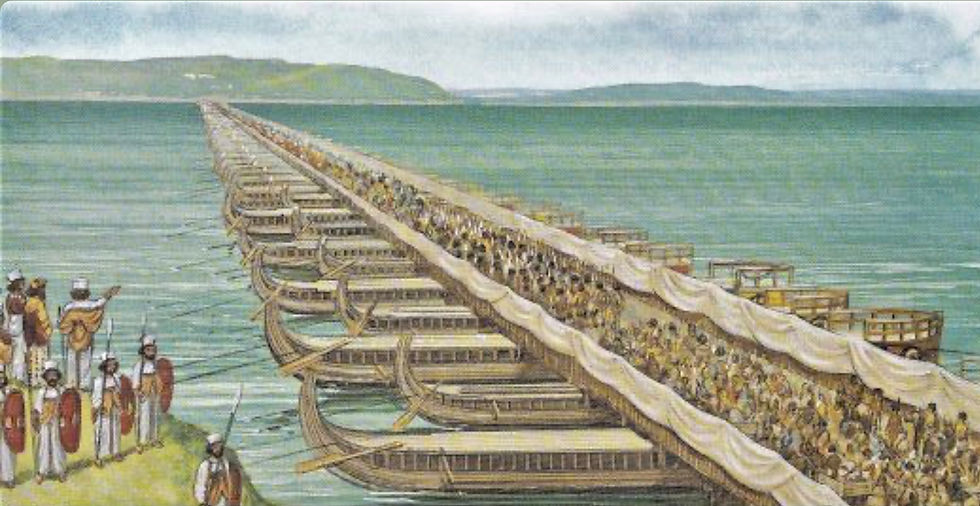
Artist's Impression of Xerxes' 2 km long Ponton Bridge over the Dardanelles in 480 BC.
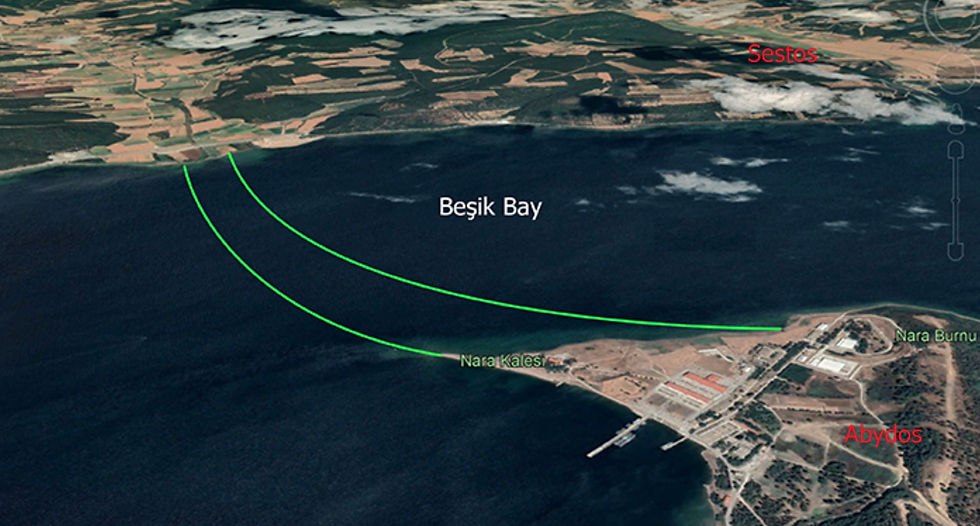
Xerxes Ponton Bridge was bent due to the strong northern current in the Dardanelles
The Straits of Messina are more challenging though. The current in the Dardanelles flows steadily north to south. The Black Sea is less salty than Mediterranean. Its lighter water thus flows south on top of the saltier water from the Med. In the Straits of Messina, the tides of the Tyrrhenian and Ionian Sea clash. The currents directions change every six hours. That Tyrrhenian water is lighter crates dangerous whirle pools. Anchoring and stabilising a pontoon bridge from the shores is not possible. Also, the Straits of Messina are 3.1 km wide compared to the 1.4 km of the Dardanelles. There is also an issue with the oak barrels. If an barrel is 1 meter wide and 1.5 meters long, you need 3'100 barrels x 6 (for the width) = 18'600 barrels or at least 6'000 fully grown oak treess. There are no such big oaks in Sicily or Calabria. Nor were there oak barrels in the Med by 251 BC. Romans and Greeks stored liquids in amphorae. Oak barrels were invented by Gauls in the 3rd century BC only. I guess we have to give this story a pass - Si non e vero e bon trovato - as the Italians say.
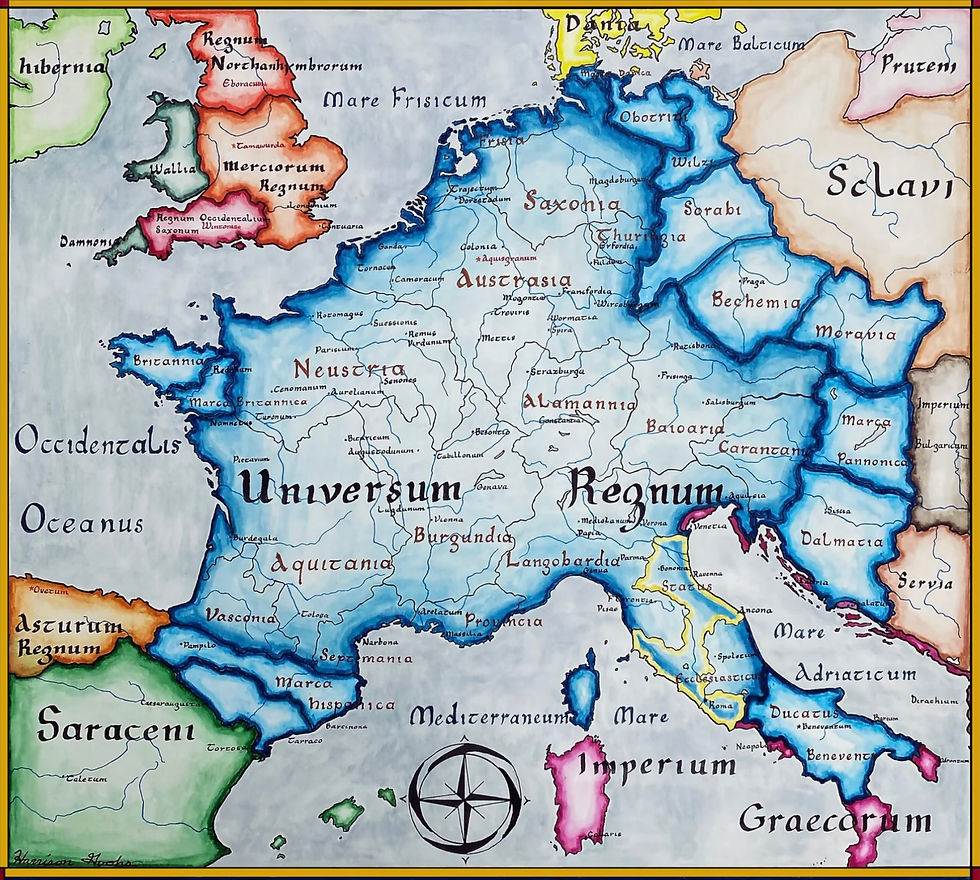
The Carolingian Empire under Charlemagne around 800 AD - Sicily was not his but controlled by Byzantium and Arab States
The idea of a bridge linking Sicily to Italy continued to fascinate though. Charlemagne, the first ruler of the Carolingian Empire, considered such a bridge in 800 AD to conquer Sicily from Byzantium. Later Norman rulers such as Robert Guiscard and Roger II of Sicily loved the idea as well. It would have linked their kingdom and allowed them to shift their armies back and forth between Arab and Byzantine enemies. But the immense cost and the many practical problems were obstacles nobody could overcome. When southern Italy became Spanish and was propelled into the front line of the war with the Ottomans, the idea was shelved. Spain's funds had to go to fortifying coastal cities and a large fleet of galleys. A bridge would not provide security. Starshaped forts with artillery and galleys with guns did.
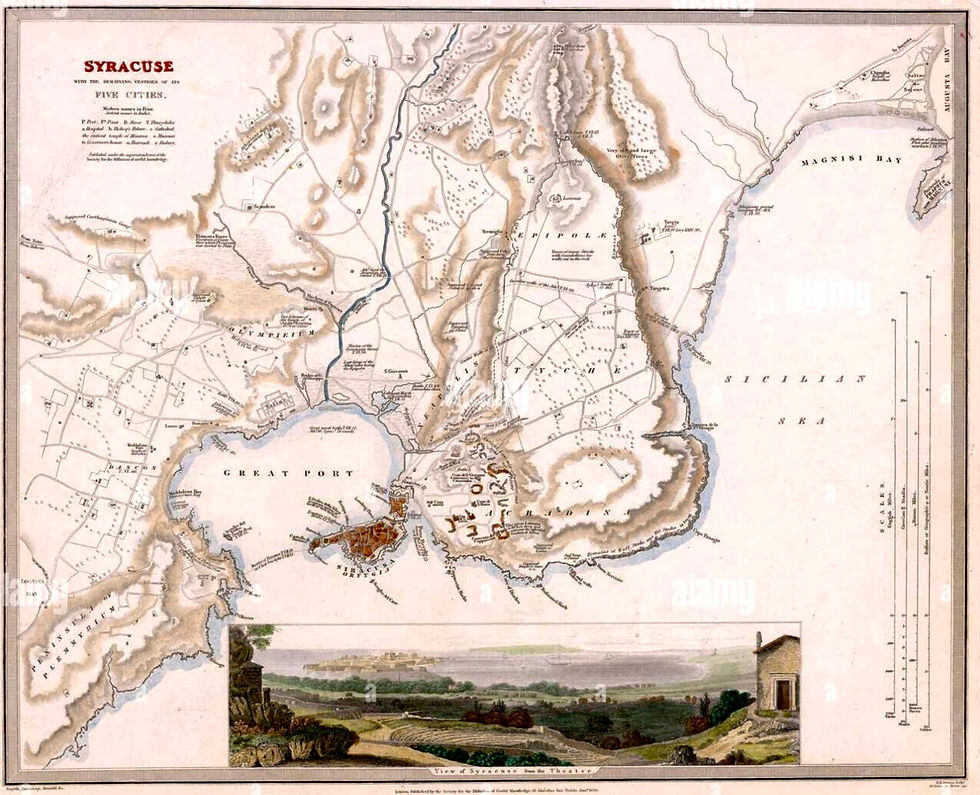
The Ancient Town of Syracuse was converted by Spain into a modern Fortress (Map 1839)
With the Italian Unification in 1860, the idea found new ears again. A French engineer, Alphonse Oudry, worked on a design for a suspension bridge between 1882 and 1860. Four years later, Italy's minister for Public Work then commissioned a respective study - it lead to nowhere. Neither did a proposal from 1870 to build a tunnel under the Straits, nor did the work of several Italian civil engineers in 1921. For Mussolini, Italy's Fascist Dictator from 1922 to 1943, the bridge had no priority. The construction of a modern navy (Regia Marina), Airforce and army were far more urgent and important. In addition, he hated the Mafia in Sicily. Why connect them to the mainland?
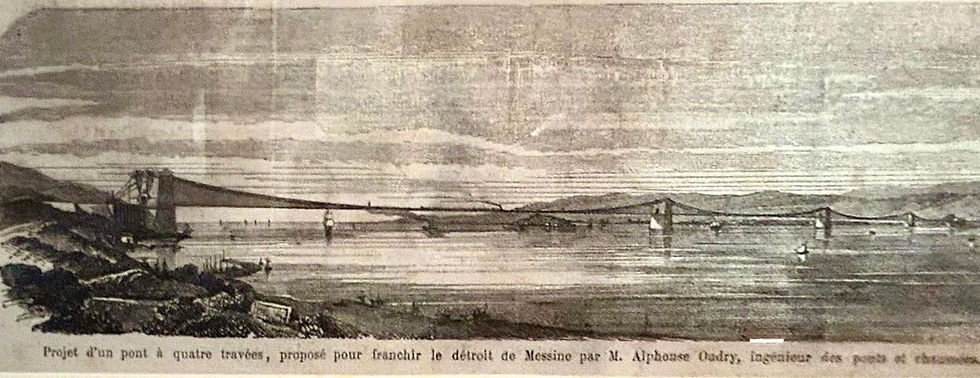
Alphonse Oudry's Design for a multi-pillar Suspension Bridge over the Messina Straits (1862)
In the Post-War Years, the bridge idea gathered steam again and was seriously analysed. In 1953, the American engineer and experienced suspension bridge builder, David Steinman, was invited by an Italian Consortium to submit a respective proposal. He did so but the financial arrangements were not in place. His well thought through proposal disappeard in the drawers of Italy's bureaucracy. But it was not the end. Further feasability studies by Italy's railways and Italy's industrial holding company IRI in the 1970s and 1980s followed and concluded that the project was feasible indeed.
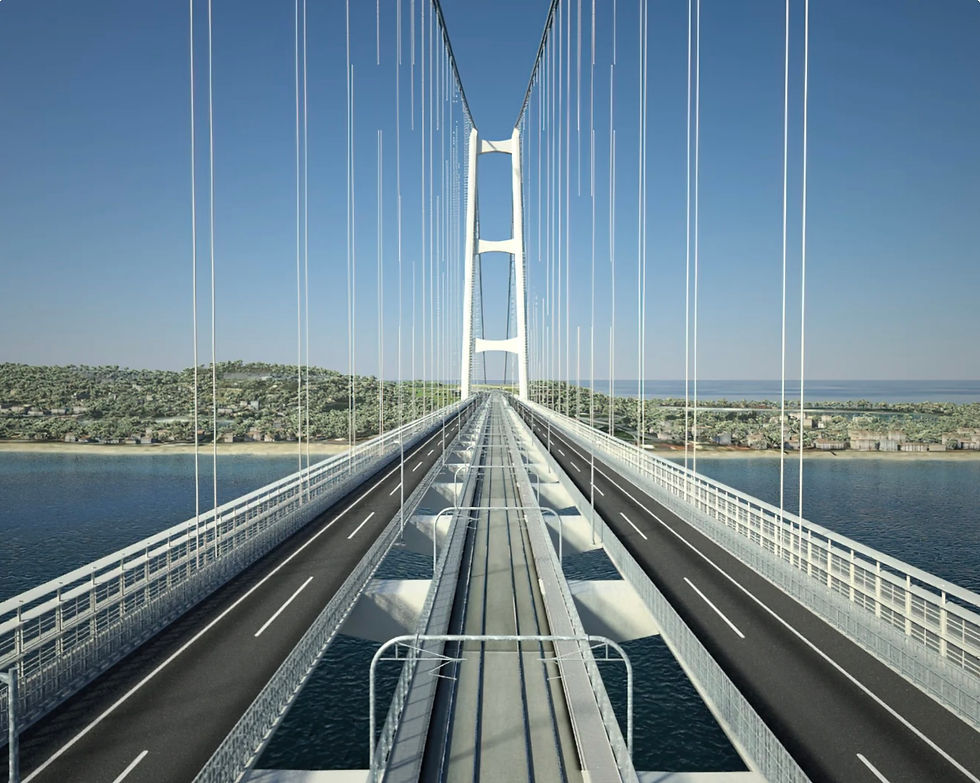
The Bridge is aerodynamically designed to withstand the strong Winds over the Straits
Eventually, the Berlusconin Government took it up in 2006, but it was cancelled again. Re-approved in 2008, cancelled again in 2013 for lack of funds. In 2023 it was eventually taken up by the Meloni Government who also decided to include its costs into Italy's commitment to lift defence spending to 5% of GDP per year (sic!). The bridge, if ever completed, will have the capacity for 200 trains a day on two tracks and 6'000 vehicles per hour on three lanes in each direction. The cost is estimated at EUR 13.5 bn, 40% for the bridge itself, 60% for local connectins & infrastructure. It is financed by the EU, Italy and a private consortium.

Computer Rendering of the Messina Bridge as seen from the Sicily Side
If you have 15 min, watch this fun video on youtube titled "No completion date - the world's most impossible bridge is back"
When we sail through the Straits of Messina in 4 weeks time, there will be nothing to see - work has not started - Italians wait for the word - the "word of the Audit Committee"


Comments